It will be released tomorrow.
Author: Andrew Sullivan
Obama, Non-Entity?
Ambinder thinks Obama won't have a big effect on the midterms:
Obama's net effect on congressional races might just turn about to be a big "meh." As skeptical as white people are about Obama's policy agenda, enough still want him to succeed. So what's the best thing for Obama to do between now and November? Instincts will persuade the White House to send the president to campaign for Democrats in safe areas and selected television markets, hoping to spark Democratic enthusiasm. As the Bush White House learned, targeted interventions can move the needles, especially when the other party's get-out-the-vote machinery is in question.
Marijuana Goes Mainstream?

Chris Good reports on Jane Hamsher's new effort:
As of this afternoon, a new coalition will officially be pushing for marijuana legalization across the country; it will consist of Students for a Sensible Drug Policy and FDL Action, along with sundry allies (of both liberal and conservative alignments) who have previously spoken out in favor of legalization.But Hamsher is the new entrant, and she's launching a $500,000 (according to her estimate) coordinated campaign to support marijuana legalization on the whole and to influence a handful of propositions on ballots this November–California's Prop. 19, which would allow counties to legalize and tax marijuana within certain guidelines plus medical marijuana initiatives in Colorado, Arizona, and South Dakota.
Tweet Of The Day
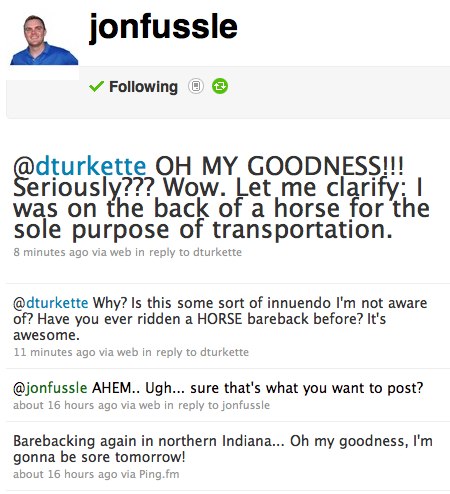
Via Bilerico.
What Broke The Senate?
This George Packer article on the Senate is getting a lot of love from liberal blogs. Bernstein thinks it's "sort of a hodgepodge":
The problems in the Senate today are pretty much entirely about the third thing that Packer discusses: partisanship and full exploitation of the Senate rules to create obstacles to the Senate working at all. Packer's story about the banking bill and Senator Corker, I think, is the key one. In that case, it turned out that none of the other problems of the Senate (three day weeks, staff, lack of personal relationships, time absorbed by raising money) mattered at all: when they wanted to Democrats and one mainstream conservative Republican had no trouble at all working together on a bill. But in the end, it turned out that Corker's participation was impossible because party discipline demanded it.
Top Secret America, Ctd
A reader writes:
Typically Posner fails to analyze the many key differences between IBM and the Security State. He posits a simple comparison and expects us to fall over satisfied due to the reflected brilliance of his own ego. He ignores that in many ways IBM was too big and that's why Microsoft and others ate much of its potentially profitable lunch for years and years.
IBM lost many, many business opportunities because of its immensities, including a significant amount of domestic manufacturing. Also, the Security State lives in a nexus of government and private business, making it easier to hide from scrutiny from both government and shareholders. This is especially true when one considers the currency of the Security State: opaqueness, secrets, and non-accountability. (If you think government is unaccountable now, try to get at a classified factoid that shouldn't be classified.) The potential for corruption, incompetence and inside dealing is immense, as typified by the way the Bush/Cheney Administration ran Iraq through the Coalition Provisional Authority, as illustrated succinctly by Chandrasekarian in Imperial Life In The Emerald City. Does anybody think the TSA, for example, makes much fundamental sense?
Perhaps most important, tough market conditions will force IBM to change, as it has over time. Does Posner really think that the Security State will change and respond nimbly to market forces (what are they?) other than to continue to bloat, become more opaque, suck away more tax dollars under the promise of more security, classify more and more unread/unprocessed data, and continue to trample individual freedoms as the revolving door between government and business spins at a faster rate to the filthy inurement of politicians, the military, and bureaucratic hangers-on?
The Republican Who Gives Me Hope, Ctd
Contra Drum, Ezra Klein defends Rep. Paul Ryan:
For a long time, liberals were talking about the sort of things you would actually have to do to get health-care spending under control while conservatives simply criticized the downsides of those intimidating reforms. And the main thing you have to do is get health-care spending into a single budget and then stick to it. You can do that by having the government set payment rates for providers or by having it set subsidies for individuals. Democrats were admitting this and thus taking on the burden of its problems, while Republicans were simply denying it.
Ryan’s proposal is an admission of the reality.
Alas, Ryan is hopeless on defense and still hooked on some of the loopier supply-side hooey. But it’s a start.
Faces Of The Day
Israelis wear masks with the face of abducted Israeli soldier Gilad Shalit during a human chain protest in which they circled the Prime Minister's residency in Jerusalem on August 3, 2010 calling for Shalit's release and marking 1500 days since their son was abducted by Palestinian militants in June 2006. By Menahem Kahana/AFP/Getty Images.
Fear, Not Hate
A shrewd analysis of why Prop 8 passed in 2008: the swing voters were not African-Americans but parents with kids under 18 at home:
The Yes on 8 campaign targeted parents in its TV ads. "Mom! Guess what I learned in school today!" were the cheery-frightening first words
of the supporters' most-broadcast ad.
They emerged from the mouth of a young girl who had supposedly just learned that she could marry a female when she grew up.
Among the array of untrue ideas that parents could easily take away: that impressionable kids would be indoctrinated; that they would learn about gay sex; that they would be more likely to become gay; and that they might choose to be gay. California voters, depending on where they lived in the state, were exposed to the Yes on 8 ads 20 to 40 times.
The lesson: It's not enough to make the case for same-sex marriage. It's also important to arm voters — particularly parents — against an inevitable propaganda attack. And it's crucial to rebut lies so parents don't panic.
Hollywood Getting The Internet
Gabe highlights another example of late-night talk shows' growing obsolescence:
Remember a couple of years ago when Between Two Ferns was just another wonderfully enjoyable web series starring a favorite but little-known comedian interviewing whoever was available? Now it’s a full-fledged viral marketing tool for the full-fledged movie stars that are in it, and no one is a little-known comedian anymore. This week’s new episode came to my attention in a publicity email from Paramount for Dinner for Schmucks. … If this is what viral marketing is these days, PLEASE MAKE MORE VIRAL MARKETING, FACELESS UNCARING CORPORATIONS.
 The Dish