Going To Church In Africa

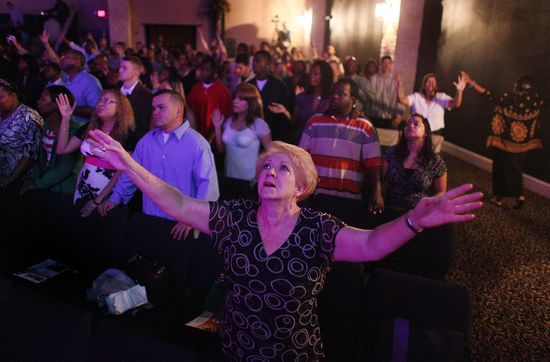
William Easterly attends an Anglican church in Bolgatanga, Ghana:

You need to understand how [other people] see themselves. A good guess is that the people in the congregation this morning, in one of the poorest regions of Ghana, do NOT see themselves primarily as “poor” or “developing”, they see themselves as Christians. Another guess is that similar feelings about religious faith would apply to other Ghanaians in other religious services, like Muslims, Catholics, traditional religions, etc.)

Perhaps this fits into the recurring Aid Watch theme about humanizing aid recipients, how poor people have a life, and may not even see themselves as poor at all, and so may according to some other perspective NOT be poor. This is not to deny the material hardships of people around Bolgatanga …

Those who seek to reduce the life of faith to something outside of faith miss the point.
Talking Though Her Nose

Ed Yong describes a device that allows severely paralyzed individuals to write via sniffing. The gadget's first user is referred to as "LI1":

LI1 is one of the quickest users and she only manages around three letters per minute, with one mistake with every six letters. That’s may seem frustrating but the freedom of expression more than makes up for it. As Plotkin and Sela write, “The speed of this self-expression is less important to individuals who, put bluntly, have no other options.” When LI1 and LI2 were asked to suggest improvement to the controller, neither mentioned speed.

When The Economy Falters, The Pews Fill

CHURCHJoeRaedle:Getty

Lisa Miller notes that church attendance goes up during recessions and down during good times. She speaks with economist Daniel Hungerman, who keeps a graph comparing GDP and church attendance above his desk:

Hungerman’s best guess explanation for the wide spaces and tight spots in his graph has nothing to do with God and self-interest (“if I pray in church, I will get a job”) but with something grander: a sense of global interconnectedness. “Maybe when the economy turns sour, no matter how much money you make, you get nervous and decide to go to church and talk with your buddies and get a sense of what’s going on in your community. Or maybe people’s desire for spiritual guidance is influenced by their perception of how the world’s doing outside of themselves. Church attendance may not reflect our own circumstances but our own idea of how the world is doing beyond us.” In other words, Hungerman’s picture may illustrate our concern for our neighbors: down in good times and up in bad.

Avent's reasoning is more mundane:

Church is free entertainment—music, socialising, a bit of story telling, and a meal in the bargain if you're lucky (or Baptist). When mom and dad are both working, a night at the movies might seem grand. When dad loses his job, church may be the most affordable way to get out of the house.

(Photo: Joe Raedle/Getty.)

Living Wills And Living Deaths

Susan Jacoby has an elderly mother who wishes that "no extraordinary medical measures — including artificial feeding — be used to prolong her life if there is no hope of recovery." Jacoby imagines her mother in a Catholic hospital:

The bishops’ most recent health-care directives, issued near the end of 2009, make it clear that they consider it the duty of Catholic health-care providers to impose artificial nutrition and hydration on patients in persistent vegetative states. My brother and I would, of course, take immediate steps to have our mother removed from a setting where her wishes would be ignored. But what if she had no living children or, like some two-thirds of Americans, had procrastinated about putting her instructions in writing?

A commenter at Secular Right responds:

What the bishops say and what is done in practice are two different things. I’m a physician employed by a large Catholic hospital group (incidentally, in ten years never once has anyone inquired about my religious views, or lack thereof). We follow the same rules/guidelines as other hospitals in these situations. If someone has a living will/valid healthcare power of attorney, we will follow their directions/guidance completely (which is both legally and ethically required).

Obviously we don’t perform abortions and we don’t prescribe birth control pills (though they can be used for other accepted medical reasons, such as hormonal therapy for ovarian cysts). Otherwise, there is absolutely no difference between us and other secular facilities (except that, given our mission, we provide a lot more uncompensated care)

The Best Magazine Articles Ever

A list. As We May Think by Vannevar Bush from the July 1945 issue of the Atlantic is the first candidate. An excerpt:

Consider a future device for individual use, which is a sort of mechanized private file and library. It needs a name, and, to coin one at random, "memex" will do. A memex is a device in which an individual stores all his books, records, and communications, and which is mechanized so that it may be consulted with exceeding speed and flexibility. It is an enlarged intimate supplement to his memory.

How Stress Kills

Jonah Lehrer classifies types of stress:

The recurring theme in the self-reports of people like Marjorie isn’t the sheer amount of stress — it’s the total absence of control. Researchers call it the “demand-control” model of stress, in which the damage caused by chronic stress depends not just on the demands of the job but on the extent to which we can control our response to those demands. “The man or woman with all the emails, the city lawyer who works through the night has high demands,” Marmot writes. “But if he or she has a high degree of control over work, it is less stressful and will have less impact on health.” (This helps explain why the women with mean bosses and menial work showed the highest incidence of heart disease.) The Whitehall data backs up this model of workplace stress: While a relentlessly intense job like a senior executive position leads to a slightly increased risk of heart disease and death, a job with no control is significantly more dangerous

Would Anyone Miss Mosquitoes?

Janet Fang poses the question to various researchers. She finds that their removal would be unlikely to significantly disrupt the ecosystem:

In many cases, scientists acknowledge that the ecological scar left by a missing mosquito would heal quickly as the niche was filled by other organisms. Life would continue as before — or even better. When it comes to the major disease vectors, "it's difficult to see what the downside would be to removal, except for collateral damage", says insect ecologist Steven Juliano, of Illinois State University in Normal. A world without mosquitoes would be "more secure for us", says medical entomologist Carlos Brisola Marcondes from the Federal University of Santa Catarina in Brazil. "The elimination of Anopheles would be very significant for mankind."