Fundamentals

Bernstein revisits the 2000 election. He thinks that the state of the economy played a large role:

For better or worse, what political scientists have found is that voters have very, very short memories; the models that work best only look at election-year economic factors.  So Gore apparently got little credit for the boom years.  Moreover, what seems to matter isn't unemployment, or general economic growth, but changes in real disposable income.  And as it happened, GDP growth continued through 2000, but growth in real disposable income stalled that year, heading into the 2001 recession.

The Bush Tax Cuts Fight

Howard Gleckman sizes up the party politics:

Stalemate means the Bush tax cuts expire for everyone. For most households, that will feel like a tax increase—an outcome favored by a handful of budget wonks but very few real people. Democrats believe this will give them the leverage they need to force the GOP to deal. Republicans, by contrast, feel they’d be able to blame the ruling Democrats for failing to tackle the pending tax hike.

My best guess is that, in the end, Congress will extend the Bush tax cuts for all but the highest earners. And it will probably do so for a year or two. But after watching Congress fail to address the expiring estate tax last year, no outcome would shock me.     

The Daily Wrap

Today on the Dish, Congress encouraged war against Iran, the GOP continued to flail on fiscal issues, Cameron took on Pakistan, a reader explained the real reason behind his support for Turkey, and the Israeli army knocked down a Bedouin village. The oil spill didn't appear as bad as once thought.

Andrew sized up the midterm elections and tore into a WSJ op-ed on the fiscal crisis. Ambinder looked to November, Friedersdorf fingered the practical perils of partisanship, Josh Green backed Elizabeth Warren, Michael Singh cheered up Green Movement supporters, and Exum had some final thoughts on Wikileaks' latest.

Basil Marceaux campaign coverage here and here. Malkin award here. NOM watch here and here. "Death panels" had legs. Palin didn't appear to have them in New Hampshire. A Trig link here

Remaining mosque talk here and here. Another big installment of the energy innovation debate here. More on the affirmative action debate here and here. Andrew Hacker tackled tenure, Nate Silver pwned Mark Penn, and Balko finished off his debate on gambling.

The Dish eulogized cartoonist John Callahan. Circumcision comic superhero here. More Who-mania here and here. Startling celebrity sex quote here. MHB here, VFYW here, and FOTD here.

— C.B.
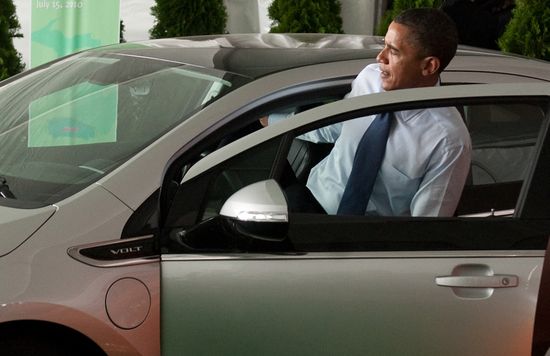
The Rebirth Of The Electric Car? Ctd

VOLTSaulLoeb:Getty

Daniel Gross isn't fazed by the Volt's price tag because he thinks it will come down. A parallel:

When the automobile age dawned at the turn of the 20th century, cars were toys, luxury products and status symbols for the rich to race and tool around in. They weren't affordable for the overwhelming majority of Americans. In 1903, most car companies were "turning out products with steep prices of $3,000 or even $4,000," writes Douglas Brinkley in Wheels for the World: Henry Ford, His Company, and a Century of Progress. In 1903, about 12,000 cars were sold in the United States The following year, Henry Ford introduced his Model B "at a startling $2,000." Now, the Bureau of Labor Statistics' inflation calculator only goes back to 1913. But $3,000 in 1913 is worth about $66,114 today. This BLS report suggests that average family income in 1901 was about $750. Any way you slice it, cars were very expensive.

(Photo: US President Barack Obama gets out of an electric Chevy Volt following a groundbreaking ceremony for Compact Power's new advanced battery factory in Holland, Michigan, July 15, 2010. The plant will build batteries for electric vehicles including the Chevrolet Volt and Ford Focus. By Saul Loeb/AFP/Getty.)

Negev: More Context

This helps:

The dispute today is over land ownership. Bedouin families around Arakib say they own about 4,600 acres of the desert, insisting that they paid taxes during the Ottoman period and British Empire. Gravestones in the cemetery show some families have inhabited the area for at least 140 years.

In 1951, Bedouin leaders say, they were forced by Israel's military into settlements along the West Bank border. "They told us we could come back in six months," said Nori Uqbi, a community activist who is suing the government to regain control of what he says is his family's land. "But it was all a lie."

Instead, he said, the villagers were never allowed to return and have been prevented from cultivating the land.

And here:

It doesn't matter that el-Arakiv was in the Negev before Israel was founded.

It doesn't matter that the state has moved the el-Arakiv bedouin from place to place over and over again.

What probably DID matter was what Prime Minister Benjamin Netanyahu said just the day before, when he publicly announced that the Bedouins are a threat to Israel. Netanyahu warned of a situation in which "various elements will demand nationality and rights within Israel, in the Negev for example, if a region is created without a Jewish majority. This occurred in the Balkans and this is a real threat."

"If a region is created without a Jewish majority"? So there is now a policy of forced internal migrations within Israel to prevent any single region having a demographic imbalance on racial terms? More background on the government's plan to populate Negev here.

Rules Based On Fear

Mandatory sentences for crack have been 100 times those for cocaine since the 80s. Congress has just reduced the ratio to 18 to 1.  Steven Taylor draws lessons:

I would not recommend crack cocaine usage and there were (and are) still social costs of some significance associated with its usage.  The problem with the reaction in the 1980s was that, like much of our drug laws, we overreact and make rules based on fear and the drama of the moment rather than rational consideration of the problem.  We paint each new drug as practically the end of the world and react accordingly (the current drug of fear is meth-in the past it was heroin).  Again:  all of these are substances that cause substantial harm, but we tend to lack a sense of proportion in dealing with them.

Is A Good Kindergarden Teacher Really Worth $320,000?

John Cassidy complicates the study Leonhardt touts:

Yes, good teaching is important. But the key policy issue is raising average teaching standards throughout the education system, not simply seeking out and rewarding exceptional kindergartens. In affluent areas of New York City, parents’ efforts to capture every possible educational advantage for their young children have already reached absurd levels. If this new research is accepted as gospel, I can already see admissions officers at snooty private schools waving it in the air and saying to parents: ‘Look, I told you our $30,000 fees were justified. Where else can you find a kindergarten teacher with a Princeton Ph.D. in Victorian literature?”

Basil Marceaux For Governor, Ctd

Wonkette calls his campaign site "indescribably perfect." Money quote:

VOTE FOR ME AND IF I WIN I WILL IMMUNE YOU FROM ALL STATE CRIMES FOR THE REST OF YOU LIFE!

Chattanooga Times Free Press snags an interview:

“I always knew it would (attention) happen because I’m sure everyone feels like me. It just takes guts,” the one-time Marine said. Voters “like my gun views,” he said. “I want everyone to have a gun. If I think that someone doesn’t have one, maybe I’ll fine them $10.”

How Bad Is Nevada?

Daniel Indiviglio takes a look:

It's sort of staggering to think about how many foreclosures are occurring in Las Vegas. First, there's the awful one in 15 homes statistic. That accounts for an amazing 6.60% of all housing units in the metro area. And remember, this was just over a six-month period. The glimmer of hope is that this actually isn't the worst the city has seen. In fact, foreclosures are down 14.73% compared to the prior half, and 8.80% lower than the same period in 2009.

Ryan Grim and Arthur Delaney tell the story behind those statistics:

So many homes in Las Vegas have been foreclosed upon that banks rarely bother to hang a "For Sale" sign on the front lawn anymore. Instead, visitors identify bank-owned properties by the brown grass and the 8.5 x 11-inch sheet of paper taped to the front door or the garage.