Reality Check
A reader writes:
It might be worth pointing out to the knuckleheads who are protesting the building of a mosque near Ground Zero that there's been a Japanese Shinto Shrine very close to Pearl Harbor for a very long time. I'd also be willing to bet that there are German Lutheran churches in NYC close to where German submarines were sinking US merchant ships in WWII. Somehow the Greatest Generation managed to deal with these things. Why can't we?
Another writes:
Lost in all of the pseudo-patriotic posturing and puffing by Gingrich, Palin et al., is the fact that it is against Federal Law for the City or State of New York to attempt to prevent the use of the buildings in question for religious (including Islamic) purposes absent a compelling government interest in preventing that use. The Religious Land Use and Institutionalized Persons Act ("RLUIPA"), (U.S.C. § 2000cc-1 et seq.), section 2(a)(1) states that:
"No government shall impose or implement a land use regulation in a manner that imposes a substantial burden on the religious exercise of a person, including a religious assembly or institution, unless the government demonstrates that imposition of the burden on that person, assembly, or institution–
(A) is in furtherance of a compelling governmental interest; and
(B) is the least restrictive means of furthering that compelling governmental interest."In other words, if the City of New York tried to oppose the use of the building in question as a mosque or other place of religious assembly, it would have to demonstrate a compelling interest in why it should be able to do so. And even it it can show a compelling interest, it must also show that preventing the use is the least restrictive way of furthering that interest. In terms of constitutional law, that is the highest possible hurdle to placing a restriction on the practice of religious and is practically impossible to do.
It is ironic that RLUIPA was pushed through largely by Christian groups to prevent local governments from placing zoning restrictions on churches. Of course, they only meant it to apply to Christian churches, not those others.
The Big Picture unpacks Glenn Beck's connections to Goldline.
Balko and Les Bernal have finished off their debate on the legality of gambling. Here's part of Balko's closing argument:
Any number of our day-to-day decisions can have indirect repercussions on lots of other people. If you're going to argue that we should prohibit gambling because problem gamblers might go into debt, causing hardship on their families, or requiring them to seek publicly funded social services or welfare, you could make similar arguments for banning everything from unprotected sex, to laying on the beach, to rock climbing, to investment banking, to pie. There are people who enjoy all of these things to excess, or with an insufficient appreciation of their risk. Some indirectly harm others or require publicly funded medical care or assistance as a result. But we don't talk about banning them. (At least not yet!)
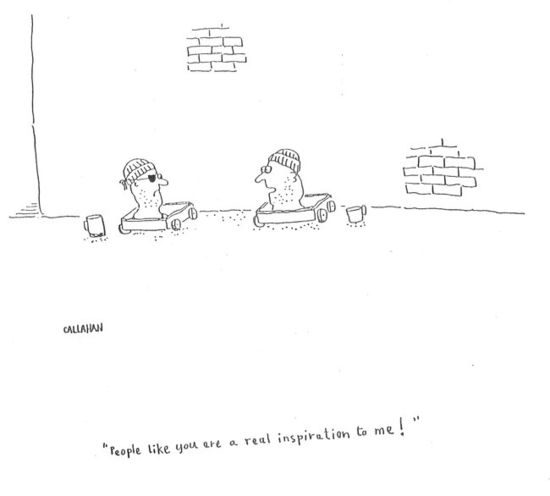
The mordant genius, John Callahan, is dead at 59. NYT obit here. Video of him here. The quality I loved about him was not just his extraordinary humor, but his indifference to his p.c. critics:
Callahan's quadriplegia was occasionally raised in defense of his more beyond-the-pale strips, particularly his frequent strips making a gag out of being in a wheelchair or otherwise disabled. But to make that argument — to point and say, "Well, he's ALLOWED to make fun of that" — misses the point of Callahan. He didn't care what he was allowed to say. Heck, I thought the guy was amazing, but there's a good third of his strips that I can't even read without shriveling in embarrassment or feeling my face flatten into a grimace of disapproval. And that taboo shattering was the point of Callahan. He was capable of funny yet innocuous gags when the spirit so moved him. But he was an artist who could make even his most fervent fans recoil in horror, and what's more, he wasn't afraid to do it.
After the jump, he sings "Lost In The City":
Yglesias is open to class-based affirmative action. But he finds the debate mostly a distraction:
If you were to start writing a list of the problems faced by poor people in the United States of America you’d run out of paper long before you got to elite university admissions policies. Poor kids start school already behind their higher-SES peers. They are then disproportionately concentrated in low-performing schools featuring ineffective teachers. And when they’re in school is the lucky time! Every summer, the schools shut down and poor kids fall further behind their middle class peers. If they depend on the school lunch program to feed them, well then they’re out of luck come summertime on the eating front as well as the schooling front. A very substantial proportion of kids from poor families drop of out of highschool and those who do manage to get into any kind of college at all have much odds of actually graduating.
Reihan agrees but goes in another direction by bringing up the mismatch hypothesis. A reader writes:
Your reader asked, "Are conservatives in favor of equalizing that to even out class-based advantages in primary education, where it can have the most impact?" Check out this new study on the effects of good kindergarten, written up by Leonhardt:
Students who had learned much more in kindergarten were more likely to go to college than students with otherwise similar backgrounds. Students who learned more were also less likely to become single parents. As adults, they were more likely to be saving for retirement.
Perhaps most striking, they were earning more. All else equal, they were making about an extra $100 a year at age 27 for every percentile they had moved up the test-score distribution over the course of kindergarten. A student who went from average to the 60th percentile — a typical jump for a 5-year-old with a good teacher — could expect to make about $1,000 more a year at age 27 than a student who remained at the average. Over time, the effect seems to grow, too.
Today on the Dish, Andrew followed up on his neoconservative pitch for Palestine, went toe-to-toe with Frum over Turkey, dropped his jaw at Bush's profligacy abroad, sounded off on energy reform, added to a discussion on government inertia, and defended his provocative record. A new paper appeared to prove that the administration prevented a depression. Oil spill update here.
More coverage of the crusade against mosques here, here, and here. Neocon spluttering over Turkey here and here. Yglesias awards here and Hewitt here. Ambinder wasn't convinced of Palin's impact in New Hampshire and Democrats prayed for her nomination (a related post here). Chuck Todd blasted Journo-list and Reihan clarified his take. O'Reilly appeared more pro-gay than Obama. Wyclef Jean contemplated a presidential run. California cannabis update here.
Readers gushed over Doctor Who, others carried on the conversation over affirmative action, and another gave advice to the unemployed. Email of the day here and runner-up here.
Andrew outed the Vatican and took the gay-pope bait. Christianism alert here and Christian hathos here. Colbert bait here, Stewart goatee here, and beardicide here. Foodie porn here and a nod to Futurama here. MHB here, VFYW here, and FOTD here. A great follow up to the window contest here.
— C.B. (30,000 feet above Kansas)
The oil on the surface of the gulf is shrinking, which is welcome news. But Susan Shaw continues to worry about the deep sea:
More caveats here. Kate Sheppard reports on natural gas, which was "some 40 percent of what is escaping from the well":
In the 10-mile radius around the well site, research teams have measured methane levels in the water averaging 100,000 times normal levels. [John Kessler, a professor of earth system science at Texas A&M University] says levels are up to a million times normal in parts of the Gulf immediately surrounding the spill site. "This is the highest concentration I've ever seen in ocean waters, easily," says Kessler. He believes it could take years—possibly decades—for the gas levels in the ecosystem to return to normal.
Timothy Lee applies the pitfalls of urban planning more generally:
The problem with trying to make society conform with reason is that society is a lot more complicated than most planners realize. So what looks on paper like a perfectly rational social order—8-lane freeways, US-imposed democracy in Iraq, the dictatorship of the proletariat—turns out to have fatal flaws when put into practice. This is why wise policymakers recognize that their knowledge is limited, and take a pragmatic, incremental approach that improves peoples’ lives without turning them upside down.

A cat shows interest in a frog sitting on a rock in the eastern German town of Sieversdorf on July 27, 2010. By Patrick Pleul/AFP/Getty Images.
 The Dish