Turkey’s Importance, Or The Lack Thereof

Frum puts aside David Cameron's criticism of Israel to bash Cameron's kind words on Turkey:

Turkey is not determined to fight terrorism in all its forms, not when it is sending flotillas to support Hamas. Germany and Russia are European countries with much more important trade and strategic relationships with Iran. Egypt has much greater potential to build bridges with Israel than Turkey, a country still mistrusted by many in the Arab world it once ruled. Turkey cannot help press Israel and the Palestinians together, because Turkey has forfeited almost all its credibility with Israel by its recent behavior.

Who could press Israel? The current Israeli prime minister is on record mocking the US as easy to manipulate and lie to. But the notion that Cameron's outreach to a vital Muslim country is somehow "evil" is a sign of how deep a nerve he has touched with the neocons. That a conservative leader is expressing common sense on the West's interests vis-a-vis the Muslim world has clearly rocked them to their foundations. By the way, I love this classic line from a neocon commenter:

The proper response is for them to feel a sharp sting, and to worry about losing us. If they don’t care about that, then all the groveling in the world will accomplish nothing but to make them despise us as weaklings to be bullied, while they continue on the anti-Western course they had chosen anyway. If they do care, then a sharp response with pain will bring them up short.

Can you imagine a similar argument with respect to the contempt Israel has recently shown for the US? When will neocons talk about standing up for America when it comes to Israel? Or is that a stupid question? Israel is the exception to every rule they otherwise insist upon – and the last few years have proved it. A reader writes:

I think [Cameron's] approach was spot-on, and Bagehot's critiques miss the point entirely–yes, it shows a lack of coordination with EU. That's the whole idea. Cameron's message is that he doesn't intend to dovetail UK foreign policy with the EU, and Turkey provides a perfect example where he sees an opening for gain based on UK intransigence. Turkey has one of the two or three best performing economies in the world today. It's international stature is gaining (the Neocons can choke on that), and it is emerging as the major regional powerbroker. In this regards, its close relationship with Israel was holding it back. So in the end, notwithstanding the stupid spittle that comes from Commentary, this isn't so much about Israel as it is a resurgent Turkey wanting to be a major player in the region and recognizing that that isn't possible with an Israeli Albatross around its neck. Cameron's people understand this perfectly.
The Other Affirmative Action, Ctd

A reader writes:

It's amazing to me how much of this discussion focuses on trying to address class-based AA at the level of university education.  What about how the relationship between property values, property taxes, and K-12 funding?  Are conservatives in favor of equalizing that to even out class-based advantages in primary education, where it can have the most impact?  If so, I haven't heard about it.  They advocate choice, but offer little to equalize the dollar advantages many communities have.

Another writes:

It is a small point, but the conversation started by Beinart discusses "class-based affirmative action" without clearly defining what is meant by the term. 

I get the feeling that they really mean wealth-based affirmative action; that the poor should receive some sort of benefit to help them enter the nation's elite.  However, wealth and class are quite different things, and a true class-based affirmative action program might include, for instance, advantages for kids who are the first in their family to attend college, or who are from schools where few graduates attend four year colleges.  I'm sure that there are many other ingenious options out there.

Of course, class is a tricky thing to define, especially in the US, which does not have the same sort of established class system you would find in the UK, let alone India (although with the America's surprisingly low levels of economic mobility, such a system could be well on the way to developing), so that might make a true class-based system hard to implement.

I am open to either class-based or wealth-based affirmative action programs, or race-based programs for that matter.  Of course, part of the cost of any such system is that they are necessarily crude efforts to level a playing field, and so will inevitably leave some people unfairly treated.  Nonetheless, I have faith that any well implemented affirmative action program will eliminate more unfairness than it generates.

Another:

Class-based affirmative action is already happening at most colleges – has been for a long time.  I was an almost full-scholarship student at my college, and my husband's has had need-blind admissions and even full tuition payment for poor students for some time now.  As colleges have become wealthier, they should be offering more scholarships.

Another:

People are clamoring for class-based affirmative action because President Reagan completely decimated the federal financial aid program in the 1980s.  Universities could implement “need-blind  admissions because poor and working students, regardless of race, received aid packages where grants, not loans, comprise the bulk of the aid.  Reagan changed all that. 

I was lucky – my family was so large and we were so poor that I was able to complete a BA at a private college and my loan burden was not intolerable.  But many of my classmates left a private to attend public universities and colleges.  While I don’t think anyone is necessarily owed four years at a private school, I was really quite miserable when many of my friends left and I was one of the few white working class kids in my graduating class.  The absence of their voices profoundly affects a campus’ discourse – liberals continue to harbor disdain and conservatives, who share that contempt, use them as a proxy in their culture war battles.
 
Harvard, however, has done far more than similar institutions in creating a more inclusive student body.  While I was no fan of Larry Summers prior to his appointment as head of Harvard, I did like that he, along with Tony Marx at Amherst, strove to have their frosh classes reflect the nation’s economic and ethnic diversity.  Here’s an old article on it.

Will Seniors Come Around On The Health Care Bill?

January Angeles defends the Medicare changes:

Reducing the overpayments will … help enrollees by making Medicare’s long-term finances more stable.  Along with other Medicare changes in the new law, it will extend the life of the Medicare Hospital Insurance Trust Fund by 12 years and keep beneficiary premiums lower.

Breaking News: The Vatican Is Super-Gay, Ctd

A reader writes:

The bubble popped for me two years ago. My still-practicing Catholic friends tell me compartmentalize. The Vatican is not Your Church, forget about them. Intellectually I can understand this rationale. But in my heart, compartmentalization does not jive because I know each of our lives is interconnected.

I still have enough faith to believe in God and in the Holy Trinity. But that’s about it right now. As a 53 single, professional woman, educated in a Catholic high school and university, I am in the desert. That’s ok. Others have been here before me, including Thomas Merton, one of my heroes:

“Yet it is in this loneliness that the deepest activities begin. It is here that you discover act without motion, labor that is profound repose, vision in obscurity, and, beyond all desire, a fulfillment whose limits extend to infinity.”

I feel very largely the same way. And I pray for the hope that is one of the three cardinal virtues. Not optimism: who could have that right now? But hope.

The Conservative Crisis – And Liberalism

A brilliant little essay from P.M. Carpenter:

All that is driving modern conservatism's concentrically defined ideology: exclusion rather than inclusion, pup tents over big tents, intellectual guillotining and purifying bloodbaths. Only a tighter and tighter ideological circumference qualifies as True and Valid Belief — an absolute killer in popular politics as well as in many an actual revolution. Outsiders need never worry for too long; the revolutionaries will stupidly slaughter themselves.

OK, so all that, as noted, is rather obvious. And in some ways, for today's liberal community, it's gratifying, even amusing. But it's also lethal.

Today's conservatism isn't serious conservatism. As a political philosophy, it's a joke. Yet in any healthy two-party system, one of them can't be a joke, not for long, anyway; for both sides to keep each other honest and rational, both, naturally and logically enough, must maintain at least some semblance of honesty and rationality.

Today, that requisite balance is decidedly unbalanced. One can't debate a lunatic, someone who genuinely doesn't give a damn about serious policymaking and cannot distinguish frivolous politics from it; therefore one is unable to sharpen one's own policy arguments against it.

It's sort of a yin-yang thing, but also a colossal paradox so characteristic of Eastern philosophy: The death of thoughtful conservatism could very well spell intelligent liberalism's demise.

Polling Pot, Ctd

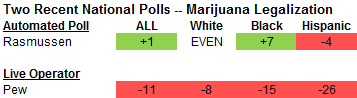
Pot_Polls

Nate Silver contemplates the differences between live operator and automated polls:

The original Bradley Effect, named for former Los Angeles mayor Tom Bradley, occurs when respondents in surveys are asked about socially desirable behaviors, such as being free from racial prejudice. Although the racial version of Bradley effect itself is probably a thing of the past, social desirability bias may manifest itself in other ways. Automated polls have sometimes shown relatively lower levels support for gay marriage initiatives, for instance, in states like Maine and California. Homophobia is fairly common, but has become socially undesirable; the purveyors of the automated polls have sometimes claimed that their respondents are free to be more honest when there's not another human being on the line. If the theory holds, automated polls might also provide a setting for voters to be more honest about their feelings on marijuana use, another behavior that is probably more widespread (and privately tolerated) than it is socially acceptable. If so, that would be good news for Prop 19.

Email Of The Day

A reader writes:

You forgot to mention that the guy holding the noose sign at the NOM rally, Larry Adams, admitted on tape to being tempted by gay sex.  As disgusting as that sign is, the interview left me feeling more pity than anger.  He actually expresses compassion by stating his main concern: he doesn't want them going to hell and that he wished they could feel God's love (even through he fails to realize they might already).  He honestly believes homosexuality is a choice because he feels he made that choice and just wishes others would do the same so they don't go to hell. 

Makes you wonder what kind of a man he would or could become without the Christianist influence during his time of confusion.

Waiting On Innovation, Ctd

Tyler Cowen didn't like the cap-and-trade bill, but he still supports a carbon tax. His logic should be familiar to anyone who follows energy debates:

Even if we cut government spending a lot, some taxes will have to go up.  This seems like the least bad tax to raise or create, since it has some chance of producing a better outcome.  It's hard to say that about most of the other potential tax boosts.