The war between dogs and cats wages on:
Update from a reader:
You’re a little slow on the Pixel the bulldog story; he DID reclaim the bed:
The war between dogs and cats wages on:
Update from a reader:
You’re a little slow on the Pixel the bulldog story; he DID reclaim the bed:
This weekend’s short story comes from Alice Munro, who won the Nobel Prize in Literature in 2013. “Boys and Girls” is one of her earlier stories, first published in 1968. How it begins:
My father was a fox farmer. That is, he raised silver foxes, in pens; and in the fall and early winter, when their fur was prime, he killed them and skinned them and sold their pelts to the Hudson’s Bay Company or the Montreal Fur Traders. These companies supplied us with heroic calendars to hang, one on each side of the kitchen door. Against a background of cold blue sky and black pine forests and treacherous northern rivers, plumed adventures planted the flags of England and or of France; magnificent savages bent their backs to the portage.
For several weeks before Christmas, my father worked after supper in the cellar of our house. the cellar was whitewashed , and lit by a hundred-watt bulb over the worktable. My brother Laird and I sat on the top step and watched. My father removed the pelt inside-out from the body of the fox, which looked surprisingly small, mean, and rat-like, deprived of its arrogant weight of fur. The naked, slippery bodies were collected in a sack and buried in the dump. One time the hired man, Henry Bailey, had taken a swipe at me with this sack, saying, “Christmas present!” My mother thought that was not funny. In fact she disliked the whole pelting operation–that was what the killing, skinning, and preparation of the furs was called – and wished it did not have to take place in the house. There was the smell. After the pelt had been stretched inside-out on a long board my father scraped away delicately, removing the little clotted webs of blood vessels, the bubbles of fat; the smell of blood and animal fat, which the strong primitive odor of the fox itself, penetrated all parts of the house. I found it reassuringly seasonal, like the smell of oranges and pine needles.
Henry Bailey suffered from bronchial troubles. He would cough and cough until his narrow face turned scarlet, and his light blue, derisive eyes filled up with tears; then he took the lid off the stove, and, standing well back, shot out a great clot of phlegm – hss – straight into the heart of the flames. We admired his for this performance and for his ability to make his stomach growl at will, and for his laughter, which was full of high whistlings and gurglings and involved the whole faulty machinery of his chest. It was sometimes hard to tell what he was laughing at, and always possible that it might be us.
Read the rest here. To read more of her work, checkout Selected Stories, 1968-1994. Previous SSFSs here.
John Colapinto looks beyond Stanley Kubrick’s Lolita to other adaptations of Vladimir Nabokov:
[When] another Nabokov novel hit the screen [in 1978] … it was, again, one of the dark-comic masterpieces from the author’s sojourn in Berlin in the nineteen-thirties: “Despair,” a novel whose plot seems tailored to a high-concept, one-sentence Hollywood pitch: “Man meets his double, swaps identities, and kills him for the insurance money.”
Like “Lolita,” the story features a highly unreliable narrator, Hermann Hermann, who also happens to be the main character—which poses real challenges to any filmmaker. Fortunately, the director was Rainer Werner Fassbinder, working from a script by the equally gifted Tom Stoppard and starring the superb Dirk Bogarde as Hermann. Fassbinder retained the Nabokovian humor but introduced his own astonishing touches, like the moment when Bogarde’s Hermann, the owner of a chocolate factory during the rise of the Nazis, stares down into a pile of baby-shaped chocolates in a bin, his eyes growing wide with premonitory horror at what suddenly seems to be a heap of corpses.
Stoppard, meanwhile, provided a script that more than matches the source author’s word play, and hints at Hermann’s creeping departure from reality, as when Hermann, obsessing over his insurance scam, mishears the word “merger” as “murder.” “Merger, murder,” Hermann says, shrugging, as if they’re all the same. Of all the Nabokov movies, this is the only one to rival Kubrick’s “Lolita,” and it is still in circulation, in libraries and on Amazon.

Ellyn Kail captions:
For Mother Love, New York-based photographer Jamie Diamond immerses herself within the subculture of Reborn dolls, true to life artificial babies crafted from materials like vinyl, doe suede, glass, and layer upon layer of paint.
The artist discovered the Reborn community while pursuing her self-portrait project I Promise to be a Good Mother, in which she used a doll to stand in for an imagined child. Behind these online collections of high end, expensive figures, she found a group of women hobbyists who worked from home studios. The process demands long-term commitment and passion, with each doll requiring dozens of paint coats and the careful insertion of each individual strand of hair into the scalp.
Most of these artists sell the dolls to other adult women collectors, who will often go on to play the role of its mother. The Reborn babies, Diamond explains, are crafted not only to resemble the real thing, but glass beads are also inserted into certain areas to mimic the physiology of living children, and they are frequently perfumed to smell like a newborn babe.
See more of Diamond’s work here.

Oliver Roeder goes through the bottom of BoardGameGeek’s rankings, noting that games based solely on luck, like Candy Land or The Game Of Life, typically rate the lowest among more serious board-gamers. Monopoly, despite the higher level of skill it requires, doesn’t fare well either:
[P]robably due in large part to its huge popularity, Monopoly has become a bête noire for many serious board gamers. It suffers from problems that most game designers nowadays try to avoid. First, players can be eliminated. This is no fun — unless, of course, the eliminated player finds something better to do than play Monopoly — and games are meant to be fun. Second, there is often a runaway leader. Someone can snap up a juicy monopoly early on, and that quickly becomes that. The rest of the game is pro forma and boring. And games aren’t meant to be boring. Third, there is what’s known to game designers as a kingmaking problem. A losing player can often choose, typically via a lopsided trade of properties, who wins the game. This is also no fun and negates whatever skill was required to begin with.
Oh, and it also takes a really long time to play.
But Roeder defends the bad board games as well:
Through whatever quirks of history, culture and commerce, these are our first games. I — and I can’t imagine I’m alone — retain fond memories of playing Candy Land with my cousins during summers at my grandma’s house and War with my friends on the school bus. Monopoly and The Game of Life may bespeak a special American capitalist fascination — an ingrained desire to live out a make-it-or-break-it adventure.
And even if it’s not an objectively good game, Candy Land teaches lessons — playing by the rules, healthy competition, winning and losing graciously. Tic-tac-toe represents a first foray into strategy and game theory — however simple — for many children. That’s not a bad thing. These games might be “bad,” but they’re important. We start with them, and we move on to better ones.
The best-rated game? Twilight Struggle. Previous Dish here on another massively popular strategy game, Settlers of Catan.
Last summer, Andrew O’Hagan undertook the peculiar experiment of borrowing “a dead young man’s name and see[ing] how far I could go in animating a fake life for him.” In the resulting meditation on identity and “the ghostliness of the internet and the way we live with it,” O’Hagan describes how he plunged his fictionalized “Ronald Pinn” into the dark web, “where one can be anybody one wants to be”:
There were areas I wouldn’t allow him to go into – porn, for instance – but the Ronnie who existed last summer was alive both to drugs and to the idea of weaponry.
It’s one of the contradictions of the dark web, that its love of throwing off constraints doesn’t always sit well with its live-and-let-live philosophy. There are people in those illicit marketplaces who sell ‘suicide tablets’ and bomb-making kits. ‘Crowd-sourced hitmen’ were on offer beside assault weapons, bullets and grenades. One of the odd things I discovered during my time with cyber-purists – and Ronnie found it too – was how right-wing they are at the heart of their revolutionary programmes. The internet is libertarian in spirit, as well as cultish, paranoid, rabble-rousing and demagogic, given to emptying other people’s trash cans while hiding their own, devoted not to persuasion but to trolling, obsessed with making a religion of democracy while broadly mistrusting people. Far down in the dark web, there exists an anti-authoritarian madness, a love of disorder as long as one’s own possessions aren’t threatened. The peaceniks come holding grenades. The Manson Family would feel at home.
When Ronnie Pinn went to see this world he found it welcoming and vile. He saw Uzis and assault rifles, bomb-making kits, grenades, machetes and pistols. As a man with cyber-currency, he was welcome in every room and was never checked. He was anybody as well as nobody. He could have been a teenager, a warrior, a terrorist or a psychopath. So long as he had currency he was okay.

You have until noon on Tuesday to guess it. City and/or state first, then country. Please put the location in the subject heading, along with any description within the email. If no one guesses the exact location, proximity counts. Be sure to email entries to contest@andrewsullivan.com. Winner gets a free The View From Your Window book, a new Dish mug, or two free gift subscriptions to the Dish. Have at it.
Last week’s contest results are here. Browse a gallery of all our previous contests here.
In his new memoir Silver Screen Fiend, Patton Oswalt recounts his multi-year “addiction to film.” Elbert Ventura appreciates that the comedian is “unsparing in evoking the condition of on-the-spectrum obsessiveness”:
Oswalt has a good angle—a portrait of the artist as a young film buff—and the book underscores a point often lost in talking about movie love: the sheer work of being a real cinephile. Oswalt’s immersion in movies really did deliver a thorough education: He trusted authorities like [New Beverly Cinema proprieter Sherman] Torgan and [Cult Movies author Danny] Peary and saw everything they suggested; he went to rep screenings instead of settling for video; he sought out hard-to-find entries in forgotten directors’ filmographies. At once confessional and curatorial, the book portrays Oswalt as not just a celluloid sybarite, but someone dead serious about the art.
Linda Holmes remarks that “one of the best things about Silver Screen Fiend is that Oswalt doesn’t always seem very likable in it”:
The easiest way to enjoy a memoir, at times, is when it makes a famous person seem like an awesome best friend you’d love to have. Patton Oswalt, on the other hand, in his own stories, can seem not just prickly, but full of explanations of things he’s learned to rise above:
hack comedy by people who are successful but untalented, inferior art, boring people, uncool venues (“giggle-shack” is his most devastating putdown). The book is not an argument for his personable nature, as books by famous people often are. …
It is, however, an interestingly aggressive, restless attempt – sometimes successful and sometimes less so – to get to the bottom of his own fascination with dark theaters and old movies, and how it dovetailed with his developing comedy career. The farther he gets from the theaters, and from the attempt to convey their grandeur and the grandeur of film itself, the better the book is.
The book’s structure isn’t always clear, which sometimes makes for an unwieldy read, and a 33-page appendix listing every movie he saw over four years, while interesting at a glance, ultimately feels like padding. But Oswalt’s ample writing talents push the narrative past these shortcomings (a section with no punctuation depicting Oswalt’s thoughts while bombing onstage is particularly vivid). His decision to write almost entirely in the present tense makes the memoir feel immediate and vital. …
The book’s resolution, which includes the birth of Oswalt’s daughter, makes clear that the story is a kind of fable about the dangers of immersion in any cultural interest. By the end, when Oswalt stumbles out of the dark and squints in the light of his new life, it’s enough to make any reader seek out the many films that made him hibernate in the first place.
In a recent interview about the book, Oswalt elaborated on one of the events that finally led him out of addiction – the release of Star Wars Episode I: Phantom Menace:
It’s not that it killed the addiction; it made me look at the addiction from such a different angle that it didn’t hold any power over me anymore. I’ll put it this way — I was the worst kind of movie fan. I’m the kind of guy who saw 6 movies a day, didn’t write any movies, didn’t make any movies, but then could be armchair quarterbacking on a movie that I had no hand in making.
Yes, I thought [Phantom Menace] was a failure, but the dude took a shot at it. It hit me that I was spending days and days and nights and nights with my friends, arguing back and forth about this film but this guy made a movie. Good or bad, he made a movie. He’s on a different relam than you.
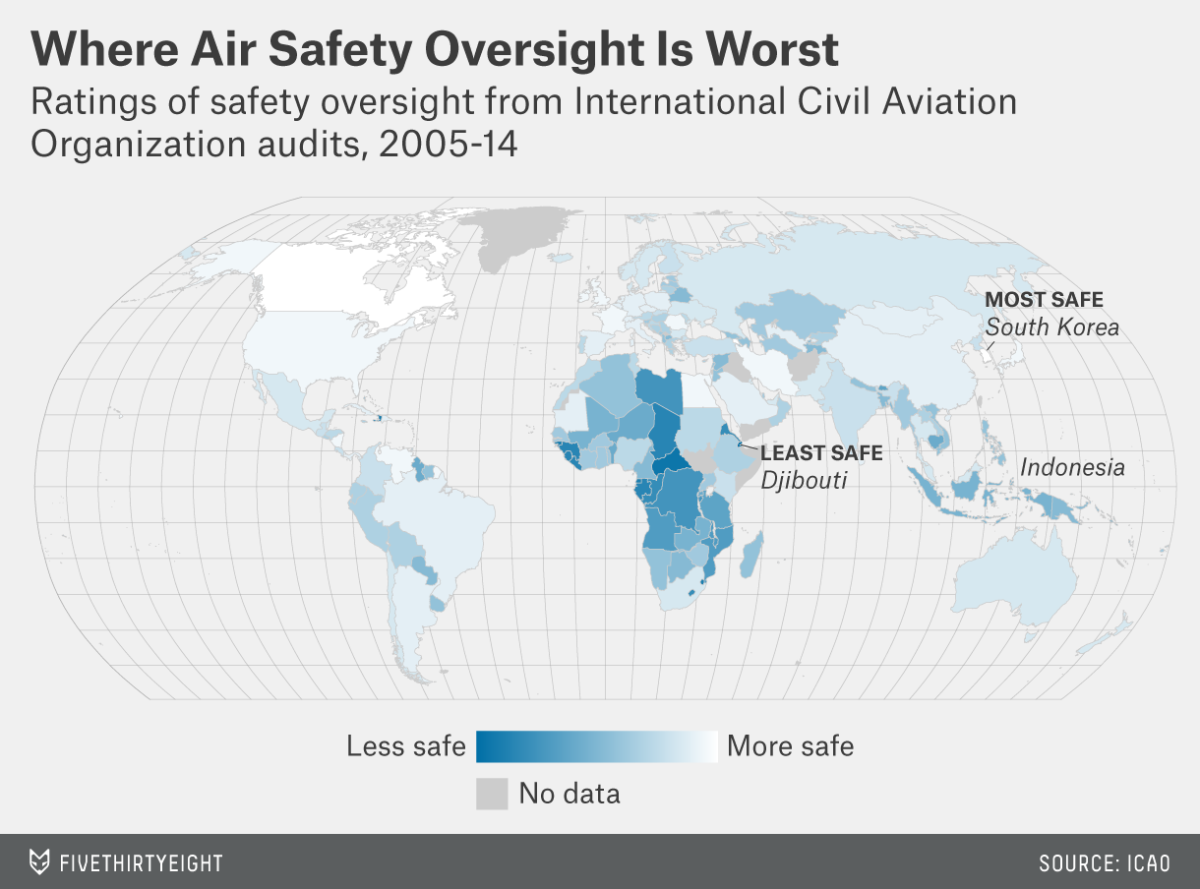
Carl Bialik shakes his head at Indonesia:
A year ago, [it] rated above average. Then, last May, the ICAO audited the country. The results were abysmal. Indonesia rated below average in all eight categories, including legislation, operations and airworthiness. The organizational structure of its civil aviation rated well below average, scoring 18 percent compared to a global average of 65 percent.
He adds that “it’s too soon to link Indonesia’s poor audit scores with the [AirAsia] disaster that is presumed to have killed all 162 people on board”:
There are, nonetheless, already indications that lax oversight played a part in AirAsia flight QZ8501. The flight took off without the necessary clearances from regulators, the acting head of Indonesia’s transportation ministry said, according to the Associated Press.

Dish poetry editor Alice Quinn writes:
The Scottish poet Kathleen Jamie, born in 1962, is the author of seven collections, including The Overhaul, just published here by Graywolf Press and shortlisted for the T.S.Eliot Prize when it was published in 2012 in Great Britain. Too few poets from England, Scotland, Ireland, and Wales are published here. She’s one to follow along with the Irish poet Michael Longley, who also has a new volume. We’ll feature Jamie this week and Longley next.
“Hawk and Shadow” by Kathleen Jamie:
I watched a hawk
glide low across the hill,
her own dark shape
in her talons like a kill.She tilted her wings,
fell into the air—
the shadow coursed on
without her, like a hare.Being out of sorts
with my so-called soul,
part unhooked hawk,
part shadow on parole,I played fast and loose:
keeping one in sight
while forsaking the other.
The hawk gained height:Her mate on the ground
began to fade,
till hill and sky were empty
and I was afraid.
(From The Overhaul © 2012 by Kathleen Jamie. Used by permission of Graywolf Press. Photo by Peter Massas)
 The Dish
