What’s the Mission? A Bleg

by David Frum

Andrew last week generously linked to an article of mine explaining the evolution of my political thinking.

But the thing I’d most like to discuss in this week of cross-posting at Andrew’s site is: where do we go from here? What’s the mission?

And – maybe even more urgently – how do we express that mission in the clearest and direct way?

Here’s my own elevator pitch describing what I’m trying to develop in my writing and political work:

“A reality-based, culturally modern, socially inclusive and environmentally responsible politics that supports free markets, limited government and a peaceful American-led world order.”

But that’s kind of a mouthful, isn’t it?

So question to all the mighty brains who read Andrew’s site and FrumForum: can you help me do better? 

Dueling Polls

by Patrick Appel

Time says I don't need to worry about a Palin presidency:

Obama clobbered Palin, 55%-34%, in a hypothetical 2012 matchup that should have Democrats salivating.

PPP on the other hand:

Obama's numbers in our monthly look ahead to the 2012 Presidential race are their worst ever this month. He trails Mitt Romney 46-43, Mike Huckabee 47-45, Newt Gingrich 46-45, and is even tied with Sarah Palin at 46.

So Obama is either tied with Palin or leading by 21 points. Glad we cleared that up.

The Exaggerated Power Of Nudges

by Patrick Appel

This NYT op-ed by George Loewenstein and Peter Ubel argues behavioral economics is no panacea.

The policy implications from many behavioral economics studies are often relatively pain-free from a political perspective. For example, they suggest that simply giving consumers a bit more information can encourage them to eat healthier, save energy, and make better health care choices. The problem, Loewenstein and Ubel assert, is that these solutions often have only tiny effects compared to the size of the problem they seek to address. Ultimately, changing relative prices is much more likely to meaningfully impact behavior deemed socially undesirable. So, making healthier foods cheaper is much more important than labeling unhealthy food. Meaningful reductions in CO2 emissions require increasing the cost of traditional sources of energy. Giving people more information about their energy consumption helps a little at the margin but should not be thought of as a solution to the problem. The op-ed has many more examples.

Cowen's verdict:

I don't agree with a number of their examples, but I do agree with their overall point.

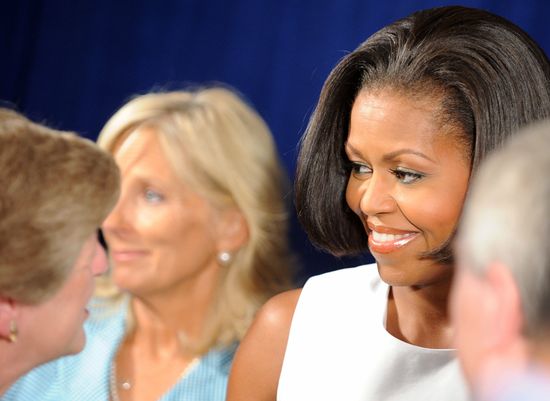
Face Of The Day

102896767_

by Chris Bodenner

First lady Michelle Obama and Dr. Jill Biden greet guests an event about the Affordable Care Act at George Washington University Hospital on July 14. Hospital employees also attended this event, including Inger Mobley, left, Clinical Manager of the Breast Care Center. Obama pointed out new regulations in the Affordable Care Act that will require new health plans to cover the cost of preventive screenings for diabetes, high cholesterol and high blood pressure.  By Leslie E. Kossoff-Pool/Getty Images.

BP Stops The Leak?

by Patrick Appel

This is great news. In not so great news, Bradford Plumer looks at the damage done:

This doesn't mean the oil-spill disaster is over. There's a lot of crude bobbing along in the Gulf right now: Scientists estimate that between 92 million and 182 million gallons have gushed out into the ocean since the Deepwater Horizon platform first blew up back in April. BP is still using dispersants to break up the oil and send it down to the sea floor, even though no one quite knows how the chemicals might affect marine life in the area. And note that oil's still washing ashore, and Bobby Jindal's artificial "barrier islands," which were supposed to protect Louisiana, are now crumbling.

On Not Becoming Unhinged, Ctd

by Chris Bodenner

A reader writes:

Regardless of my views on the moral or evolutionary arguments, I was struck by the egocentrism and entitlement in your reader's post about his wife's changed sexual responses. I certainly empathize with his frustration, but the reality is that his wife bore the burden of birth control, and the physical consequences of that choice. Now she's faced with the possibility of a lifetime of painful and/or unsatisfying sex. His "getting it elsewhere" would mean she bears that burden on her own, too.

She likely thinks about and wants satisfying sex, too; but she doesn't have the option of exploring less "laborious" pastures.

Non-monogamy increases the stereotypical gender gaps – the female is responsible for the childbearing – and "suffers" all of the ramifications of that – before (risking her health with birth control choices), during (obviously it's all on her), and after birth (not only in changes to her body's physical "beauty" as defined by cultural norms, but in this case – and many – in terms of her sexual responsiveness, as well). Meanwhile, the male continues on his merry way, physically un-impacted by the whole inconvenient biological process of adding to his family – looks intact, health intact, sex drive intact.

Men cannot, physiologically, share all of this "burden" with their partners, but at least in a monogamous relationship they're committed to sharing some of the emotional and relational ramifications. I think it's naive to believe that a "temporary" extra-relational sexual encounter – that was satisfying and fun – would not lead to increased dissatisfaction with the current state of the marriage. I think we can just look to all of the affairs that lead to divorces and new marriages to recognize the enticement of a new and exciting relationship.

And, would most men honestly think it was OK if their wives found sexual satisfaction elsewhere if THEY were the ones whose sex drive/ability had changed (ex. as a result of injury or illness)? And if not, why not? What would they want from their wives in this situation? Perhaps if they reflected on a "shoe on the other foot" scenario, they'd be less likely to bemoan their "entitlement" to good sex.

Monogamy takes work and commitment, and sometimes sacrifice. And, I would suggest that relationships in which each partner knows that the other willingly and lovingly accepts them as they are (that whole sickness and health thing!), and is eager to work within the relationship to create happiness and satisfaction (sexual and otherwise) for both of them  are the most stable and joy-filled over the long run.

Your reader feels like a demon (I truly sympathize with his desires and his guilt), and I'd wager that his wife feels guilty and inadequate for her inability to satisfy her husband. These are two people who are hurting, and it is sad for both of them. I hardly think, though, that non-monogamy would resolve those negative emotions for either of them – perhaps replace them with other negative feelings.

Monogamy should not mean let's stay together and exclusive no matter how miserable we are. The power and grace of monogamy  is realized when both partners are committed to finding ways to overcome that misery WITHIN the relationship – when they actively and creatively work TOGETHER through the inevitable small and big crises that are a part of life.

I don't think your reader's fantasies of non-monogamy in any way help him improve his marriage; and I definitely don't think acting on those fantasies would be helpful, either. I hope – for his sake, his wife's, and his son's – that he and his wife can work together to develop a satisfying sex life within their marriage, and that their relationship becomes stronger and more joyful and fulfilling – not just because of improved sex, but because they experience the shared satisfaction and pride in knowing they defied the odds and made monogamy really work.

Many excellent points.  But I should point out one key detail from the previous reader: he and his wife were already on the edge of divorce before he even considered non-monogamy. So perhaps some sort of open arrangement could salvage the marriage if it gets close to divorce again. (Then again, such an arrangement could make a inevitable divorce that much more painful and spiteful, particularly now that there is a kid in the picture.)
Limited Alliances

by Patrick Appel

Julian Sanchez chews over "liberaltarianism":

Yeah, there doesn’t seem to be much interest on the left in any kind of broad self-conscious “Liberaltarian Alliance”—but practical political coalitions don’t actually spring from New Republic essays, any more than real-world friendships arise from a formal declaration of an intent to be friends. They’re a function of actually getting out there and doing the work, issue by issue, bill by bill, election by election.  Given my own pattern of interests, I end up mostly working on issues where I agree with civil libertarians on the left. And pretty much without exception, they’re happy to work with me on those issues, and for that limited purpose indifferent to whatever disagreements we might have over optimal levels of federal taxation and spending.

A Thousand Cuts, Ctd

by Patrick Appel

A reader writes:

The post about "A Thousand Cuts" showed a stunning lack of understanding of what it will take to cut the budget. I am very familiar with the budget process in state government and the federal government works the same way.

In the first place, it IS Congress and the various Administrations that have put us where we are. Expecting the bureaucracy to make cuts ignores the fact that the bureaucracy exists to implement and administer laws, not interpret and adjust the impact of them. No bureaucrat, at the federal or state level, has any flexibility to make cuts in programs, and any law that gave them that authority would probably be ruled unconstitutional. No one has elected the bureaucrats and they are not really accountable to the people, they are only accountable to the specific agency or department for which they work, and then only to the extent that existing law gives them any discretion within certain parameters. No bureaucrat has the authority to slash whole programs. You assume they have more power than they actually have.


The reason it is so hard to cut the budget, especially nowadays, is every single government expenditure has a constituency, and groups and even individuals who may be impacted by the budget cuts all know how to contact their legislator and will fight to the death to save their piece of the pie. Once a program is created, it gets rolled over year after year because the money to pay for it has become part of an agency base budget.

The real changes that are required need a level of commitment that is hard to sustain in what is really a two year election cycle for all but the Senate. Somebody needs to engage in a process to re-engineer the services provided, and have the authority and guts to actually implement those changes. Why are we still funding the Rural Electrification program? The Energy Department was created in the 1970's to address the oil shortage. 50,000 employees and 40 years later, and how closer are we to energy independence? But the department is "baked into" the federal budget, and I'll bet a dollar that no one has gone back and revisited the original purpose for the department and asked "is this still a goal that we should pursue"? I don't mean that no on in the Energy Department does any work, but the value added work for which they were created has shifted over the years because the original goal was not attainable, or no one was willing to push towards that goal, or both.

So the answer is to really step back and consider what services the federal government should provide, what it can provide, and at what level, but laying the responsibility for doing that at the foot of the bureaucrat is not going to get us anywhere.

I take some of these points, but Canada is doing something similar to what I proposed, so I'm not convinced it's crazy. We still need Congress to address big ticket items and locate ineffective programs; giving bureaucrats the power and a reason to save money would be a compliment, not a replacement, to the sort of restructuring this reader describes. I'm not sure how this would be unconstitutional given Congress would be giving this power to bureaucrats and could take it away. Congress is accountable even if it is not making the decisions directly.

Another reader:

Regarding "A Thousand Cuts" you write that "if the department doesn't spend its full budget the budget might get clipped the next year."  I've spent enough time working in government offices (local & state) to say you should change the phrase "might get clipped" to "will get clipped".  Department heads make sure that every cent of an annual budget is spent – often at then end of a fiscal year such spending is in haste and on completely superfluous exercises.  A conversation along these lines is long overdue – and  – if it can be conducted without the ever-present cynicism of party politics we might actually begin to make some positive changes to how government operates.  I say this with the personal belief (and my own level of cynicism) that the last thing the right wants to do is make government more efficient and responsive – that would make their "all government is bad government" mantra look as foolish as it actually is.

Sarah Palin, King-Maker?

by Patrick Appel

Poulos doubts Kazin's theory:

For it to happen, the GOP would have to (1) produce a leading contender for the nomination who is both (2) unacceptable to Palinites and (3) a man Palin doesn't like personally, doesn't owe any favors, and can't promote to her advantage (let's not kid ourselves: Palin wouldn't veto a woman even if she could). I just don't see that narrow, complex scenario playing out in any event. Palin's ability to shape the party from its margins will likely remain significant but marginal. McCarthy made his impact from deep within his party; Wallace made his (and these are not my preferred Palin analogues, not by a longshot) from far outside it. Palin is a woman who endorsed Carly Fiorina and supported John McCain — and not out of weakness, either. For me, not even Kazin's fear of a kingmaking Mama Bear carries much weight.

Blogs from a northern town

by Dave Weigel

UNALASKA, AK — So here's a question that no one has asked me.

"What's it like to blog from a remote location like historic Dutch Harbor/Unalaska, America's largest fishing port?"

Well, I'll tell you. It's rife with difficulties! In previous posts I've mentioned that everyone on this island gets Internet access from a satellite, and I have now learned that the mountain the satellite pickup rests on is called "Haystack." So it's slow. It's also hard to finesse. I'd like to work closer to the girlfriend I came out here to visit when I'm at her radio studio. But the connection is slow near her office and, relatively, fast in an adjacent room where a bunch of high schoolers are recording a radio show that, for reasons that elude me, makes frequent use of a dance remix of Air Supply's soft-rock classic "All Out of Love."

We are used to blogging quickly. That means more than posting; that means opening multiple windows to find links and insert YouTube videos into posts. That means catching e-mails and chats quickly and following up with them as you write. None of that's really possible here, and the result is, well, the sort of blogging we used to do in 2000 or so — the blogging I read at AndrewSullivan.com when I was loading it on an ethernet connection at college. It's slow. It's full of lag time to re-think and over-think ideas.

For the news blogging I'm accustomed to, this is unsustainable. When I work I try to get things first, get quotes first, get numbers first. I use my cell phone — which doesn't work here — and I meet with sources — who don't live here. You also realize how much trash code, and how many useless widgets, exist on sites now built for the broadband world that covers basically everywhere you aren't. But for 2000/2001-style muse-blogging, this might be ideal. Plus, if you're up for it, you get local news alerts like this.

07/05/10  Mon 1055 Theft – A man reported his white Ford truck, in which he had left his keys, was missing from the area of the APL dock. Responding officers found that a crewman on a boat docked there had been told to take a white Ford truck with keys in it to the grocery store. He did exactly that, not realizing he had taken the wrong white Ford truck. No charges were filed.