Non-Monogamy vs Adultery

by Chris Bodenner

This reader responds to Savage:

I don’t and didn’t mean to make moral judgments about sexual non-monogamy.  If I were making moral judgments, they would be about honesty, trust or lack thereof, abusiveness of various kinds, etc.  I ended my comments with “More power to them,” which Dan Savage seems to have missed or chosen to ignore.  It wasn’t meant sarcastically.

One point I was trying to make, and perhaps didn’t make very well, was that sexual monogamy is something of a red herring.  Other readers who wrote in with stories of making non-monogamy work — whether in practice or, so far, just in theory — included what I came to think is the crucial element: what I call monogamy of decision-making.  For me, sexual non-monogamy was the apparent problem, but it was lack of clarity and consensus about what the relationships really were that was the real problem.

I don’t suppose Dan Savage has any intentions of shutting up; why should I?  In my earlier years, it was the non-monogamists who wouldn’t shut up about how superior open relationships were.  I could spend the rest of my life talking about this without redressing the balance.

The Palin Model, Ctd

by Chris Bodenner

The aspiring senator from Nevada has become a keen disciple:

David Brody: I just want to understand. You’re saying that you’re not willing to play this mainstream media “gotcha” game basically? Is that what you’re saying?

Sharron Angle: No. There’s no earnings for me there. We’re looking at how can we best benefit from the media. We get so many requests. I do sometimes 7 interviews a day so it’s not like we’re running from the media. It’s just that we’re earning with that media.

David Brody: Not to harp on the point but when you’re on Fox News or talking to more conservative outlets but maybe not going on “Meet the Press” or a “This Week”, those type of news shows, then the perception and the narrative starts to be like you are avoiding those mainstream media outlets.

Sharron Angle: Well, in that audience will they let me say, "I need $25 dollars from a million people, go to Sharron Angle.com, send money?" Will they let me say that?

Steve Benen shows her in action:

Angle chatted with Fox News' Neil Cavuto this week, and the very first words that came out of her mouth were, "Well, first of all, Neil, it's great to be on your show to talk about this campaign against Harry Reid who needs $25 million — and I have been saying I only need a million people to send $25 to SharronAngle.com." Eric Hananoki notes that Angle "also made fundraising pitches on Hannity and Fox & Friends."

Whether Sharron Angle could function as a United States senator is unclear, but her future as a televangelist appears bright.

Chart Of The Day

Bisexual_Dating

by Patrick Appel

I'm not sure what to make of this:

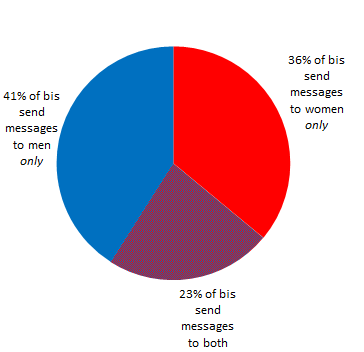
OkCupid is a gay- and bi-friendly place and it's not our intention here to call into question anyone's sexual identity. But when we looked into messaging trends by sexuality, we were very surprised at what we found. People who describe themselves as bisexual overwhelmingly message either one sex or the other, not both as you might expect.

This suggests that bisexuality is often either a hedge for gay people or a label adopted by straights to appear more sexually adventurous to their (straight) matches. You can actually see these trends in action in the chart below. Again, this is just the data we've collected. We'd be very interested in our bisexual users' thoughts on this single-sex-messaging phenomenon…

Picky Eaters, Ctd

by Patrick Appel

A reader writes:

As a hardcore meat-eater who recently went vegetarian, I wanted to chime in on this debate.

Until January, I was eating meat at least once a day, usually twice, and never in small quantities at a time. I always admired vegetarians, but I never thought I could handle it myself. Even six months into this new diet, I have never in my life eaten a salad.

But early this year, I moved from Philadelphia to Georgia and in doing so decided to give this whole vegetarian thing a shot. I had to start a new routine anyway, so I figured I would see how long I could last without meat. Prior to this, I genuinely cannot remember the last time I went more than two or three days without a piece of flesh. My plan was to see if I could last a month, and then eat meat a couple times a week. It is now July, and even as barbecue pork and fried chicken abound in this carnivore's paradise, I haven't had a bite of meat.

I get cravings now and again, but it's always for stuff like wings or chicken fingers or burgers. And that's sort of my point: I quit meat not for ethical reasons (which I mostly empathize with but find murky in general) but for health reasons.

I've had high cholesterol since I was first tested in high school, and while increased exercise, medicine, and minor dietary modifications all helped, I needed to do something dramatic. Meat was a big reason my cholesterol was as high as it was. I know there are other health concerns that stem from cutting out meat (like iron and B12 deficiencies), but I've taken steps to ensure those are taken care of (namely, by not going full-bore vegan yet).

Anyway, I'm still shocked at how easy this has been, given how much I like meat. I definitely take issue with the claim that vegetarians don't typically like meat in the first place. I've found — in my case, and in the case of most of my meat-eschewing friends — that the inverse is true: the longer you're a vegetarian, the less you like meat. I suspect that most of the people who make the claim that the switch would be "too hard" for them are people who haven't even tried.

Another reader:

I am one of those vegetarians who made the shift in my late teens, over 20 years ago. It was NEVER a hard choice for me. I grew up not liking meat very much, and I lived in a kosher house. The combination of my household's dietary restrictions and my own natural preferences meant that I ate a wider variety of appealing (to me) foods after I went vegetarian than I did before.

Does that make my choice less moral? In my case, moral issues, environmental concerns, and basic taste equally informed my decision. On the other hand, my choice has been very, very easy, so I don't get any extra points for exercising will-power. I wonder if the switch is easier for all of those who, like me, never enjoyed totally unrestricted eating.

As for your own situation, I think it is great to reduce your own meat consumption, and I don't think you need to agonize over not going full-throttle vegetarian. I always tell people that if it's really that hard for them, it may not be the right choice. Meanwhile, today's options for humane animal products are better than they have been since big agriculture took over our food supply. You can get grass-fed beef, free range foul, wild-caught (and sustainable, but it's tricky) seafood, and pastured eggs.

So with no disrespect to those whose religious and/or philosophical beliefs preclude any animal consumption, I would advocate for a middle path of less and more humane consumption of animal products. For me, it's never been about the food-chain; it's always been about sustainability and suffering.
A Thousand Cuts

by Patrick Appel

Veronique de Rugy argues that cutting spending is not only possible and necessary but that it can be politically expedient:

Cutting public spending can seem challenging. Entitlement spending increases automatically in a recession and as the population ages. Meanwhile, military actions in Afghanistan and Iraq and the ongoing threat of terrorism all help lawmakers claim that those parts of the budget are off limits. Lawmakers tend to be wary of spending reductions in general, as they believe their political survival rests on rewarding their supporters with jobs or subsidies. Yet there is evidence that Congress can cut spending—and cut it by a lot.

The spending debate usually focuses on Congress and the President, but there is also an incentive problem at lower levels of government. During the presidential debates, Obama talked about taking a scalpel rather than a hatchet to spending. I'd rather hand out thousands of scalpels to the federal bureaucracy.

The problem with cutting spending at the highest levels is much waste is hard to identify. No matter how deft Obama's scalpel is, it's inconceivable he will be better able to identify deadwood than the federal workers assigned to these projects. But these workers have no reason to do a cost-benefit analysis; it's not their money, if the department doesn't spend its full budget the budget might get clipped the next year, there is no reward for coming in under budget, and it's a political liability to cut corners. Giving departments bonuses for slashing spending or allowing unused funds to roll-over into the next year's budget would begin to fix this incentive problem. Even if these steps didn't cut the deficit significantly, it would result in a more efficient government, provided you don't make the incentives so attractive that government workers begin cutting worthwhile services and projects.

The Evolutionary Case For Monogamy? Ctd

by Patrick Appel

A reader writes:

I think Christopher Ryan leaves out part of the picture by suggesting that genetics can be the only source for evolutionary selection in the Darwinian sense.  This is basically an extension of the nature/nurture debate.  Just like the evolution of our genes can determine who we are and how we behave, so too can the evolution of cultural norms within a given society.  Societies that perpetuate ideas and norms that are beneficial to quality of life in the long run may prove more successful than societies that do not.  It's one part of the argument for why the west won the Cold War  — capitalism proved to be a more successful idea than a state-controlled economy.  Thus, I would suggest that supposing (1) children from families that value and practice monogamy are more likely to be successful, and (2) such values perpetuate through generations, then this could indeed be a form of evolutionary selection.  Each successive generation from such families would have a higher likelihood of success than each successive generation from families that don't value monogamy.  Over many generational iterations, and all other factors being equal, one could predict the dominance of monogamous culture over others. 

Social evolutionary theory is a very real stream of social science, but it is obviously a much harder theory to pin down than genetic evolution because you don't have any code to point to as evidence.  I would recommend reading the groundbreaking works of Max Weber from a century ago and more recent work on evolutionary psychology by Steven Pinker, if anyone is interested. 

Another reader:

As far as genetic correlates of monogamy go, you might want to look at this study on voles…and related others. They seem to have identified a few genes that, when turned off, make a normally monogamous species polygamous. This is of course not an exact correlate to human behaviour–pair bonding in rodents is clearly not identical to human love and marriage–but it's about as good as we have right now.

I've seen the vole studies. Ed Yong had a good post on their significance a couple years back.

Illustrating Discrimination

Dignlg

by Chris Bodenner

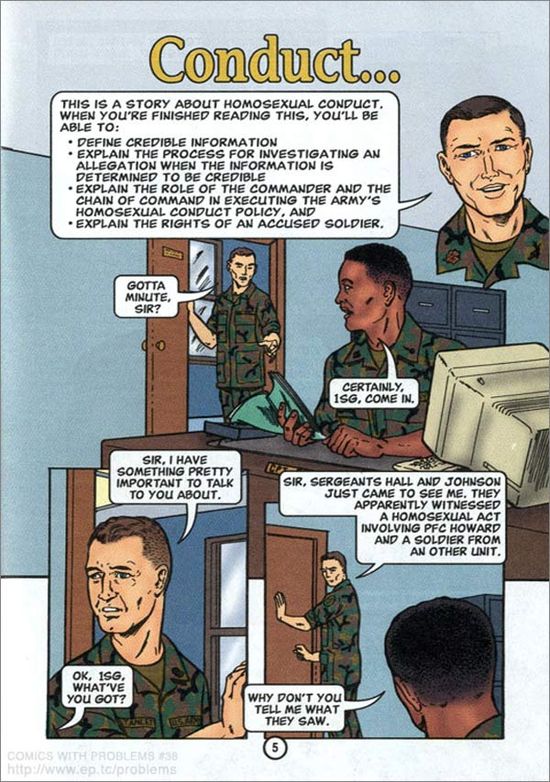
Xeni Jardin digs up an Army comic book from 2001 instructing soldiers on DADT.  Ackerman narrates:

“Dignity and Respect” opens with the saga of Private First Class Howard. He has the misfortune of being observed in a homosexual act by two of his fellow soldiers. That triggers a tiptoe through a thicket of regulations and bureacrat-speak. Like: “What is a ‘reliable person?’” Eventually, Howard is given the boot.

Then comes the tale of Sergeant Williams. He considers himself a “good soldier,” and wants to stay in the Army. But he has the temerity to tell his superior officers that he may be homosexual. Imagine that! Gays who serve their country actually wanting to serve their country.

“You’re certain about [his] sincerity?” Williams’ first sergeant asks his commander. “I think so,” she answers. Then she recommends Williams for a discharge.

The illustrations are just begging for an Internet remix.

On Not Becoming Unhinged, Ctd

by Chris Bodenner

A reader writes:

My wife and I love each other very much.  A while into our relationship, before we married, she had her Norplant birth control device removed from her arm, and went to the NuVa ring device.  We didn’t know this at the time, but this slowly caused sex to be more painful to her, I’m guessing due to some hormonal imbalance that caused her to not produce natural lubrication, and this spiraled to more mental anguish issues.  This sex and pain issue got to the point where she suggested divorce, and I begged her to just continue trying to recover.  It’s slightly better, to the point where we can have sex, but we have to use other forms of lubrication, and we have to proceed painfully slowly.

I want to stay with her, I love her, and I know that sleeping with another woman would hurt her very badly.  But I am at a point where I feel her sex drive won’t recover, and it’s obvious she only ever does it just to satisfy me, and with very little energy.

When Dan talks about opening the door a crack, I think that I’m not sure I could travel down that road.  We have a son now.  We still love each other very much, and therefore I still want a functional family for him.  But hearing him talk about the kind of fantasies people have, about being honest with each other, and about using temporary non-monogamy to save a marriage, I gotta say it resonates with me simply because the long laborious process I have to go through simply to have sex with my wife causes me to think about getting it elsewhere.  And because of that I was demonizing myself, and I don’t want to do that anymore, because it makes matters worse.

The Daily Wrap

Today on the Dish, Bristol and Levi got engaged – again. A reader summed up reaction in the inbox, Pareene bemoaned the MSM's role, and Jesse Griffin reported a damning detail on Levi. In other news, a Tea Party spokesman fueled the NAACP's fire, Dan Choi got off the hook, John Cloud relayed research on cougars, and Pew showed how the blogosphere lives off traditional media. DOMA coverage here and especially here. Cannabis coverage here and especially here.

Weigel responded to reader objections over Trig, destroyed Megyn Kelly for fomenting racial discord, went after Beck for the same, analyzed the defeat of two Tea Party darlings, dissed Democrats for their economic politics, spotlighted a particularly unjust obscenity case, and filed another colorful dispatch from Unalaska.

Frum artfully pwned Mark Levin, recommended a payroll tax holiday for a whole year, honored Bastille Day, and chuckled at the Levi-Bristol announcement.

In other Palin coverage, Michael Kazin frowned at Cottle's admiration of her PR and Drum dreaded the spread of it. Plumer and Fallows compared BP to other oil giants, Balko defended the cop accused of murdering Oscar Grant, Jonathan Cohn touted Mariah Blake's piece on medical supplies, and Bill Peckham criticized the kidney trade. Dan Savage scolded a Dish reader and advised on open relationships while Patrick injected disease into the monogamy debate.

Readers joined the discussion on eating habits, another corrected Wilkinson on Singapore's healthcare system, and another sounded off on markets. Goddard launched a political dictionary. Badger-blogging here. MHB here, VFYW here, and FOTD here.

— C.B.