The screwing of John Stagliano

by Dave Weigel

If you've been missing Richard Abowitz's dispatches from the obscenity trial of John Stagliano, correct your error and check in. Things are getting especially interesting, and especially disgraceful on the prosecution's side.

The prosecution revealed that the case began when the Los Angeles Police Department Vice Squad sent themselves to the porn industry's biggest annual convention, Adult Entertainment Expo, in my home town of Las Vegas in 2007. Left unaddressed was why California law enforcement was working so far outside its jurisdiction, particularly given that Southern California is the production center of the porn industry. Similarly revealing was that after deciding to target Stagliano, whose residence and business do fall in L.A. County, Los Angeles police chose not to investigate him, and instead contacted the FBI's obscenity crew to step in. 

Defense attorney Paul Cambria in his opening statement suggested an explanation. The movies in question, he noted, "do not contain illegal sex acts." There were no depictions of force or violence. Every participant was a consenting adult. In other words, since Stagliano was not violating any California laws, the local vice squad, rather than respect his right to keep working legally, chose to punish him by tipping off the feds.

That contact was the catalyst that ultimately lead Special Agent Bradley to go "undercover" to order Milk Nymphos and Storm Squirters 2 from Stagliano's distribution company so that the DVDs would cross state lines (from Maryland to D.C.) and therefore enter the FBI's jurisdiction. Now, three years later, the government is offering arguments about the director's choice of close-up shots as evidence of a crime.

The Reasonoids have more.
The Market For Mistakes, Ctd

by Patrick Appel

A reader writes:

I don't think that classical economists would make the argument that the market never gets things wrong, but they may have a different take as to why mistakes get repeated/aggregated and what to do about them.  In the subprime mortgage example given, classical economists would point to three market problems – information asymmetry, agency problems and government intervention.  Information asymmetry shows up when investors buy mortgage pools, but have no idea about the underlying credit-worthiness of the borrowers.  Agency problems arise when the mortgage broker offering the mortgage has no downside exposure to default.  Government intervention makes it all possible when Fannie and Freddie implicitly back the debt with the taxpayer's future income streams.
 
Anti-market types will search for solutions in more regulation. Market disciples would call for a break-up of Fannie and Freddie and increased information availability regarding the mortgages in the pools.  We had plenty of regulations and regulators on the job already, and they couldn't get past Barney Frank and his gang. So going forward, this market disciple would prefer we go with the approach of increased information and less government involvement.  Of course, we are getting exactly the opposite.

Unalaska journal, part II

by Dave Weigel

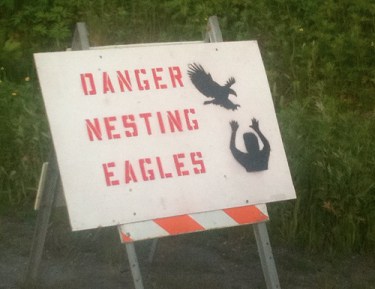
UNALASKA, AK — I took this photo yesterday on some winding road or another on the way to Summer Bay. This is a real sign, and it's one of several that warn Unalaska denizens of the threat posed by bald eagles. Sure, you think bald eagles are majestic. You don't see them more frequently than any other animal in your city, and you don't see them digging through trash and dumpsters. (Honestly, the image of a bald eagle dumpster-diving, feathers matted with waste, is un-erasable. It's like walking in on Uncle Sam as he's on the john.)

On the way out to the island, a few of my co-passengers laughed at my enthusiasm. "You can see all of Dutch Harbor in a day," said one guy making his semi-annual trip out here to work for Caterpillar. Indeed, you can. Thanks to a fire that took out a Chinese restaurant earlier this year, you can count the number of eateries on two hands. The airport has a bar, as does the hotel, as does a sports joint, and that's it, thanks to a "Footloose"-style crusade against drinking that occurred here last decade.

This isn't the place I'd pick for a moral crusade. Crime is so unheard of that it's common to leave your keys in your car, and it's not unheard of to leave your house unlocked. The only resistance I've met from an authority figure here was polite disapproval for bringing an empty soda into a museum. (I threw it out.) But this isn't some podunk town. Yesterday, I sat down to work in the same room as some kids recording a radio show for KUCB. As they edited songs on a Mac, one kid asked me what kind of iPad she had, because she'd just bought her own and was digging it. An hour later, inside that museum, a woman saw me using my ostentatious Steve Jobs word domination device and asked if wireless was working. Convinced that it was, she opened hers up. That's two expensive toys on an island with less than 4000 people, where the Internet is so slow that you can't watch Netflix and five-minute YouTubes can take 30 minutes to stream.

Not that constantly loading up a computer and trying to watch "The Girl With the Dragon Tattoo" is the best way of spending time here. The sun shone yesterday until close to 1 a.m., and the time before it set was well spent climbing up Bunker Hill, named for the many surviving bunkers built during World War II to gird for Japanese invasion and bombings. They're some of the sturdiest structures, still, in a place where the highest recorded winds have gone up to 200 mph — roof-tearing, house-collapsing nightmare weather.

Glenn Beck explains our coming race war

by Dave Weigel

I mentioned in my post about Megyn Kelly that Glenn Beck, too, had been running sensationalist stories about the basically irrelevant New Black Panthers. Here's some of his July 7 show on the Panthers to give you an idea of what I'm talking about. He's talking about the Reconstruction period and assaults on black voters from the Ku Klux Klan, comparing the military-garb-wearing NBPP to racists of the past.

Reconstruction. They aimed to intimidate Republican voters of both races. They sought to obstruct radical Republican policies. Please don't just hear the Republican and Democrat in this. Please.

They wanted to restore the rule by native whites. Now the most violent racial clash was the Colfax Riot. Dispute was over the 1872 election, ended with Louisiana having dual governments at all level of politics.

Former slaves feared Democrats would seize power. They tried to take over Colfax. A massacre ensued. Fifty African-Americans were murdered after they already surrendered.

This is a horrific period of our time and our history, but we should know it so we don't repeat it. In 1874, organized white paramilitary groups formed in the Deep South. They intimidated and even killed black voters. Again, listen to this. A paramilitary group. White paramilitary. What does that mean?

That means people who are not in the military, but are dressed up. They were the Knights of the White Camellia, the white league. And they were among the early, really violent hate groups. Awful. Awful people.

The right here is the surrender of the Louisiana State House to the white league. That's the trouble. Whites, many of them Democrats, joined these terrorist organizations when they began losing power to the radical Republicans, both white and black.

Let me show you a cartoon, OK? This is a political cartoon from "Harper's Weekly," October 1874. The artist is showing here – they're mocking the white league and the Klan for making conditions of freed slaves worse than slavery themselves.

Here is the KKK and here is the militant white league. Got it? Now, 100 years later, have we changed? Have we changed? This is what we were trying to stop.

Does Beck actually believe that the New Black Panthers — who have appeared, harmlessly and clownishly on Fox News for a decade — are on the verge of a violent, government-backed war against whites? I doubt it. But how many people hear this and believe him?

What A Kidney Is Worth, Ctd

by Patrick Appel

Bill Peckham, who is on dialysis himself, presents a criticism of organ markets I’ve not heard before:

By paying for kidneys you change the system that has developed for the acquisition/transplant of other organs and tissues.

If a kidney from a living donor is worth $20,000, what’s a postmortem kidney worth? How much for a postmortem liver? Postmortem donation of hearts, livers, lungs and all manner of other useful tissues rely on altruistic donation. If body parts become commodities what will it mean for all the people waiting for postmortem donations? I think the needs of people waiting for irreplaceable body parts (e.g. hearts, lungs, liver (mostly)) should be considered before the needs of those waiting for a kidney.