Email Of The Day

by Chris Bodenner

A reader writes:

For the first time I really believe she will run. If this isn't "getting your house in order," I don't know what is.  And contrary to Bristol's claims, I don't think anyone takes a breath in that family without clearing it with Sarah first. 

The announcement was clearly meant to ruin Andrew's vacation.

How Bias Bends Fact, Ctd

by Patrick Appel

Jonah Lehrer's two cents:

Unless we engage with those uncomfortable data points, those stats which suggest that George W. Bush wasn't all bad, or that Obama isn't such a leftist radical, then our beliefs will never improve. (It doesn't help, of course, that our news sources are increasingly segregated along ideological lines.) So here's my theorem: The value of a political pundit is directly correlated with his or her willingness to admit past error.

A Jobs Agenda for Republicans

by David Frum

I suggest some ideas in the Financial Times today

A vote to repeal healthcare would be symbolic only: even if repeal passed, which it would not, the president would veto it. Extending the Bush tax cuts would be helpful to long-term economic growth – but hardly constitutes an effective anti-recession measure. The Bush tax cuts have been in force since 2001 and 2003. The crash of October 2008 and the ensuing recession happened anyway. The medicine that did not prevent the disease is hardly likely to cure it.

Yet there are policy improvements that Republicans could deliver – and which would help lift the country out of the worst recession since 1945. The first is a payroll tax holiday. Mr Obama added $787bn to the national debt with a poorly designed “fiscal stimulus” that did little to create jobs. Now is the time for a Republican alternative. The US collects about $40bn a month from the payroll tax that funds Social Security and Medicare. A one-year holiday from such payments would put money in workers’ pockets and encourage employers to hire, at only a little more than half the cost of the Obama stimulus. The holiday would have been a great idea in January 2009. It still is now.

The Palin-Johnston Engagement

LeviAndBristol
by Patrick Appel

Well, this explains Levi's recent apology. Ben Smith has new piece on whether Palin will run for president. His reaction to the engagement:

It's evidence that she is running to the degree that she's cleaning up a messy family situation. It's evidence that she's not because, yet  again, her efforts to emerge as a serious person are drowned out her daughter's exclusive dish to USWeekly.

The Evolutionary Case For Monogamy?

by Patrick Appel

One of Christopher Ryan's readers asks:

My question is, could there be a natural selective pressure in post-agricultural societies to favor monogamy, such as if offspring raised by monogamous parents would be more likely to "succeed" (have higher fitness, or reproductive success) than those raised by single parents?

Ryan's answer:

What's the genetic correlate to "monogamy?" In other words, assuming there are no genes specifically devoted to making one more or less prone to long-term sexual monogamy, how would the very significant selective pressures you describe affect the genome?

I have to say up front that neither I nor my co-author are experts in genetics, so I may well be missing something, but while I see how monogamy could have been promoted by very strong familial, cultural, and economic pressures (see centuries of arranged marriage among the wealthy and powerful of Europe, for example), I don't see how that would be replicated at a genetic level…There may be some association with genes that affect novelty-seeking behavior perhaps, or overall libido, but I can't imagine it getting more specific than that.

In addition to the selective pressures Ryan's reader notes, what about disease?

In her book on HIV, Elizabeth Pisani argues that Western nations haven't seen the same sort of heterosexual HIV epidemics as some African nations partially because of differing sexual practices. Citizens of nations such as America are more likely to practice serial monogamy, i.e. one sex partner after another. HIV is most infectious in the early stages, so monogamy limits its spread and makes it more likely that those with HIV will become aware of their condition before passing the disease to multiple partners. According to Pisani, in several African nations individuals are much more likely to have several sexual partners at the same time and they are therefore more likely to both contract and spread HIV through these networks. It seems possible that as population density increased, which caused tremendous death and poverty, sexually transmitted diseases made monogamy evolutionarily advantageous, in some communities at least. The Sex At Dawn authors get half-way there on page 208:

While there were no doubt occasional outbreaks of infectious disease in prehistory, it's unlikely they spread far, even with high levels of sexual promiscuity. It would have been nearly impossible for pathogens to take hold in widely dispersed groups of foragers with infrequent contact between groups. The conditions necessary for devastating epidemics or pandemics didn't exist until the agricultural revolution.

Any other theories? Or problems with this one?

The Palin Model

by Patrick Appel

Drum believes that political candidates will shun the press in greater and greater numbers:

I'm putting my money on the Palin-ization of politics. Partly this is because the mainstream press is dying anyway, and partly it's because Palin and others are demonstrating that you really don't need conventional press coverage to win. In fact, as Rand Paul and Sharron Angle can testify, it's a real risk. Between YouTube and Twitter and Facebook and blogs and friendly talk radio hosts — as well as more conventional things like TV ads and database-driven phone outreach — who needs the New York Times? Increasingly, I'll bet the answer is, no one.

The Mark Levin-Conor Friedersdorf Show

by David Frum

Why does Mark Levin keep taking the bait?

Watching the exchanges between Conor Friedersdorf and Mark Levin is like watching a boy toss stones at a caged rhinoceros in the zoo. 

Plink, plink, plink: the first two, three, four stones bounce off the grazing brute’s leathery head. But at last the beast can endure it no longer. He charges at his tormenter – and crashes right into the zoo fencing. 

It happened again yesterday.

FrumForum blogger Alex Knepper cited Levin as a negative example in a critique of what Knepper called “talking point conservatism.” Conor quoted and linked to Knepper on the Atlantic site.

That afternoon, Levin erupted on his Facebook page against “malcontents,” “mental contortionists” and “pseudo-intellectuals” who did not sufficiently appreciate his book Liberty and Tyranny, a book he unironically describes as a “classic.”

Now the question again: Why? Why doesn't – why can't – Levin control himself? Surely he must recognize he would do better to preserve a dignified silence? As Levin will be the first to point out, his book sold many hundreds of thousands of copies. Maybe not so many as Jonathan Livingston Seagull, but still … a lot. Why not cash the checks and enjoy the proceeds? Why explode just because a handful of “malcontents” think your book is dumb?

It’s a fascinating question, and the answer does Levin some credit. Whatever you may think of his radio persona, Mark Levin is not a stupid person, and he is not a cynical person. He can’t laugh his way to the bank. He wants more than the money. He wants to be regarded as the author not just of a commercially successful book, but of an intellectually important book. Unfortunately for Levin, people like Conor have disproportionate sway over the accolades Levin covets. A Sean Hannity would not understand. A Glenn Beck would not care. But Levin does understand, and does care.

So he reacts. Unfortunately for him, Levin is not a very nimble debater. He's a monologuist. But when he tries to make a point in an environment where he does not monopolize the microphone, he is awkward and unsure. Shouting "Hey Friedersdork – you're a jerk" does not wound Conor's feelings. It does not impress the audience Levin so desperately wants to impress. 

Yet Levin cannot help himself. It’s all too provoking! Levin tells his critics they are “eviscerated.” But they don’t look or act eviscerated. Levin insists that his book is “sophisticated.” But he notices that the people who read the books generally regarded as sophisticated do not agree with his self-assessment. And so he paws the ground, lowers his tusk – and charges, thud, against a blank wall. 

The bellowing stops. The dust settles. The stunned rhinoceros regains its footing. And then the sound resumes: plink, plink, plink. 

The Evolutionary Case Against Monogamy, Ctd

by Chris Bodenner

Dan Savage insists that personal accounts like this one (from a Dish reader) distort the debate:

[A]s you read the sad stories about failed open relationships that are being offered in (over)reaction to Sex at Dawn—the authors don't actually advocate open relationships—please bear in mind that the voices of happy, content, and successful non-monogamous couples are almost entirely absent from this debate. … While the successfully non-monogamous keep their mouths screwed shut—the tribute a presumed vice is bullied into paying an overblown virtue—survivors of failed non-monogamous relationships 1. never shut up and 2. see their stories highlighted by moralizers as proof that non-monogamous relationships never work out.

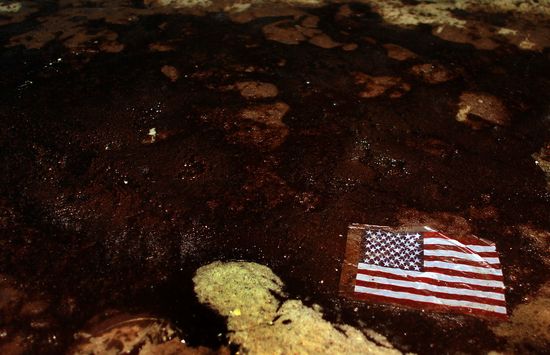
Is BP Uniquely Bad?

FlagJoeRaedleGetty
by Patrick Appel

Bradford Plumer weighs the evidence:

The company has a long record of safety violations—in 2005, an aging BP plant in Texas exploded, killing 15 people, and an after-action report blamed "organizational and safety deficiencies at all levels of BP." Then came a large leak that poured 267,000 gallons of oil into Prudhoe Bay, Alaska in 2006, thanks to poorly maintained pipes. And just this year, federal inspectors have found 62 safety violations at BP's Ohio refinery. Yet BP never underwent the same cultural shift that ExxonMobil underwent.

Fallows compares BP to Shell here, here, and here.

(Image: An American flag lays in a slick of oil that washed ashore from the Deepwater Horizon oil spill in the Gulf of Mexico on July 4, 2010 in Gulf Shores, Alabama. By Joe Raedle/Getty Images)