Family Guy could win an Emmy for the song, "Down's Syndrome Girl."
Author: Andrew Sullivan
Industry Standards vs BP Standards
An infographic that devastates the outrageously reckless British multinational.
That Double Rainbow Dude: New Internet Superstar
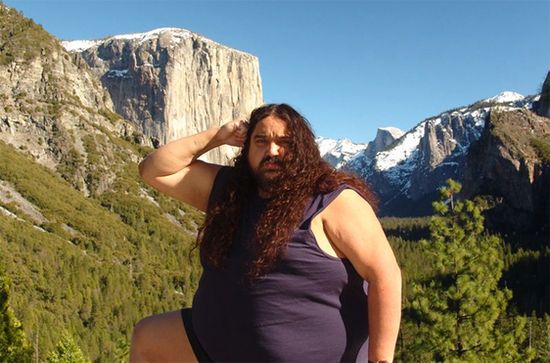
The autotuned version is awesome. And the dude is already attracting imitators and mashups. Austin Carr nabs an interview with the "professional cagefighter-turned-nature-love." Gabe pulls several money quotes, including:
When I asked what he would do with his newfound popularity or influence, [Paul] Vasquez [aka "Yosemitebear Mountain Giant"] wasn’t certain: “I’ve been thinking about this a lot. Last night I went to an Indian sweat and I prayed really hard about this. When I shot the video, I was not high at all, I was not having sex, and I was not hiking, as a lot of people assume. This is my land that I bought in 1988. Wait, what was the question?”
The Conservatism Of Same Sex Marriage (Once More With Feeling)
John Culhane sinks his teeth into the DOMA ruling:
The one new justification that the government raised was protection of the status quo. The court demolished — I mean, demolished — this argument, noting that the “status quo” had been for the feds to recognize states’ definitions of marriage, so that DOMA radically changed that status. And the practice of recognizing, and deferring to, local law on marriage, had been unaltered throughout our history, even in especially contentious cases such as interracial marriage. That practice, in turn, was grounded in the long-standing recognition that marriage and family law is one of the most fundamentally state law issues of all.
And Joe Carter wonders why my case for marriage equality has always been a conservative one.
That case is as follows: it is conservative not to eject people from the fabric and tradition of their own families; it is conservative to support emotional and financial stability which the daily discipline of marriage fosters; it is conservative not to balkanize citizens into groups based on identity; it is conservative to discourage gay men and women from marrying straight men and women on false pretenses and then ending up in divorce; it is conservative to include everyone into the social institutions that stabilize society; it is conservative to promote mutual responsibility and care-giving to avoid too much dependence on government; it is conservative not to trample states rights and amend the federal constitution when such things are grotesquely unnecessary; it is conservative to adjust to social change by adapting existing institutions, like civil marriage, than inventing totally new and untested ones, like civil unions.
But Carter isn't listening. He's a Christianist, not a conservative. For him, doctrine is what matters. For Burke, unyielding doctrine in politics was the problem.
Manners And Opinion Journalism
Mom and Dad are fighting (a little). In one corner of the living room, we have Jim Fallows, whose combined facility for penetrating analysis and scrupulous journalistic manners has always left me slack-jawed. In the other, we have Mike Kinsley, who parented me into journalism (although I hasten to add bears no responsibility for my subsequent provocations) and is the funniest, rudest columnist I know. Fallows' rule of journalistic etiquette is as follows:
Write as if you might run into the person afterwards. And when you run into people, be comfortable owning up to what you've said and where you disagree.
Oh God. Do I really have to be that nice to Bill Kristol? What happens if I bump into John Yoo? Kinsley mercifully comes to my rescue:
Write about what you think is important. Write the truth. And if you see someone coming you’d just as soon not run into, feel free to run away instead.
I do, I do. Kinsmo hedges this a little today, saying he meant no implicit criticism of Fallows' uber-mensch standard and hazards that there might be some journalistic advantage to knowing the powerful. (I have to say that if refusing to write a bad review of a book is integral to not being a "bully-coward", then count me out. I much prefer reading negative reviews to positive ones, and I've written plenty of both.)
My own general view has, over the years, become I.F. Stone's: just make sure you never run into the people you cover or have much to do with them socially. I am one of the more feral Washingtonians, allergic to parties, incapable of schmoozing (without total nervous exhaustion afterwards), bored by acquaintances, and addicted to my real friends, who have nothing whatever to do with what I do for a living. I know this makes me seem terribly rude and/or arrogant by the Village's standards. But it seems to me more important to remain in good graces with my readers than with the objects of my criticism. I really would rather hang with my beagles than with the president.
And so, I am not in Aspen this week – which is better for Aspen as well as for me. And at those secret media elite dinner parties, my role as the turd in the punchbowl is now almost a tradition. And yes, I did attend one with Karl Rove. And no, it wasn't pretty. There are some low-lifes to whom it is almost an ethical requirement to be rude.
DOMA Reax
You can read the rulings here. Jack Balkin thinks they will be overturned:
I am a strong supporter of same sex marriage. Nevertheless, I predict that both of these opinions will be overturned on appeal. Whether one likes it or not– and I do not– Judge Tauro is way ahead of the national consensus on the the equal protection issue. I personally think that discrimination against gays and lesbians is irrational, but a federal district court judge– who must obey existing precedents, and who is overseen by a federal judiciary and a Supreme Court constituted as they currently are–is in a very different position than I am.
Perhaps more importantly, his Tenth Amendment arguments prove entirely too much. As much as liberals might applaud the result, they should be aware that the logic of his arguments, taken seriously, would undermine the constitutionality of wide swaths of federal regulatory programs and seriously constrict federal regulatory power.
David Kopel agrees:
Balkin is right to point out that the new federal health control law could be found unconstitutional by any court which applies the Tenth Amendment as seriously as did Judge Tauro.
On the whole, I don’t think Gill is one of the stronger judicial opinions supporting SSM. Its reasoning is too cursory. It doesn’t rely on the more obvious and to me more defensible argument: that discrimination against gays and lesbians is constitutionally suspect, deserving strict scrutiny. And unless reversed by the First Circuit, Gill could turn out to be a short-lived and expensive victory for SSM when it reaches the Supreme Court (assuming the Prop 8 case doesn’t get there first).
Balkin writes that the ruling is "way ahead of the national consensus on the the equal protection issue." Probably. As Gabriel Arana reported, that's certainly a concern moving forward with Perry v. Schwarzenegger. But the window of time during which Democrats equivocate by supporting civil unions instead of marriage equality is coming to a close — at some point soon those politicians sitting on the fence are going to have to pick a definitive side and risk the political consequences of either alienating the LGBT vote or their other, more religious core constituencies. That may happen before there's a genuine "national consensus" in favor of marriage equality.
A key question is whether the Obama administration will appeal the ruling, and, as Jake Tapper reports, they probably will.
The effect of the decisions will probably be put on hold during the course of the appeal.
The decisions only affect sections 2 and 3 of DOMA — the federal benefits part. It does not require interstate recognition of marriage equality. People married in Massachusetts will still get no respect in Florida.
The decisions also only affect people in Massachusetts, though that could expand on appeal. The decisions are probably not retroactive, so that people who paid extra taxes or were denied federal benefits based on DOMA will probably not be able to get their money back.
I think this decision puts the folks who have been saying “let the states decide,” while really opposing marriage equality, in an interesting position. The ruling says that the Federal government has to respect state decisions on this — even if a state decides to recognize same-sex marriages. Now most of those folks will have to come up with some rationalization to explain why when they said they wanted the states to decide, they didn’t mean that they wanted the states to decide.
Taken together, it seems clear that Tauro finds that a distinction based on marriage is permissible. But one that is based on sexual orientation is not. This would seem to suggest that because states can determine marriage laws (Commonwealth), it can either allow or refuse same-sex marriage (until otherwise restricted). So those legally married same-sex couples in Massachusetts, Iowa, Connecticut, Vermont, New Hampshire, Washington DC, New York and Maryland and some 18,000 couples in California would be married in the eyes of the federal government while those in civil unions or domestic partnerships would not.
I have now read Hadley Arkes' response. I'd like to quote it, but it doesn't seem to grapple with the issues at all. It relies on definitional arguments about "marriage" – arguments that have actually already been resolved in Massachusetts and upheld by its legislature, governor and Supreme Judicial Court. And there is no discussion as to why a state should be prevented by the federal government from providing full equality to its citizens, without violating core principles of federalism. Arkes seems to imply that because the federal courts struck down miscegenation bans, the federal government can enforce – against state law – inequality for gay citizens and non-citizens. Maybe you can understand his case better.
It seems to me that, however this plays out in the courts, the reasoning in these cases, and the principles they inject into the discourse, are helpful. It does seem to me bizarre that I am married in both my places of residence – DC and Massachusetts – and my marriage license is identical to every other straight couple's. But the federal government – in a way unique in its entire history – refuses to acknowledge these clear state licenses solely on the basis of the fact that I'm gay.
The federal government is both refusing to recognize what it always recognized, and creating a two-tier system where gay couples are officially designated as worth less under the law than straight ones. And this is the position of the Obama administration. And they say they are pro-gay. They aren't. They like us kept very firmly in our place. And they will now argue in the courts that second class citizenship for two percent of the population is a principle they embrace and will continue to advance – even when the states have decided otherwise.
That's their prerogative. But they're full of it. Their position on marriage is about as coherent as their position on Afghanistan.
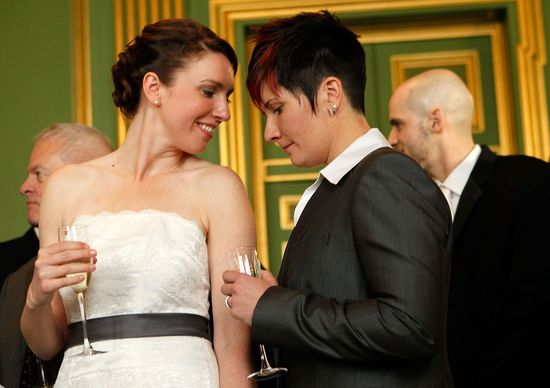
(Photo: Same-sex couple Alexandra Khalaf (R) and Amy Sokal share a monent after they exchanged vows during a group wedding March 20, 2010 at the Andrew W. Mellon Auditorium in Washington, DC. Ten same-sex couples participated in the mass wedding after the nation's capital became the sixth place in the nation that recognized same-sex marriage. By Alex Wong/Getty Images.)
The Evolutionary Case Against Monogamy, Ctd
A reader writes:
As someone who's lived in an open marriage for the last 8 years but have never had sex with anyone else but my wife since we met, I thought our experience might shed light on the actual experience.
I was 38 when we married. I'd been married before and saw that marriage implode over one issue: Trust. (Which had nothing to do with infidelity. There was none).
When we got together we agreed that this, more than any other thing, would destroy the marriage. So we talked about trust and talked about our sex lives and our proclivities and came to the conclusion that yes, we might well be tempted to sleep with someone else. After all, we're only human.
So we established some simple rules.
If either one of us feels we just have to sleep with someone else, we can. But we have to tell the other spouse. And we have to tell the person in question that we are married and plan to stay that way. AND, (this is the big part) either of us gets veto power with no questions asked. If I want to sleep with someone my wife despises, she can say no and vice versa.
Eight years and neither one of us has been with anyone else. But it's taken a strain off the relationship that I think most people never even know they experience until they don't have to. I don't want to sleep with anyone else. I want to sleep with my wife. But if some pretty girl wants to, and I'm so inclined, it's awfully nice to know that I can. I just don't get to lie about it.
It's a great way to live and it's a great way to be married. I adore my wife. I cannot imagine what it would be like to live without her. If her having a brief fling with some guy is going to be that important to her, I'm willing to swallow my ego and let her do her thing. Because, after all, insisting on monogamy even when it makes your spouse unhappy or even at the cost of dishonesty (the REAL killer of marriages) isn't really love at all. It's possession.
The Unstoppable Sarah Palin
Chris Matthews sees Palin inflicting an "early knockout" in the primaries. Larison, still betting against her, argues that the GOP establishment will quash her candidacy:
Palin and Mondale are alike in that they represent the face of the party as it was when it was defeated, but they are quite different in their sources of support. Mondale was the candidate of the party establishment and important interest groups, and Palin has made a point of aligning herself with every possible anti-establishment, insurgent campaign she can find.
Contra Kornacki, Bernstein finds the comparison off:
Yes, Mondale got clobbered — but he was clobbered by a popular incumbent president boosted by a strong economy. Under those circumstances, it didn't really matter who the Dems ran; when the electorate is happy with the incumbent, there's not very much the out-party can do about it.
Kornacki responds. Ken Silverstein wagers that she doesn't even have a shot at the vice presidency. Of all these, I trust John Ellis' judgment the most. Yes, he's Bush's cousin, but his insights are always worth reading. I think he's dead on here:
As the Republican avalanche of 2010 builds — and I saw a poll the other day of a Democratic-leaning state Senate district on Long Island where the "right track" (8%)/"wrong direction" (83%) was unlike anything I had ever seen — Palin has smartly positioned herself as the champion of the conservative counter-revolution. By December, she will almost certainly be the de facto front-runner for the GOP presidential nomination.
By the time the Establishment GOP wakes up to this reality, it may be too late for them to do anything about it. Their view of Palin is that she's useful to the party because she can help keep "the Tea Party types inside the tent." And maybe she can serve coffee while she's at it. Palin's view is that (1) "the Tea Party types" are the party, (2) she is their standard bearer and (3) anyone who thinks "the Tea Party types" are there to lick envelopes and knock on doors should think again. They're there, she asserts, to take back their party and to take back their country.
"She's too stupid" is what the Establishment GOP really thinks about Sarah Palin. "Good-looking," but a "ditz." This is unfertile ground, since Palin can turn the argument on a dime and say: "They drive the country into bankruptcy, they underwrite Fannie and Freddie, they bail out Goldman Sachs, they fight wars they don't want to win, they say enforcing the immigration laws is silly and they call me stupid! I'll give you a choice: you can have their smarts or my stupidity, which one do you want?" A large number of GOP presidential primary voters will take Palin's "stupidity" in a heartbeat.
Know fear.
Freezing Yourself
Kerry Howley brushes up on cryonics, i.e. low-temp preservation of individuals for future reanimation. Robin Hanson, among those profiled in the piece, explains his enthusiasm for the practice:
I’m pro cryonics not because I’m pro all-med-no-matter-what, but because its cost benefit seems favorable – a >5% chance of decades more life for a few tens of thousands of dollars. And this isn’t at all about immortality, the odds of which are far lower, but mainly about more decades of healthy interesting life.
6 Things From History Everyone Pictures Incorrectly
Velociraptors had feathers?
 The Dish