Chart Of The Day

Dunning_kruger

Tal Yarkoni takes another look at the Dunning-Kruger effect:

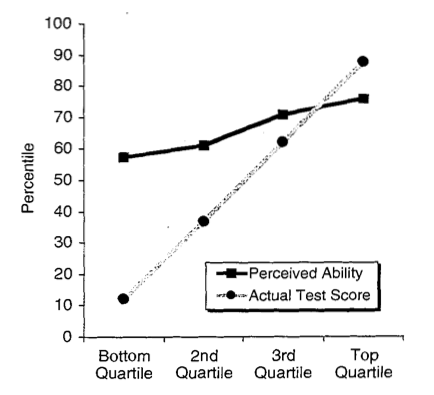
This is one of the key figures from Kruger and Dunning’s 1999 paper (and the basic effect has been replicated many times since). The critical point to note is that there’s a clear positive correlation between actual performance (gray line) and perceived performance (black line): the people in the top quartile for actual performance think they perform better than the people in the second quartile, who in turn think they perform better than the people in the third quartile, and so on. So the bias is definitively not that incompetent people think they’re better than competent people. Rather, it’s that incompetent people think they’re much better than they actually are. But they typically still don’t think they’re quite as good as people who, you know, actually are good. (It’s important to note that Dunning and Kruger never claimed to show that the unskilled think they’re better than the skilled; that’s just the way the finding is often interpreted by others.)

(Hat tip: Tyler Cowen)
The Real Afghanistan Debate?

Exum sketches it:

Despite all the anger and emotion in current debates over U.S. and allied Afghanistan strategy, few are arguing for a complete and rapid withdrawal. Michael Cohen, one of the current strategy's critics, linked to several alternate strategies for Afghanistan on his blog the other day, and none argue for a complete withdrawal. The real debate, in other words, revolves around how quickly we can transition to a lighter footprint.

Taxing The Sugary Stuff? Ctd

Drum isn't convinced by this study:

Even assuming that all the assumptions in the report are correct, all it does is show that our net calorie intake from beverages would, on average, go down. But if you switch to diet soda, it's pretty likely that you'll just make up the calories somewhere else. In fact, if this study is correct, it's possible that you might increase your total calorie intake.

The Daily Wrap

Today on the Dish, the Iranian government was set to stone a woman to death, the Uganda beheading turned out to be a hoax, the Hawaiian governor vetoed civil unions, the Louisiana governor called for guns in churches, and raising the retirement age looked more likely. Andrew and Beinart felt that the president further caved to the Israeli prime minister, Andrew confronted Chait over the gulf between Congress and the American public on Israel, and the US inroads into Arab PR continued to falter.

In Palinland, Andrew scratched his head over Levi's sudden about-face, Chris Good explained why it matters, Mercede couldn't understand why her brother would turn on her, and a reader figured it was all part of a custody battle. Hasidic women were crazy for Palin's hairdo, Steve Kornacki took a turn at her chances in '12, readers added on, and Dana McCourt was sick of all the Trig talk.

Andrew circled back to the NYT's application of "torture," called out the AP for the same, examined the evolution of public perception on torture, and mounted a defense of AC. Bernstein and Wheeler jumped on the public perception thread while TNC piled on the NYT.  Ambers and Kaplan savaged Romney on his foreign policy and others joined in. Wehner had some wise words on the Steele debacle, Adam Serwer pointed out that more deportations are occurring under Obama than Bush, Frum questioned social mobility, Terry Tamminen proposed taxing carbon on a state-by-state basis, and Robert Wright saw humans as a global superorganism.

A particularly foul Hewitt Award here. Yglesias here. Mad Men fodder here. MHB here, VFYW here, and FOTD here. The latest winner of the window contest here.

— C.B.

Life As A Cell

Robert Wright feels that "technology is weaving humans into electronic webs that resemble big brains." He doesn't think it "outlandish to talk about us being, increasingly, neurons in a giant superorganism":

I do think we ultimately have to embrace a superorganism of some kind — not because it’s inevitable, but because the alternative is worse. If technological progress grinds to a halt, it will be because chaos has engulfed the world; and if we don’t use technology to weave people together and turn our species into a fairly unified body, chaos will probably engulf the world — because technology offers so much destructive power that a sharply divided human species can’t flourish.

If you accept that premise, then the questions are: What sort of human existence is implied by the ongoing construction of a social brain; and, within the constraints of that brain, how much room is there to choose our fate?

Are Kids Doing Better Than Their Parents?

Earningsadjusted19792009

Catherine Rampell finds a chart:

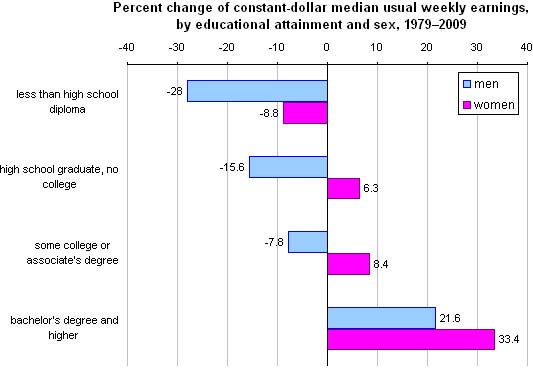
As you can see, most men today earn less than equally educated men in 1979, with the exception of the most highly educated.  The opposite is true for women: Most women today earn more than their equally educated counterparts from 1979, with the exception of the least educated.

Joyner calls this chart evidence that earnings have plummeted over the last 30 years:

In 1979, most married women stayed at home with the kids or simply tended house; that almost immediately changed.   And, while being a high-school dropout wasn’t exactly a road to riches even then, there were still entry level jobs that would take you and allow you to work yourself up if you were good enough.

Derek Thompson adds:

The upshot is that even as the cost of college comes under scrutiny, the evidence continues to suggests that four expensive years is the price our generation has to pay if we expect to earn more than our parents.

Not From The Onion, Ctd

Max Fisher puts Iran's new hairstyle guidelines in perspective:

Demographically, Iran should be a democracy. It has high literacy and education rates, a large and vibrant middle class, independent labor and business communities, and a strong tradition of political organizing and involvement. The regime retains authoritarian rule in large part because it firmly controls so much of Iranians' public lives. The regime typically increases these controls in times of social unrest. The baseej, an informal citizen militia loosely tied to the state, can closely monitor their neighbors and brutally enforce state restrictions. Many Iranians become so consumed with navigating these complicated laws that public spaces become places of fear and self-censorship. Because phone taps are common and because your neighbor might be a baseej who closely monitors whoever enters your home, even private spaces are suffocated by state control. Regulating hair styles may not seem like it would be very effective, but this move is part of a sweeping, pervasive strategy to engineer individual freedom out of every imaginable aspect of public life.

How Dumb Is Mitt Romney? Ctd

Max Bergmann sees what Mitt is up to:

From a political perspective Romney is severely compromised with the Republican base for his past liberal positions on domestic and social policy issues (pro-choice, health care reform, etc). But one area where he is a blank slate is on foreign policy. And Romney has made a concerted effort to fully embrace the Heritage Foundation's national security positions.

Crowley agrees:

As a former business executive, Romney has shown little past interest in arms negotiations. But that's true of nearly all the most-often discussed 2012 Republican presidential possibles: Sarah Palin, Mitch Daniels, Mike Huckabee, Haley Barbour, John Thune and Tim Pawlenty. (To be fair, Palin does talk about national security; but no one would call her an expert.) Hence Romney's piece feels like an effort to play national security wonk and elevate himself above a field of domestically-oriented figures.