The Future Of The Family

From Reihan's nuanced take

Family forms have always been diverse, Ozzie-and-Harriet was always an imperfect portrait of family life for many if not most Americans. Yet the fact that the balance is shifting even further away from two-parent households is going to stretch public resources to the limit.

E.D. Kain is more upbeat.

Sobering Up

Brendan Koerner profiles AA:

As dependence grows, alcoholics also lose the ability to properly regulate their behavior. This regulation is the responsibility of the prefrontal cortex, which is charged with keeping the rest of the brain apprised of the consequences of harmful actions. But mind-altering substances slowly rob the cortex of so-called synaptic plasticity, which makes it harder for neurons to communicate with one another. When this happens, alcoholics become less likely to stop drinking, since their prefrontal cortex cannot effectively warn of the dangers of bad habits. This is why even though some people may be fully cognizant of the problems that result from drinking, they don't do anything to avoid them.

Jonah Lehrer takes a second look at the neurological mechanisms at play.

Marijuana Prohibition And “Racism Without Racists”

POTSLIDEAlfredoEstrella:AFP:Getty The NAACP endorsed California’s marijuana legalization bill last week. A report on marijuana arrests among minorities explains their rationale:

Young blacks and Latinos use marijuana at lower rates than young whites. So why are police in California arresting young blacks and Latinos at higher rates than young whites, and at greater numbers than their percentages of the population? Based on our studies of policing in New York and other cities, we do not think the arrests are mostly a result of personal bias or racism on the part of individual patrol officers and their immediate supervisors. Rather, this is a system-wide phenomenon, occurring in every county and nearly every police department in California and elsewhere. Police departments deploy most patrol and narcotics police to certain neighborhoods, usually designated “high crime.” These are disproportionately low-income, and disproportionately African-American and Latino neighborhoods.

It is in these neighborhoods where the police make most patrols, and where they stop and search the most vehicles and individuals, looking for “contraband” of any type in order to make an arrest. The item that young people in any neighborhood are most likely to possess, which can get them arrested, is a small amount of marijuana. In short, the arrests are racially biased mainly because the police are systematically “fishing” for arrests in only some neighborhoods, and methodically searching only some “fish.” This produces what has been termed “racism without racists.”

Scott Morgan opines:

Our marijuana laws have never, and will never, be enforced fairly. The brutality of modern drug enforcement reaches every community, but if young white men were given criminal records and subjected to profiling and police harassment at the same rates as people of color, the criminal justice system would quickly come to a crashing halt. The drug war was built on a foundation of fundamental unfairness, and mitigating its catastrophic impact on communities of color requires measures far more drastic than telling police for the millionth time that there’s more to their job than searching young black men all day and night.

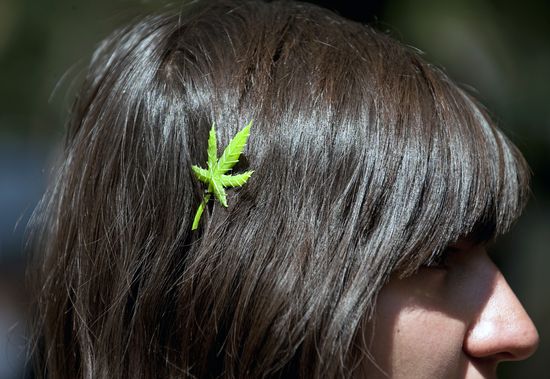
(Photo: A woman wears a Marijuana hair slide during a rally in support of the International Day for the Liberation of Marijuana, in Mexico City, on May 8, 2010. By Alfredo Estrella/AFP/Getty Images.)

Should We Pray For Hitch? Ctd

A Professor of Cancer Biology writes:

I would say that it's OK to pray for Hitch as long as you don't tell him. To tell him you are praying would be malicious. The STEP trial established that intercessionary prayer per se was ineffective either positively or negatively as long as the patients don't know about it. However, patients who know that they are being prayed for do measurably worse than the unprayed or ignorant of prayer.

Why Do Middle-Age Men Cheat?

Christopher Ryan and Cacilda Jethá continue to plug their book on the evolution of human sexuality. On infidelity:

With the caveat that every situation is different, one factor we think deserves more attention is the role of testosterone (T) in middle-aged men’s eroticism. In their twenties, men’s T levels begin a long decline, often experienced as diminished passion and appetite for life. Suppressed T levels are associated with depression, heart attacks, dementia, and overall mortality rates from 88 to 250 percent higher. One of the few things that can reliably and immediately revive a man’s sagging testosterone is exposure to a new woman. One researcher found that even a brief chat with an attractive woman raised men’s testosterone levels by fourteen percent within minutes. In Sex at Dawn, we suggest that many men may be confusing the hormonal changes triggered by an affair with actual “love,” thus leading them to make ill-advised decisions catastrophic to their families, their marriages, and eventually themselves.

Why People Fall For Horoscopes

It's biologically ingrained:

The tendency to believe vague statements designed to appeal to just about anyone is called the Forer Effect, and psychologists point to this phenomenon to explain why people fall for pseudoscience like biorhythms, iridology and phrenology or mysticism like astrology, numerology and tarot cards.

The Forer Effect is part of larger phenomenon psychologists refer to as subjective validation, which is a fancy way of saying you are far more vulnerable to suggestion when the subject of the conversation is you.

A Poem For Sunday

HOMELESSSpencerPlatt:Getty

 If Homelessness Were Genetic

by Sean Spence.

If homelessness were genetic,
Institutes would be constructed
With tall white walls,
And ‘driven’ people (with thick glasses)
Would congregate
In libraries

And mumble.

If homelessness were genetic
Bright young things
Would draft manifestos
‘To crack the problem’,

Girls with braces on their teeth
Would stoop to kiss
Boys with dandruff
At Unit discos

While dancing (slowly)
To ‘Careless Whisper’.

Meanwhile, upstairs, in the offices
Secretaries in long white coats
And horn-rimmed spectacles,
Carrying clipboards,
Would cross their legs
And take dictation:

  ‘Miss Brown, a memo please,
  To the eminent Professor Levchenko,
  “Many thanks indeed
  For all those sachets you sent to me,
  Of homeless toddlers’ teeth.”’

If homelessness were genetic
Rats from broken homes
Would sleep in cardboard shoeboxes
Evading violent fathers,
Who broke their bones,
While small white mice
With cocaine habits
Would huddle in fear,
Sleeping in doorways,
Receiving calibrated kicks from gangs of passers-by

(A ‘geneenvironment interaction’).

If homelessness were genetic
Then the limping man, with swollen feet,
A fever,
And the voices crying out within his brain
Would not traipse
Between surgery and casualty
Being turned away
For being roofless

Because, of course,
Homelessness would be genetic

And, therefore,
‘Interesting’.
(Photo: Spencer Platt/Getty.)