Chart Of The Day

Recession2

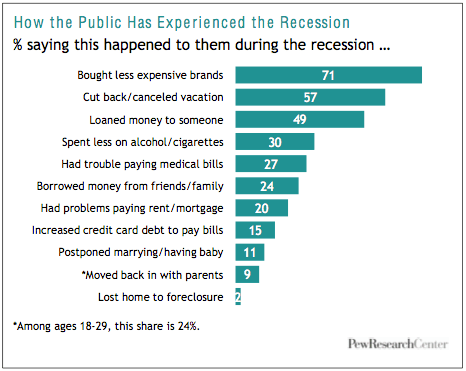
Pew has a new report on the recession:

The work-related impact of this recession extends far beyond the 9.7% who are unemployed or the 16.6% who (according to the U.S. Bureau of Labor Statistics) are either out of work or underemployed. The Pew Research survey finds that about a third (32%) of adults in the labor force have been unemployed for a period of time during the recession. And when asked about a broader range of work-related impacts, 55% of adults in the labor force say that during the recession they have suffered a spell of unemployment, a cut in pay, a reduction in hours or an involuntary spell in a part-time job.

William Galston is somber:

As recently as 2002, 61 percent thought their children’s standard of living would be better than their own; only 10 percent thought it would be worse. Today, the optimists’ share has declined to 45 percent, while pessimists now constitute fully 26 percent of the population. And doubt tends to reinforce caution. We don’t have enough evidence to conclude that the Great Recession will generate the kind of long-lasting risk aversion that characterized the Depression-era generation throughout their lives. But we do have reason to believe that for some time to come, what Keynes famously called “animal spirits” will remain subdued, which suggests that we’re in for a slow recovery and historically high levels of unemployment for much of this decade. If the Pew report is on target, the “new normal” will be more than a slogan.  

Stuck In Traffic

Richard Florida spends some time in the car:

Commuting costs America an estimated $90 billion dollars per year in terms of lost productivity and wasted energy, according to the annual Urban Mobility Report. Our own detailed calculations by Martin Prosperity Institute (MPI) research director Kevin Stolarick find that every minute shaved off America's commuting time is worth an estimated $19.5 billion dollars.  That translates into $97.7 billion for five minutes, $195 billion for 10 minutes, and $292 billion for every 15 minutes saved nationally.

The Legacy Media And Torture, Ctd

Sargent's two cents:

We all agree that pickpocketing constitutes "theft." A pickpocket doesn't get to come along and argue: "No, what I did isn't theft, it's merely pickpocketing, and therefore it isn't illegal." Any newspaper that played along with a pickpocket's demand to stop using the word "theft" would be taking the pickpocket's side, not occupying any middle ground. There is no middle ground here.

High And Low Roads

Jim Henley travels them:

I don’t presently care to argue that there is never any “need” to go down any given low road. In some cases I may support some low roads for some purposes. Locking up murderers, for instance. In other cases – torture – I have a much easier time saying “Never go there.” But what we see over and over again is that we judge high-road approaches as failures unless they produce nigh-instant and complete favorable results, while we show nearly infinite patience for journeys down the low road.

The Daily Wrap

102551760

Today on the Dish, Garrett Epps relayed Kagan's response to marriage equality, Adam Serwer picked up on her philosophy, and Bernstein wasn't so sure. Andrew asked if the Israeli-Palestinian relationship was apartheid and aimed both barrels at the NYT over torture. Greenwald piled on.

Sharron Angle finally talked to the media – about church-state separation – while a Tumblr transposed her and other Christianists' words with Christ. Palin-Johnston spat here. More Trig discussion here and here. More Palin here. Andrew returned fire to Breitbart and shared his thoughts Hitch's diagnosis

Frum grasped for an approach to a double-dip recession, Leonhardt stayed positive on the bad job numbers, and Rory Stewart remained gloomy over Afghanistan. Drum wanted to nudge Social Security into solvency, Free Exchange was afraid of soaking the rich, Allahpundit predicted Obama's cooperation with Republicans, and a reader dissented over Andrew's support of lifting the cap. Alan Simpson pointed out Reagan's multiple tax hikes.

Mark Liberman took down the "Obama is first female POTUS" meme and a reader helped. Dan Zak glimpsed at the end of gay history and Alyssa Rosenberg looked forward the new Jersey Shore. Readers added to the thread on in utero gay therapy and another defended porn. Malkin Awards here and here. More dog love here. Tumblr fun here and a dose of Simpsons here. MHB here, VFYW here, and FOTD here.

— C.B.

(Photo: U.S. Supreme Court nominee Elena Kagan listens to a question from members of the Senate Judiciary Committee on the third day of her confirmation hearings on Capitol Hill June 30, 2010 in Washington, DC. By Brendan Smialowski/Getty Images.)

Why Does Trig Matter? Ctd

A reader writes:

Why does he matter?  Because despite all the sentimentality and the cozying up to parents of children with developmental disabilities, Sarah Palin doesn't stand for the policies that will help those families. I am the widowed mother of a nineteen-year-old daughter with Down syndrome. In another six months she'll be eligible for Medicare via SSDI. But ten years ago, when my husband became disabled and stopped working, hanging on to our group health coverage was critical, because we could not have bought health insurance for her on the private market.

We are fortunate; it worked out. But parents of kids with disabilities are not able to change jobs or start businesses or make any life decisions without considering how this will affect their family's ability to purchase medical insurance. The health reform legislation that Palin criticizes will solve that. Most families with kids with disabilities can't afford to put big bucks into HSAs. In truth, Palin's wealth isolates her from the problems of ordinary families of disabled kids.

When she was first nominated for VP, friends in the Down syndrome parent community started forwarding me all glowing articles about Trig, and Palin's commitment to special needs children because she'd been there. He's now three years old, and she is only beginning to walk the walk.

Not As Powerful As We Pretend

Rory Stewart continues to believe that the Afghanistan war is doomed:

The only way in which we could move beyond the counter-insurgency theory, or the hundred other theories which buttress and justify the Afghan war, is by rejecting their most basic underlying premises and objectives. Instead of trying to produce an alternative theory (on how to defeat the Taliban, create an effective, legitimate and stable Afghan state, stabilize Pakistan and ensure that al-Qaida could never again threaten the United States) we need to understand that however desirable such things might be, they are not things that we — as foreigners — can do.

The Bad Jobs Numbers

Leonhardt clutches to shards of hope:

It’s worth keeping something in mind: The official government statistics are probably understating job growth right now. That tends to be the pattern after recessions end. As the economy is starting to add jobs again, the Bureau of Labor Statistics understates job growth. And the opposite happens during recessions: That’s when the government understates job losses.