Poems Are Not Selfies

Daniel Johnson traveled to Oxford to profile Geoffrey Hill, the university’s Professor of Poetry, describing him as a man born out of time:

By the time Hill came on the scene … the landscape had been transformed: the line between poetry and prose had been blurred, the laws of prosody had been suspended and poets were marginalised by or subsumed into other art forms, such as popular music. Poems too became primarily vehicles of self-expression. Like everybody else, poets had to compete for attention and celebrity. As schools no longer taught their pupils poetry by heart, the handful of verses that retained public affection acquired the status of secular icons. New poetry seldom achieves such recognition, for the very good reason that is rarely memorised or indeed memorable. Poets instead strove to reinvent their functions: as performance art for highbrows, icing on the secular wedding cake, or therapy for the deserted, the desolated and the dumped.

Against this, Hill champions a poetry of ideas:

“It is public knowledge that the newest generation of poets is encouraged to think of poems as Facebook or Twitter texts — or now, I suppose, much more recently, as selfies.” The mention of such an improbable neologism from such a source elicited an embarrassed titter from the audience, as if Hill had caught his academic peers indulging a secret vice.

“The poem as selfie is the aesthetic criterion of contemporary verse,” he continued. “And, as you know, in my malign way I want to put myself in opposition to this view. That is to say, the poem should not be a spasmodic issue from the adolescent or even the octogenarian psyche, requiring no further form or validation.” Hill came back to the theme in his vindication of [Gerard Manley] Hopkins, whose sonnets did not, he expostulated, deserve the condescension of posterity: “I do not think that they are Hopkins’s selfies.”

The underlying reason for Hill’s rejection of poetry as pure self-expression is that he sees such narcissism as beneath the dignity of his calling. He preaches, rather, what he has practised ever since his youth: a poetry of ideas. It is this determination to place ideas at the heart of his work that sets him apart from even his most celebrated contemporaries.

In a Paris Review interview over a decade ago, Hill defended “difficult” art in similar terms:

We are difficult. Human beings are difficult. We’re difficult to ourselves, we’re difficult to each other. And we are mysteries to ourselves, we are mysteries to each other. One encounters in any ordinary day far more real difficulty than one confronts in the most “intellectual” piece of work. Why is it believed that poetry, prose, painting, music should be less than we are? Why does music, why does poetry have to address us in simplified terms, when if such simplification were applied to a description of our own inner selves we would find it demeaning? I think art has a right—not an obligation—to be difficult if it wishes. And, since people generally go on from this to talk about elitism versus democracy, I would add that genuinely difficult art is truly democratic. And that tyranny requires simplification.

A Poem For Saturday

3306277484_48bd1c5946_b

Dish poetry editor Alice Quinn writes:

We post poems by gay poets all year long, naturally, and this weekend and next, we’ll feature three each by the Italian poet Patrizia Cavalli, who lives in Rome, and Kevin Simmonds, an American who lives in San Francisco.

Cavalli has been a favorite of many friends of mine for decades—poets, writers, and others notably devoted to the arts. Among her admirers are Eliza Griswold, several of whose translations,  I Am the Beggar of the World: Landays from Contemporary Afghanistan, we featured in March, Maxine Groffsky, an exceptional literary agent, the memoirist and novelist Edmund White (“Look at her closely: it’s as if you were seeing Sappho in the flesh.”), and Marilyn Goldin, a brilliant screenwriter who wrote with and for such luminaries as Bernardo Bertolucci and Agnes Varda and who died some years ago in her home in upstate New York near a monastery where she served the Swami as a scholar and writer. (I delight in every chance to celebrate this extraordinary woman.)

The Pulitzer Prize-winning novelist and story writer Jhumpa Lahiri expresses best why we have chosen the poems we have to represent this Italian poet’s limpid, mischievous, and perhaps above all, abundantly (and winsomely) genuine work, “She articulates with disarming precision, the instability, the absurdity, the exquisite anguish, of love. Perhaps her poems can’t change the world, but they have changed my life.”

Our first selection from Patrizia Cavalli translated, from the Italian, by Moira Egan and Damiano Abeni:

Love not mine not yours,
but the fenced-in field that we entered
from which you soon moved out
and where I’d lazily made my home.
I watch you from the inside, you out there,
strolling distracted on the outskirts
and coming closer now and then to check
whether I’m still there, stopped and stunned.

(From My Poems Won’t Change the World: Selected Poems of Patrizia Cavalli, edited by Gina Alhadeff. Translation © 2013 by Moira Egan and Damiano Abeni. Reprinted by permission of Farrar, Straus & Giroux, LLC. All rights reserved. Photo by Henry Burrows)

The Political Burroughs

The Junky author defied the red-blue divide:

[T]he young Burroughs’ hatred of the New Deal liberals who held power in North America didn’t keep him from embracing the anti-feudal, anti-imperial liberals dish_burroughs he encountered in South America. In Colombia he even gave his gun to a guerrilla boy. “Always a pushover for a just cause and a pretty face,” he wrote to [Allen] Ginsberg in 1953. “Wouldn’t surprise me if I end up with the Liberal guerrillas.”

In later years, conversely, he still didn’t have much praise for the federal government. In The Job—Daniel Odier’s book of interviews with Burroughs, published in various forms between 1969 and 1974—the novelist denounced the income tax (“These laws benefit those who are already rich”) and allowed what began as a rant about money to evolve into an attack on inflation. (“Money is like junk. A dose that fixes you on Monday won’t fix you on Friday. We are being swept with vertiginous speed into a worldwide inflation comparable to what happened in Germany after World War I.”) When Odier inquired about the assassination of Sen. Robert Kennedy, Burroughs began his answer with the sort of conspiracy theory you might expect from a hip ’60s liberal—”It seems likely that the assassination was arranged by the far right”—but then veered in a different direction, declaring that “the arrangers are now taking this opportunity to pass anti-gun laws, and disarm the nation for the fascist takeover.” On the rare occasion that Burroughs did manage to say something nice about the feds, he still couched his comments in libertarian language. In 1982, when Isaac Asimov’s Science Fiction Magazine asked him how he felt about the space program, he replied that it was “practically the only expenditure I don’t begrudge the government.”

Turns out he marched to the beat of a very different drummer:

Jack Black was a former hobo and burglar whose memoir You Can’t Win engrossed the teenaged Burroughs, leaving a lasting impact on both his outlook and his literary voice. … It was Black’s description of an underground code—and his scattered references to the beggars and outlaws who embraced that code as an extended “Johnson Family”—that gave Burroughs’ rebellious streak an ideological framework. A Johnson “just minds his own business of staying alive and thinks that what other people do is other people’s business,” Burroughs wrote in his 1985 book The Adding Machine. “Yes, this world would be a pretty easy and pleasant place to live in if everybody could just mind his own business and let others do the same. But a wise old black faggot said to me years ago: ‘Some people are shits, darling.'” In 1988, penning a preface for a reprint of Black’s book, Burroughs offered this account of the world’s core conflict: “A basic split between shits and Johnsons has emerged.”

Previous Dish on Burroughs here, here, and here.

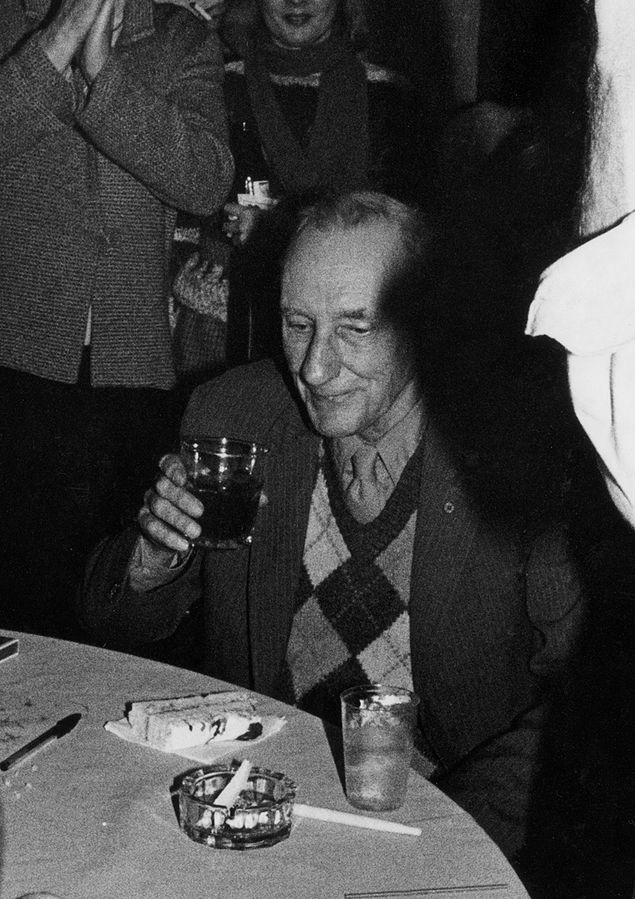
(Image of Burroughs at his 70th birthday party via Wikimedia Commons)

A Short Story For Saturday

Recently, we touched on John Cheever’s influence on Mad Men. This weekend, we’re highlighting one of Cheever’s most-loved stories, “The Swimmer.” The opening lines:

It was one of those midsummer Sundays when everyone sits around saying, “I drank too much last night.” You might have heard it whispered by the parishioners leaving church, heard it from the lips of the priest himself, struggling with his cassock in the vestiarium, heard it from the golf links and the tennis courts, heard it from the wildlife preserve where the leader of the Audubon group was suffering from a terrible hangover. “I drank too much,” said Donald Westerhazy. “We all drank too much,” said Lucinda Merrill. “It must have been the wine,” said Helen Westerhazy. “I drank too much of that claret.”

Keep reading here (pdf), or look for it in The Stories of John Cheever. You can also hear the story from the lips of the author himself, in a 1977 recording, above. Previous SSFSs here.

(Hat tip: Dan Colman)

Compassion For Pedophiles

Non-practicing ones, that is:

This embed is invalid


A reader flagged it:

I just listened to this astonishing podcast on pedophilia. It’s an interview with an admitted pedophile who has yet to act on his attraction. It also discusses his inability to find a therapist to work with him. The podcast is about 27 minutes and is not the type of interview you will ever hear on mainstream media. Naturally, I thought this would be perfect for The Dish. Truly fascinating stuff.

Another adds:

I hope pedophiliac research gets the funding it deserves. It’s sad to think of all those people who need help but have nowhere to get it, and all those children who become victims as a result.

The Original Eccentric Birder

Scott Keys and Daniel Karp profile Eugene Schieffelin, who, as part of his love affair with the Bard, sought to “gather every bird referenced in Shakespeare’s plays and introduce them into the United States”:

What transformed Schieffelin from a mere Shakespeare aficionado to an active fanatic, though, was his membership in the American Acclimatization Society, a New York City group founded with the purpose of importing European plants and animals to the United birds-of-shakespeareStates. Bringing birds mentioned in Shakespeare’s plays to American soil was Schieffelin’s personal and public tribute to the Bard. Starlings made a brief appearance in Shakespeare’s work: Act 1, Scene 3 of Henry IV. “Nay, I’ll have a starling shall be taught to speak; Nothing but ‘Mortimer,’ and give it him,” Shakespeare wrote, a single line of script where a soldier is ordered, by the king, never to mention his brother-in-law’s name again, leading the soldier to dream of buying a starling that will repeat the name over and over. Starlings, after all, are incredible mimics, adept at copying everything from other bird songs to car alarms to human beings.

The idea that it could be problematic to introduce a new species into a foreign area was not widely understood at the time. In fact, [How Shakespeare Changed Everything author Stephen] Marche argued, the very notion was reviled. Victorians took great umbrage at the Darwinian concept that nature was cruel, finding it contrary to their religious sensibilities. The belief, therefore, that you could impact – much less hurt – a natural environment by releasing a new bird in it was ludicrous. Until the beginning of the 20th century, there was an Outback Steakhouse approach to ecology: No rules, just right.

Starlings now do an estimated $800 million in crop damage every year.

(Illustration via Andrew Petcher)

The View From Your Window Contest

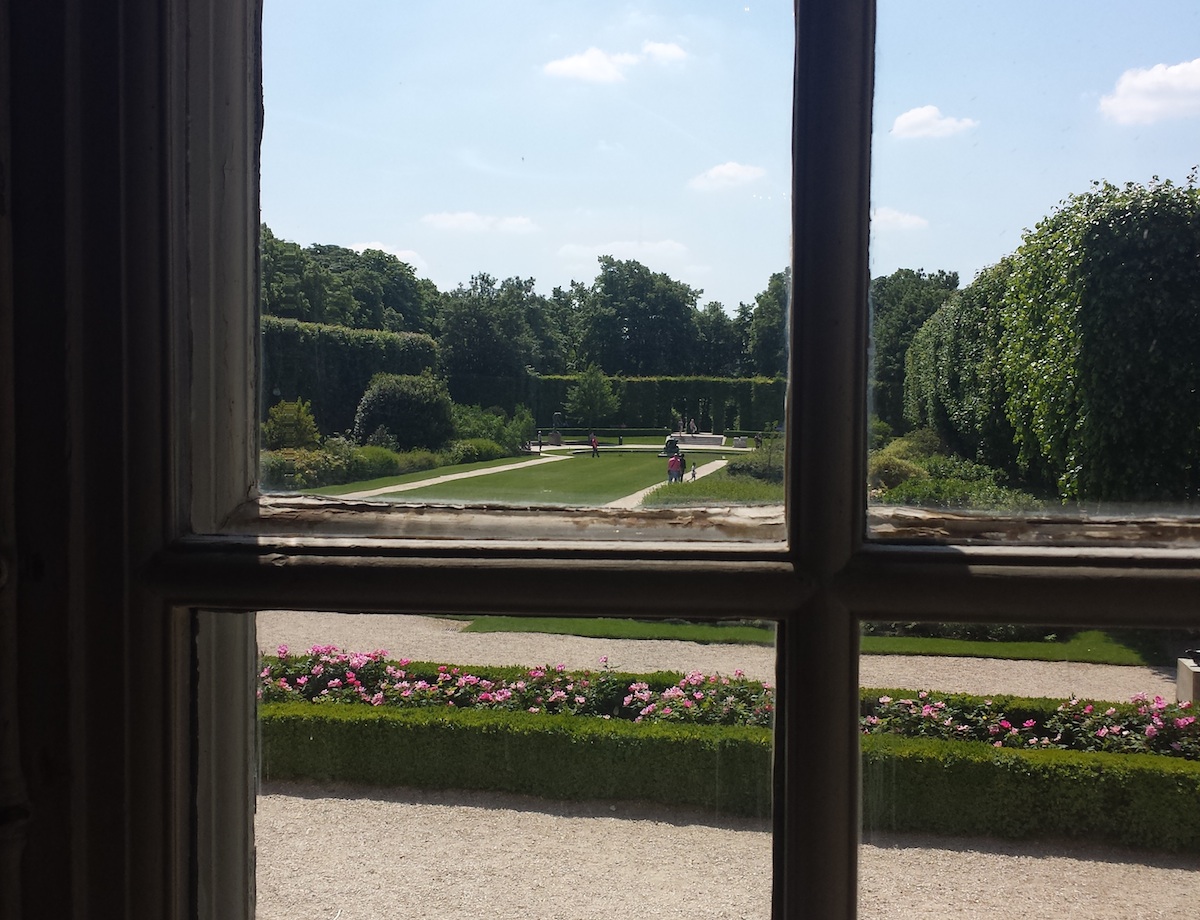
VFYWC-208

You have until noon on Tuesday to guess it. City and/or state first, then country. Please put the location in the subject heading, along with any description within the email. If no one guesses the exact location, proximity counts.  Be sure to email entries to contest@andrewsullivan.com. Winner gets a free The View From Your Window book or two free gift subscriptions to the Dish. Have at it.

Feminism For Men

Noah Berlatsky wants more of it:

I don’t think feminism is only about women’s empowerment – or, at least, there have been other feminisms, too. Specifically, feminism often takes the form of critique, especially of misogyny. This is often defined as the hatred of women, but in her book Whipping GirlJulia Serano provides a broader definition. She says that misogyny is the “tendency to dismiss and deride femaleness and femininity.” In part, this involves deriding and devaluing women, but it also means devaluing any expression of femininity, no matter the gender of the person in question.

For example, misogyny means that people see bosses or those with hugely successful careers as being more important than those who stay home and care for their kids, because caring for kids is seen as feminine. Empowerment feminism tends to argue that women should be able to do anything that men can do. But there have also been versions of feminism that argue that what men do isn’t necessarily so great; that maybe, instead of leaning in to be the man, we should try to see if we can get to a place where no one has to be the man at all.

So one thing feminism is about, and has been about, is questioning what it is to be a man, which obviously affects men pretty directly. Women are the main victims of misogyny, because women are inescapably associated with femininity. But other people can suffer, too. Gay men, for example, are stereotypically seen as feminine, weak, frivolous, and helpless: “A pansy has no iron in his bones,” to quote the author Raymond Chandler in one of his more misogynistic and homophobic moments. Similarly, femininity is often seen as fake or inauthentic—a trope that is especially damaging for trans women and men, whose gender identities are often seen as unmanly, false, fake, or performed.

Face Of The Day

Screen Shot 2014-06-05 at 7.25.29 PM

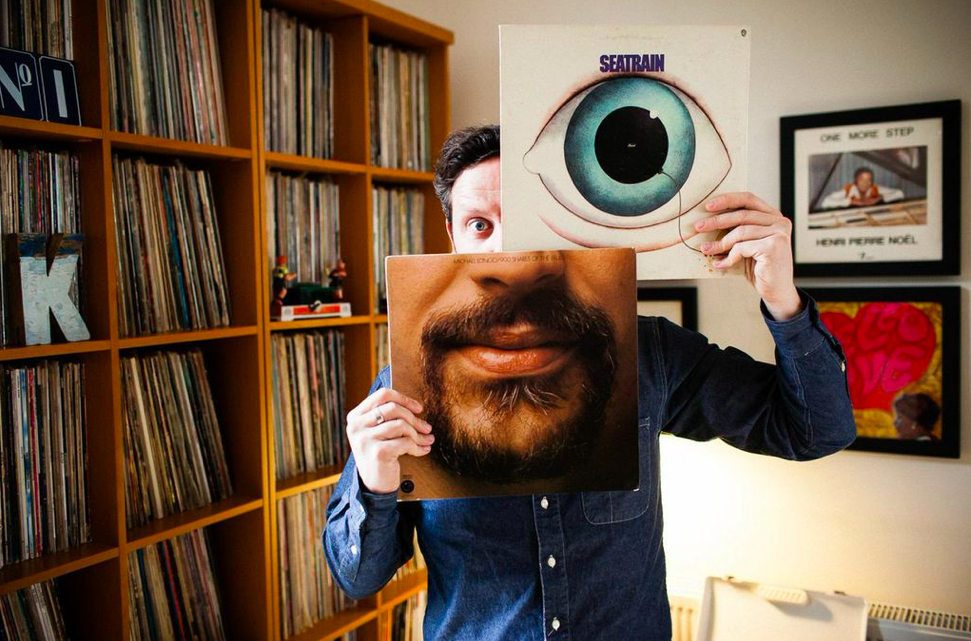
Eilon Paz focuses on old vinyl records and their owners:

Iranian photographer, Eilon Paz takes photographs of over 130 vinyl connoisseurs and their collections in the most intimate of environments, their record store rooms. Paz, a record collector himself, thought it might might be interesting to explore the people around him whose record collections are both larger and weirder than his own.The stunning, candid photos look at a variety of well-known vinyl champions as well as a glimpse into the collections of world-renowned and lesser-known DJs, producers, record dealers, and everyday enthusiasts.

In a 416-page coffee-table book, Dust and Grooves, Paz’s photographs are grouped together with compelling essays that closely examine the records and the people whom collect them. The book is divided into two main parts: the first features 250 full-page photos framed by captions and quotes, while the second consists of 12 full-length interviews that look deeper into the collectors’ personal histories and vinyl stories.

Buy the book here.

“Where Bad Taste Becomes Great Art”

It’s schlock music, according to Jody Rosen, who pens an impassioned defense of a tradition that “has given us our most indestructible songs, a tradition as time-honored, as sturdy, as it is maligned“:

Schlock is music that subjugates all other values to brute emotional impact; it aims to overwhelm, to body-slam the senses, to deliver catharsis like a linebacker delivers a clothesline tackle. The qualities traditionally prized by music critics and other listeners of discerning taste — sophistication, subtlety, wit, irony, originality, “experimentation” — have no place in schlock. Schlock is extravagant, grandiose, sentimental, with an unshakable faith in the crudest melodrama, the biggest statements, the most timeworn tropes and most overwrought gestures. Put another way: Schlock is Rodgers and Hammerstein, not Rodgers and Hart. It’s “Climb Ev’ry Mountain” and “You’ll Never Walk Alone,” not “Manhattan” and “My Funny Valentine.”

The word comes from the Yiddish shlak,meaning secondhand, or damaged, goods”:

Schlock has a close relative in another Yiddishism, schmaltz — a label often given to music that is swamped by goopy sentimentality, as a roast chicken is swamped by rendered fat. Much schlock music qualifies as schmaltz, or is at least very schmaltzy. But schlock is a broader category than schmaltz; it makes room for songs that are grandiose but less reliant on lachrymose sounds and sentiments. (Toto’s “Africa” is schlock but not schmaltz, concealing its torch-ballad bombast beneath a placid easy-listening arrangement.)

Other terms are sometimes used interchangeably with schlock: kitsch, cheese, camp. Schlock contains elements of these, but none are true synonyms. Schlock is more dignified than kitsch like “How Much Is That Doggie in the Window?” or Red Sovine’s tearjerker trucker ballad “Teddy Bear.” It is weightier, more substantial, than pure pop cheese like the Spice Girls’ “Wannabe” or novelty-song cheese Los del Rio’s “Macarena.” And while certain listeners embrace schlock, with both affection and condescension, as camp, schlock itself is allergic to the irony that is a prerequisite of camp. A karaoke singer might perform “The Rose” or “Every Rose Has Its Thorn” or “Kiss From a Rose” as a campy sendup, but Bette Midler and Poison and Seal take those songs seriously — offer up those roses on bended knee.

Schlock is earnest and solemn; it’s ambitious and aspirational and exalted. It shoots for the moon or, at least, for the penthouse suite.

(Video: “Until the Night,” Billy Joel’s surprisingly singular mention on Vulture‘s list of the 150 greatest schlock songs)