Kagan On Marriage Equality

Garrett Epps is covering the Kagan hearings. From yesterday's summary:

Charles Grassley (R-IA) asked, "Do you believe that marriage is a question reserved for the states to decide?" This question, Kagan pointed out, was the subject of a high-profile suit now in the courts, making comment improper. Then Grassley asked whether she considered a 1970 case on the issue, Baker v. Nelson "settled law."

Baker v. Nelson was an early case claiming that banning same-sex marriage violated the Constitution. The Minnesota Supreme Court held it did not, and they appealed to the Supreme Court, which dismissed their appeal in one sentence for "want of a substantial federal question." Kagan (and I, in the background) brightened at yet another nerd opportunity. "The view that most people hold I think is that (such a summary dismissal) is entitled to some precedential weight but not to the weight that would be given to a fully argued fully briefed case," she began, clearly ready for a long talk. Enough of that. "I'm disappointed that you didn't use the world 'settled law,'" Grassley said, and moved on.
Kagan, Liberal

Bucking the majority opinion, Adam Serwer writes that "Elena Kagan's confirmation hearing has been the most substantive and interesting since the Clinton administration":

Kagan's revealed a great deal about her legal philosophy by rejecting obtuse textualism, acknowledging that there are times when judges should privilege intent over the actual principle outlined in the Constitution, and arguing that while the Constitution does not change, the circumstances under which we interpret it do. This clearly places Kagan on the liberal side of legal philosophy, and while she can't indicate how she'd rule on important cases, there's no question that for the first time since Roberts, a nominee has meaningfully challenged the prevailing conservative philosophy of judging.

The “Easy” Social Security Fix, Ctd

Free Exchange objects to soaking the rich. "Soaking the rich" means not allowing us a total exemption from social security payments after a certain amount of income. I don't like it either – and Drum makes a good case for incrementalism, both politically and fiscally. But the more we discuss these options, the better. And on that matter, a word of praise for John Boehner who has finally managed to propose something that might actually help the country's perilous finances:

Boehner also called for means-testing Social Security so that retirees with “substantial non-Social Security income” don’t get payments. This should be popular with upper-middle-class Republican voters, whose great complaint has always been that the government insists on giving them too much money.

Why does Collins mock a Republican the minute he gets serious about fiscal responsibility?

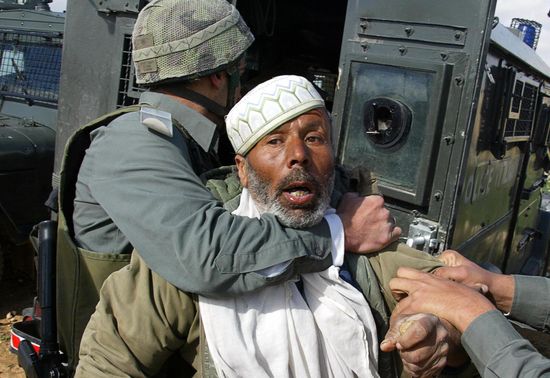
How Is This Not Apartheid?

KARMELHazemBader:Getty

Nick Kristof observes ethnic cleansing and collective punishment first-hand:

On one side of a barbed-wire fence here in the southern Hebron hills is the Bedouin village of Umm al-Kheir, where Palestinians live in ramshackle tents and huts. They aren’t allowed to connect to the electrical grid, and Israel won’t permit them to build homes, barns for their animals or even toilets. When the villagers build permanent structures, the Israeli authorities come and demolish them, according to villagers and Israeli human rights organizations.

On the other side of the barbed wire is the Jewish settlement of Karmel, a lovely green oasis that looks like an American suburb. It has lush gardens, kids riding bikes and air-conditioned homes. It also has a gleaming, electrified poultry barn that it runs as a business. Elad Orian, an Israeli human rights activist, nodded toward the poultry barn and noted: “Those chickens get more electricity and water than all the Palestinians around here.”

These Palestinian Arabs were subject to constant harassment and violence from the Jewish settlers nearby. Kristof adds every caveat – about security, about double-standards, etc. But I fail to see how this kind of governing system, brutally punishing people for being the wrong ethnicity and religion and using the apparatus of the state to impoverish and marginalize them, is somehow in a different moral zone than apartheid. Could a reader mount a case for a clear difference? I think even parts of Soweto were allowed to access the national grid.

And how is the US supposed to engage the moderate Muslim world to help defuse Islamism and Jihadism, if we are also partly financing this kind of brutal sectarian and ethnic discrimination against Muslims?

(Photo: A Palestinian from Arab al-Hazaleen (south Hebron) fights 14 February 2007 with Israeli border police as an army bulldozer demolishes Beduin mud houses beside the Israeli settlement of Karmel. By Hazem Bader/AFP/Getty Images.)

Another Odd Lie?

PALINEthanMiller:Getty

From a speech delivered at the International Bowl Expo in Las Vegas yesterday:

Palin recalled her youth when her father set pins in Idaho. "My Dad was on a Thursday night bowling league," she said. "He bonded with his buddies. I have memories of that point of my life which mean very, very much to me."

A press release confirms that account:

Professing a personal appreciation for the bowling industry, Palin also noted that, during his high school years, her father Chuck Heath Sr. worked as a pin boy and that she herself has fond childhood memories of watching him play in this Thursday night bowling league.

Palin was three months old when she left Idaho. Maybe there's some explanation for this that I don't know of yet. But the truth is: Palin constantly makes stuff up to appeal to whatever audience she is in front of.

(Photo: Ethan Miller/Getty.)

Why Is Bibi Angry?

CSIS looks at the Arab-Israeli military balance:

As the report shows, Israel has … benefited from continuing US aid and arms transfers – benefits that are substantially greater than the dollar figures show because Israel is able to draw on the most advanced US military technology, often on preferential terms, and integrate into its own advanced military industrial base. Israeli political claims that the Obama Administration has somehow distanced itself from a concern with Israel’s security have not been reflected in arms transfers and security cooperation.

The End Of Gay History?

Dan Zak fears young gays are forgetting their forebears:

For a demographic that was once so twined with mortality, the gays have gotten good (or have they always been good?) at focusing on the now, the young, the ephemeral. Today’s gays — the gays of my generation, the millennials, the 20-somethings — are post-gay, or New Gay, loosed from the closet, free of the diving bell of AIDS-as-executioner, left to skirmish over (or ignore) petty legislative battles on a state-by-state or school-by-school basis. The “end of gay culture” has been journaled for nearly a generation now. What about gay history? Is that ending too? From Sappho to Prop 8, and then what? Now what? Yearly parades celebrating outrageousness, tempered by the tired yammerings of marriage defenders?

Will gay history end when Storme DeLarverie and her peers are dead? Or when a gay man or woman is elected president of the United States?

Glenn Beck’s Reading List, Ctd

Douthat passes judgement:

[Conservative] rethinking needs to circle back to the realities of contemporary politics, and the challenges of actual-existing policy issues, rather than indulging in manichaean fantasies about a final battle between virtuous liberty-lovers and wicked statists.What’s more, [Continetti is] right to suggest that certain ways of rethinking American politics are simply toxic and self-discrediting and ought to be labeled as such, no matter how many copies of “The Road to Serfdom” they inspire people to buy.

Indeed, to the extent that Jonah Goldberg is heavily invested in many of the ideas that Beck is popularizing, then it’s his obligation to draw a clear distinction between those arguments and the noxious, John Bircher paranoia that Beck often swaddles them in.

Less Powerful Than We Think

Exum tends "to believe the actions of local actors are more significant than those of U.S. policymakers":

In general, we Americans — especially some of our friends on the American Right — tend to overestimate the importance of what we do in comparison to what local actors do. (Iraq and Afghanistan, seriously, should have taught us better.) That doesn't mean we fold up our tents and head home: we just have to be realistic about what we can hope to achieve through the application of U.S. power, military force especially.

Christianist Watch

Sharron Angle finally granted a 30-minute interview to the Nevada media. Here's a bit on the separation of church and state:

Pareene parses her answer:

As for the context, she actually got it mostly right:

"Thomas Jefferson was actually addressing a church and telling them through his address that there had been a wall of separation put up to protect the church from being taken over by a state religion, and that's what they meant. They didn't think they couldn't bring their values to the political forum, and it didn't mean that people with religious beliefs shouldn't have that freedom."

Right. No state religion. This is what we liberals try to explain, all the time: that the separation of church and state protects churches. So, thanks for getting on board, Sharron! But I'm still not sure how she squares that answer with a repeated insistence that "the tenet of the separation of church and state is an unconstitutional doctrine," since she seems to be explaining one of the stated reasons for the establishment clause.