Ross On Afghanistan: Getting Warmer, Ctd

In response to Millman, Douthat fleshes out his position:

[Yglesias] concludes that American policy toward Afghanistan should “restrain our goals, shy away from efforts to conquer hostile territory, and simply try to provide some help to friendly Afghans while scaling our commitment of resources down to a more sustainable level.” Aiming for “a more sustainable” American presence doesn’t sound like a policy oriented toward an actual withdrawal; rather, it sounds like a recipe for what Rory Stewart, in an essay admirable for its honesty about the scope of the commitment he has in mind, suggested would be 20 years or more of muddling through in Afghanistan.

This possible future seems at once unacceptable and all-too-plausible. And it’s precisely because I don’t think we can afford to spend upwards of two decades heavily invested in the Hindu Kush that I’m unwilling to give up on the hope of a more decisive outcome — not a final victory, which I agree is a chimera, but a shift in the balance of power in Afghanistan that makes it easier for leading U.S. policymakers to embrace a real withdrawal.

Yeah but how credible is that? Somehow the US has to convince the Taliban that it cannot outlast us – by ramping up forces now with the obvious, if ambiguous, exit ramp in the summer of next year – while holding hearings in which the debate about how long to stay is completely transparent. What Ross is proposing sounds awesome in theory – if we prepare for a permanent occupation, we will get a more temporary one. In practice, in a ten-year war for a negotiated settlement with the people who allowed al Qaeda to attack us a decade ago, with a bankrupt and teetering Treasury, the US has no chance of meeting the determination of the Taliban to control what is their country according to their profound and passionate religious beliefs.

It's over, Ross. All over, but the coming decade of muddling through to more stalemate. And this month saw more NATO casualties than at any time since the beginning.

Hewitt Award Nominee

“Somebody has to say this. When Hitler took power, no one wanted to think that the Holocaust, the murder of 6 million Jewish people, was possible. I’m saying that you have to recognize and name tyranny when you see it. And I think people are finding out that I’m the candidate who’s willing to speak clearly and not be afraid of sounding politically incorrect, and my opponent isn’t that candidate," – congressman congressional candidate Rick Barber, finally forced to respond to the press about his increasingly deranged ads.

And by the press, I mean, of course, Dave Weigel.

Quote For The Day

"When I first heard her say that, I thought to myself, "That has to be a joke. It's sarcasm, right?" But then I went back and replayed the clip – no sarcasm! She meant it! If I'm hearing [Lara] Logan correctly, what Hastings is supposed to have done in that situation is interrupt these drunken assholes and say, "Excuse me, fellas, I know we're all having fun and all, but you're saying things that may not be in your best interest! As a reporter, it is my duty to inform you that you may end up looking like insubordinate douche bags in front of two million Rolling Stone readers if you don't shut your mouths this very instant!" I mean, where did Logan go to journalism school – the Burson-Marsteller agency?" – Matt Taibbi, journalist.

But my favorite sentence from the piece is one that resonates so fucking strongly in this time of such fantastic media corruption and cowardice:

If there's a lower form of life on the planet earth than a "reputable" journalist protecting his territory, I haven't seen it.

Chart Of The Day

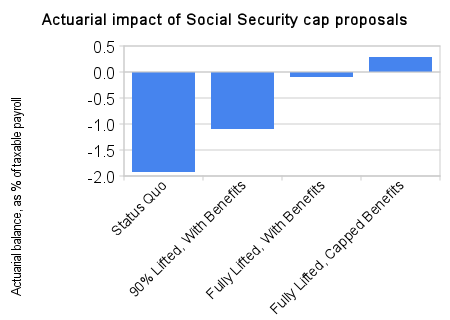
Socialsecuritycap

Dylan Matthews balances Social Security by lifting the contribution cap:

Currently, wages over a certain yearly total ($106,800 this year) are exempted from Social Security payroll taxes. Medicare's payroll tax has no such cap. This has raised the question of how raising the cap could extend Social Security's solvency….Congressional Research Service looked at this question in 2008 by evaluating three different proposals. The first would raise the cap so that 90 percent of wages are taxed (CRS estimates this would mean a cap of $171,600 in 2006) and pay higher benefits to those affected; the second would eliminate the cap and pay higher benefits; and the third would eliminate the cap for taxes but would not increase benefits…

While all proposals put a dent in the shortfall, completely eliminating the cap without increasing benefits actually creates a long-term surplus, and eliminating the cap while increasing benefits comes close. The nature of Social Security as a social insurance, rather than welfare, program suggests that the latter proposal may be more palatable, as it retains the connection between what wage-earners pay into Social Security and what they get out of it.

This is basically a big new tax on the rich. But it is also the closing of a silly loophole. In an ideal world, it would be unnecessary. Now, this reform, or something like it, seems to me to be essential.

The View From Your Recession

A reader writes:

Once you quoted someone who referred to the self-employed as being "on their own" because they don't receive unemployment benefits. If memory serves, you have not yet run an email from one of those people, so I thought I might as well do it.

I am a self-employed commercial artist, who "went freelance" in 2002. For five or six years I was able to round up enough work from various magazine and ad agency clients (many of whom you would recognize) to earn a half-way decent living. I've never been anything more than solidly middle-class, but I was able to pay my bills, occasionally put some money away for a rainy day, and once in a while take my longtime girlfriend out to a nice dinner.

Starting in 2008, I noticed the budgets I was used to were getting reduced. Jobs that used to bring around 2K suddenly were being offered to me for $800.00. Not wanting to piss off regular clients or miss the chance to have my work out there, I took the work. Doing this of course meant I had to take in a lot more work just to stay afloat.

Since then, it has only gotten worse.

Budgets got slashed even more, and some clients have folded up shop entirely. I am now deeply in debt. While I am still able to pick up jobs here and there, there are weeks that go by where I have nothing to do. I keep busy by working a part-time retail job, but they only need me for a few hours a week so it barely makes a difference.

Being a freelance artist has been my life-long dream; it's the only thing I've ever wanted to do since I was a child. I stayed focused and graduated from art school, and stuck with it all through my 20s, even though I never could land any work. But I told myself that if I just kept at, eventually I'd "make it."

Well, it seemed like I did … for a while. But now I lay awake at night, wondering how I'm going to pay my bills and get out the massive debt I've accrued. I've been willing to chuck it all if I could find a full-time graphic designer job, but from the listings I've seen on various job sites, any place hiring also wants their graphic designers to have skill sets completely unrelated to being an artist (like being an IT guy) – presumably to save money by having two positions filled by one person.

There's no government unemployment benefits to help me through this; I am truly on my own.

Guerrilla Gardening

Greenaid

Kelly Rand spies an urban design project:

Greenaid takes old gumball machines, rehabs them and turns them into “seedbomb” dispensers. The seedbombs are made from clay, compost and seeds and are perfect for the cracks, crevices and empty spaces found in daily life. They can be temporarily placed in sidewalk cracks, empty planters and in missing concrete pieces from parking lots.

Suck UK commercializes the concept with hand-grenade replicas.

Dissident By Accident?

Steinglass ponders the complicated ethics of reporting on unsophisticated political dissidents who don't understand the potential consequences of speaking out:

I’ve..interviewed highly educated, self-conscious dissidents who knew precisely what they were getting themselves into and had a reasonable sense of what strategies were likely to be effective. I’m happy to report the statements of this…sort of dissident. Moreover, I’m obliged to. They’re political activists who are making news. My job is to report the news. They’re acting quite deliberately, and they can take care of themselves. With the less sophisticated dissidents, however, things get complicated. I sometimes feel that these are people who have been pushed over an emotional edge by the unfair treatment they’ve received, and are lashing out in a fashion that, in the end, will only hurt them. By running interviews with them, you’re essentially exploiting and to some extent egging on their self-destruction.

The Blogosphere Slows? Ctd

SocialNetworking
Joyner yawns:

This reminds me of the brilliant pieces telling us that China is overtaking the United States economically because they’re growing at a much faster rate.   Mature, large entities do indeed tend to be “stagnant” relative to emerging upstarts, given that there’s much less for the former to grow.  But it doesn’t at all follow that the upstart’s rapid growth is sustainable.  Indeed, it’s almost a mathematical given that it isn’t.

(Image via Steve Rubel)