… and only now allowed to marry.
Author: Andrew Sullivan
World Cup War
A reader writes:
I saw something real bizarre on the World Cup coverage of the English-German match on ESPN. The host talked about the English-German rivalry saying “Well after two world wars and many world cup battles…” WTF? Then the Brit-commentator next used “D-Day” as a metaphor to further comment on the rivalry. DOUBLE WTF? Then if that wasn’t freaky enough, German striker Jurgen Klinsman went on to speak (in broken English) that the German people are an “impatient people” especially after “being on the wrong side of two world wars,” and proceeded to talk about the German teams’ tendencies to attack and attack. TRIPLE WTF??!
Henry Porter chews over the war talk:
The very odd thing about modern Germany is that it appears to be almost entirely a mystery to the British, who are surprised to discover that the side fielded by Germany today hardly consists of the Aryan specimens on display at the Berlin Olympics. Men of Tunisian, Spanish, Bosnian, Polish and Brazilian ancestry form the German squad, together with the Turkish midfielder Mesut Ozil, who recites the Koran while the German national anthem is sung. To taunt players from the new Germany, freed since 2000 from the rigid nationality laws of 1913, with references to the Second World War is as weird as the stoning of dachshunds in Britain at the outset of the First World War. But the irrelevance of the jibes, and the taboo about mentioning the war, is precisely what makes it all so funny to the British, which I suppose says something about us.
Except it isn't funny when England loses to Germany.
Growing up, I was told of several key moments in British history: Trafalgar, Dunkirk, the Battle of Britain, and the 1966 World Cup final. The tone got extra reverent when it came to 1966. Maybe when Americans realize that World Cup football is not about football, it's about nationalism, they'll like it better.
Two-Faced Michael Oren
Behold, the duplicity made manifest.
Thoughts On Byrd
Speak no ill of the dead? Well, let me simply say that the racist, populist, larcenous bigot of a Senator – a man who robbed the American tax-payer to pave his state with baubles and bribes – is not going to be much mourned in these parts.
Ross On Afghanistan: Getting Warmer
It's such a relief to have my former colleague, Mr Douthat, writing intelligently from the right-of-center in the NYT. How does one begin to tackle the likes of Krauthammer or Kristol on the new empire? They are never wrong, never revisit any previous dogmas, and believe that a priori, American force is always right. Better to have some modicum of honesty to engage with. Ross' core argument as to why, after ten years, we are still increasing troops and resources in Afghanistan, is as follows:
First, the memory of 9/11, which ensures that any American president will be loath to preside over the Taliban’s return to power in Kabul.
This strikes me as his weakest logical link. What we're talking about here is a "memory". Do we commit men to arms because of a memory – or because they have a chance to achieve an advancement of American interests in a dangerous world? I fear this primary domestic political argument is what is really fueling this war. Which is to say: even if the war should end, it cannot. Even if it contributes not a whit to national security, no president could afford to withdraw and then explain a subsequent terror attack on the US. The right would play the Dolchstoss card; and the Democrats are far too weak-kneed to counter or withstand it. This, to my mind, is not a solution to the problem; it's a restatement of it.
Second, the continued presence of Al Qaeda’s leadership in Pakistan’s northwest frontier, which makes it difficult for any American president to contemplate giving up the base for counterterrorism operations that Afghanistan affords.
But this means that even if the war in Afghanistan were successful, we still could not withdraw because of the Qaeda bases in Pakistan. And we were told this weekend, for good measure, that there are a mere 50 or so al Qaeda operatives in all of Afghanistan. So we are occupying a country to tackle another country, which we cannot occupy and which is technically an ally. How do you tell the families of the fallen that this is what their son died for?
Third, the larger region’s volatility: it’s the part of the world where the nightmare of nuclear-armed terrorists is most likely to become a reality, so no American president can afford to upset the balance of power by pulling out and leaving a security vacuum behind. This explains why the Obama administration, throughout all its internal debates and strategic reviews, hasn’t been choosing between remaining in Afghanistan and withdrawing from the fight. It’s been choosing between two ways of staying.
But since Pakistan's nukes are not going away, and Islamist fervor is stoked by US occupation of Afghanistan, this means that the US will be there forever. Ross talks as if this presents no structural challenges. But it seems to me it does reveal the core reality of post-9/11 America: it enabled and entrenched a permanent US occupation of Af-Pak with over 100,000 troops for ever. (By for ever, I do not mean eternity, merely an occupation without a foreseeable end within the next five years, and a bipartisan consensus in Washington that we cannot afford to leave.)
The question remains: does occupying Afghanistan recruit more than 50 terrorist for al Qaeda? At 51 new Jihadists, we are creating more terror than we are defeating in Afghanistan. And since the only way to tackle al Qaeda in Pakistan is by exactly the kind of tactics that Biden – and not Petraeus – has suggested for Afghanistan, one has to ask if pursuing counter-insurgency in one place and counter-terrorism in another is … well, spectacularly incoherent. You get all the human and fiscal cost of counter-insurgency occupation and all the blowback and Jihadist-recruitment of counter-terrorism.
Then there's the factor that Ross doesn't even mention: what if the core object of counter-insurgency in Afghanistan is, in the best of all possible worlds, simply impossible? What if that failed state, after a generation of religious and ethnic warfare, cannot be turned into a functional state at any price in any foreseeable time-frame? Washington doesn't like to believe there are some things it simply cannot do. Even now. Even after Iraq, they still believe in their power to do anything.
This is how great powers destroy themselves. By the pride of elites and the fears of the masses.
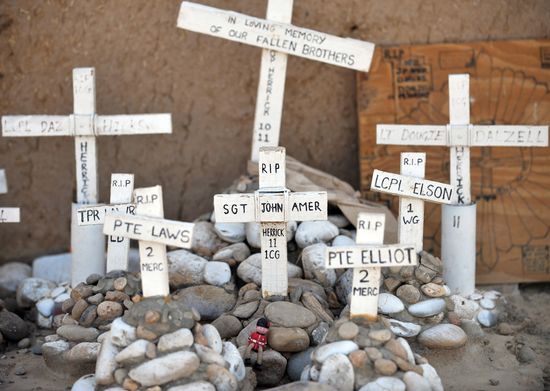
(Photo: This picture shows a commemorative memorial to British soldiers killed in action on previous tours of Afghanistan, at a patrol base in the Nahr e Saraj, Helmand on June 28, 2010. The death toll for foreign soldiers in Afghanistan neared the grim milestone of 100 for June alone as the CIA chief warned the anti-Taliban war would be tougher and longer than expected. By Bay Ismoyo/AFP/Getty.)
Quote For The Day

"Oh my god I feel like I just stepped off of a roller coaster! Go round and round and up and down and shit flying out of everywhere and standing. Remember when you had to write a report as a college student and you just tried to jam in as many quotes as possible? You know, from as many random things you could get, you know, that’s what I got. I got she didn’t ever finish a statement," – a journalist on an open mic, uttering the truth immediately after Sarah Palin's recent speech at CSU-Stanisalus.
He must be glad he doesn't work for the Washington Post. The campus was all but shut down to prevent any students protesting the farce.
Why There Isn’t A Female Viagra
Christopher Ryan proffers that "female sexual response is too complex for any pill." I defer to others' judgments.
How Struggle Makes Us Stronger
Jonah Lehrer explains:
For me, the lesson of stuttering is that obstacles can also be advantages, that who we become is deeply influenced by what we cannot do. (Or, to quote the sage words of Kanye, "Everything I'm not/made me everything I am.") The secret is to struggle through, because the very act of raging against a disadvantage generates its own set of skills.
That, at least, is the message of this new paper on Tourette's Syndrome and cognitive control.
Telling You What You Want To Hear
David McRaney tackles confirmation bias:
Punditry is a whole industry built on confirmation bias. Rush Limbaugh and Keith Olbermann, Glenn Beck and Arianna Huffington, Rachel Maddow and Ann Coulter – these people provide fuel for beliefs, they pre-filter the world to match existing world-views. If their filter is like your filter, you love them. If it isn’t, you hate them. Whether or not pundits are telling the truth, or vetting their opinions, or thoroughly researching their topics is all beside the point. You watch them not for information, but for confirmation.
Chart Of The Day
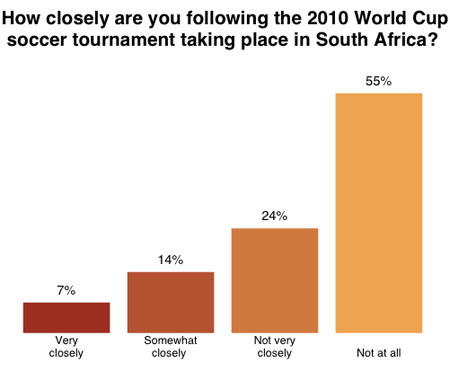
From The Economist/YouGov poll:
 The Dish