The Blogosphere Slows?

This is news to me:

Earlier in the decade, rates of growth for both the numbers of blogs and those visiting them approached the vertical. Now traffic to two of the most popular blog-hosting sites, Blogger and WordPress, is stagnating, according to Nielsen, a media-research firm. By contrast, Facebook’s traffic grew by 66% last year and Twitter’s by 47%.

870 Iowa Jobs vs The World’s Poor

Laura Freschi makes the case against mandating that food aid come from US growers:

Current US food aid policies are NOT an effective or efficient way for the US to achieve what should rightly be the primary objective for food aid. According to the government’s own accountability office, buying food locally in sub-Saharan Africa (which is where the majority of US food aid goes) costs 34 percent less than shipping it from the US, AND gets there on average more than 100 days more quickly, AND is more likely to be the kind of food people are used to eating.

Islamism Realpolitik

Marc Lynch shows the error of Paul Berman's view that "it is not violent Islamists who pose the greatest danger to liberal societies in the West but rather their so-called moderate cousins, such as Tariq Ramadan":

Secular Muslims, such as Ayaan Hirsi Ali — the Somali-born writer and former Dutch politician — are a sideshow to the real struggles taking place between reformers and traditionalists, Muslim Brothers and Salafists, rulers and oppositionists. The real challenge to the integration of Muslims in the West comes from Salafists who deny the legitimacy of democracy itself, who view the society around them as mired in jahiliyya, and who seek only to enforce a rigid, literalistic version of Islam inside whatever insulated enclaves they are able to carve out. The liberals to whom Berman is drawn represent a vanishingly small portion of Muslim-majority societies. They are generally drawn from well-off urban elites that have become ever more detached from their surrounding environments and would not fare well in the democratic elections that the United States claims to want. Meanwhile, granting such prominence to ex-Muslims who support Israel and denounce Islam discredits other reformists in the real terrain where figures such as Ramadan must operate. Supporting them may offer the warm glow of moral purity — and they may be more fun at parties — but this should not be confused with having an impact where it counts.

The Tree Of Knowledge, Not Understanding

  Birds

Errol Morris finishes his series on anosognosia with a parable:

When God created man (and woman), he gave them the ability to perceive the world, but withheld from them the ability to understand it.  We could come up with one cockamamie theory after another, but real understanding would always elude us.  It was mean-spirited on God’s part.  And to make matters even worse, God gave us the desire but not the wherewithal to make sense of experience.  One might easily foresee that this would lead to unending, unmitigated frustration and suffering.  But here’s where self-deception, anosognosia and the Dunning-Kruger Effect step in.  We wouldn’t be able to make sense of anything, but we would never be aware of that fact.

This quote from David Dunning, from earlier in the post, is also worth reflection:

Here’s a thought.  The road to self-insight really runs through other people. So it really depends on what sort of feedback you are getting.  Is the world telling you good things? Is the world rewarding you in a way that you would expect a competent person to be rewarded?  If you watch other people, you often find there are different ways to do things; there are better ways to do things.  I’m not as good as I thought I was, but I have something to work on.  Now, the sad part about that is — there’s been a replication of this with medical students — people at the bottom, if you show them what other people do, they don’t get it.  They don’t realize that what those other people are doing is superior to what they’re doing.  And that’s the troubling thing. So for people at the bottom, that social comparison information is a wonderful piece of information, but they may not be in a position to take advantage of it like other people.

The Out Of Touch MSM

Nice-try-once-again-old-media-25947-1277263391-34

A reader writes:

The appropriateness of the Weigel's comments about Drudge aside, I'm much more horrified by the suggestion, on Goldblog and elsewhere, that this is somehow the Washington Post's fault for hiring journalists who, you know, have opinions about stuff.  When will news outlets give up on the charade of neutrality in reporting? 

In an era of monopolistic news reporting, if you are the only newspaper in town, or one of three channels on the tube, you are you going to be a lot less concerned with providing a superior product and a lot more concerned with not saying anything that might alienate a member of your captive audience.  It's not important to have the smartest reporters or the sharpest analysis – after all, people are pretty much forced read the news you give them.  Instead, it's just important to have reporters that are careful (or dense) enough to stop thinking about a subject before they risk suggesting that one interpretation of events might be superior to others.  

End result: a perverse culture that values manufactured or feigned neutrality above all else, endless "he said/she said" reporting, and a mainstream media that is afraid to actually let its own reporters use their brains.

Thankfully, the internet is ripping the heart out of our mid-20th century media culture.  We're going back to old-old-school reporting, way back to the era of when newspapers had open party affiliations.  If I want to learn about an issue, I don't watch cable news debate theater, designed to ensure both sides go in endless circles.  And I certainly don't read a David Broder column.  I go read an honest, intelligent partisan, an Yglesias or Klein or a Frum or a Salam, and then I go read a response from the other side.  Even if there isn't a response, at least I know what I'm getting — I have a sense of the worldview I'm hearing and the assumptions that are going into the argument.  I don't have to worry that the writer is burying some secret conclusion out of sight.  Full disclosure beats selective omission, every time. 

Good reporting requires honesty, integrity, and analytical rigor.  Good reporting is not editorializing.  But a good reporter should not be neutral.  A good reporter should tell me what he thinks, why he thinks it, and why it's relevant.  

(Image via BF)

Extending Our Brains

Scott Adams is enthralled by what he calls the "exobrain":

Everything we create becomes a de facto data storage device and brain accessory. A wall can be a physical storage device for land survey data, it can be a reminder of history, and it can be a trigger of personal memories. 

A business is also a way to store data. As a restaurant owner, I was fascinated at how employees came and went, but their best ideas often stayed with the business, especially in the kitchen. The restaurant was like a giant data filter. The bad ideas were tested and deleted while the good ideas stayed, most often without being written down.

Before Stonewall

The invisibility of the real history of the civil rights movement for gays and lesbians continues at the Smithsonian:

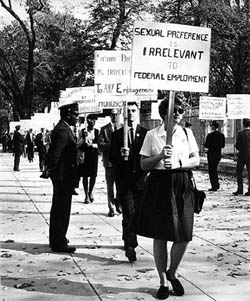
A dozen picket signs on old wooden sticks carry the DNA of the gay civil equality movement in America. Forty-five years ago, this month, in 1965, these pickets were held high by men and women considered among the first generation of LGBT activists in front of Lyndon Johnson's White House.
2010-06-25-bgittings65.jpg
With the men wearing jackets and ties and tailored skirts for the ladies, all arrived neatly dressed to disarm the looks of fellow citizens, while their hand-lettered signs proclaimed unimaginable things like "First Class Citizenship for Homosexuals". Despite their professional appearances, this handful of men and women on this history-making picket line, knew perfectly well that their conduct literally put themselves and their jobs on the line, in broad daylight.

Today, however, those brave pickets are stored in the dark of a Smithsonian vault, where they have been held for they past four years, ever since they first were presented to The National Museum of American History.

In 2006, the original protest pickets were donated to the Smithsonian by The Kameny Papers Project, funded in part by former Congressman Michael Huffington and other generous friends and allies. Frank Kameny is often considered the still living father of the gay civil equality movement in Washington, D.C. and led many such picket lines in his day. Fired by the federal government in 1957 because he was gay, Kameny responded in righteous fury that such an action could be taken against him, a World War II veteran who had seen combat in Germany, a Harvard-educated astronomer determined to work for America's nascent space program.

I was honored to carry one of those original posters at the Equality March last fall. And look at that photograph: the dignity and courage there puts us all to shame. On Gay Pride Day, here is something I am truly proud of – the gay men and women who made my life – and that of so many others – possible.
Big Brother Is Watching: Yay?

Professor of Philosophy Emrys Westacott wrestles with surveillance:

Kantians should welcome surveillance, since ultimately it leads to the achievement of the very ideal they posit: the more complete the surveillance, the more duty and self-interest coincide. Surveillance technology replaces the idea of an all-seeing God who doles out just rewards and punishments, and it is more effective, since its presence, and the bad consequences of ignoring it, are much more tangibly evident. Consequently, it fosters good habits, and these habits are internalized to the point where wrongdoing becomes almost inconceivable.