
How The Brain Argues With Itself

Blue

Errol Morris continues his mediation on anosognosia:

[V.S. Ramachandran] has used the notion of layered belief — the idea that some part of the brain can believe something and some other part of the brain can believe the opposite (or deny that belief) — to help explain anosognosia. In a 1996 paper…he speculated that the left and right hemispheres react differently when they are confronted with unexpected information. The left brain seeks to maintain continuity of belief, using denial, rationalization, confabulation and other tricks to keep one’s mental model of the world intact; the right brain, the “anomaly detector” or “devil’s advocate,” picks up on inconsistencies and challenges the left brain’s model in turn. When the right brain’s ability to detect anomalies and challenge the left is somehow damaged or lost (e.g., from a stroke), anosognosia results.

In Ramachandran’s account, then, we are treated to the spectacle of different parts of the brain — perhaps even different selves — arguing with one another.

We are overshadowed by a nimbus of ideas. There is our physical reality and then there is our conception of ourselves, our conception of self — one that is as powerful as, perhaps even more powerful than, the physical reality we inhabit. A version of self that can survive even the greatest bodily tragedies. We are creatures of our beliefs. This is at the heart of Ramachandran’s ideas about anosognosia — that the preservation of our fantasy selves demands that we often must deny our physical reality. Self-deception is not enough. Something stronger is needed. Confabulation triumphs over organic disease. The hemiplegiac’s anosognosia is a stark example, but we all engage in the same basic process. But what are we to make of this? Is the glass half-full or half-empty? For Dunning, anosognosia masks our incompetence; for Ramachandran, it makes existence palatable, perhaps even possible," - 
Live-Tweeting A Firing Squad, Ctd

Hang

A reader writes:

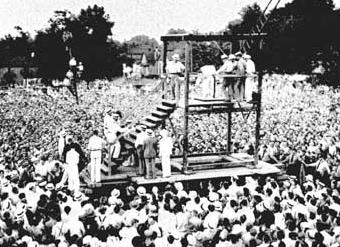
The first respondent you posted is a little confused about the differences between people now and people in history. As recently as a century ago, and certainly throughout most of human history, death was a constant companion for people of all stripes. Infant mortality, maternal death in childbirth, horrific wasting diseases, hand-to-hand combat – all these and more combined to ensure that most people, if not everyone, was well acquainted with death by the time they reached adolescence.

Now I'm not saying that a public execution wouldn't attract gawkers; it undoubtedly would. But I imagine there are a lot of people who support the death penalty whose minds would be changed if they had any experience of actual death.

(Photo: The last public execution in the US, carried out in Owensboro, Kentucky, in 1936 after Rainey Bethea was convicted for the rape and murder of a 70-year-old woman.)

Blogbudsmen

TNR has a new blog staffed by Jim Manzi and Michael Kazin intent on critiquing TNR content from the right and the left. Yglesias worries about "punch-pulling" and “commenting on the not-comment-worthy.” Chait defends the project:

The point is to give our readers the benefit of smart rebuttals, and in turn to force our writers to operate under the discipline of knowing that we can't offer a poorly-constructed argument without risking this being pointed out to our readers. That's a different kind of discipline than knowing that some other blogger who my audience doesn't read might attack me.

Yglesias returns fire, calling Chait's post "almost self-refuting." It seems to me that a blog best critiques itself by airing dissent and pushback from readers and other bloggers, rather than creating some kind of internal mechanism for critiques. The latter does seem to me to reflect an old media mindset – as if online magazines can actually function as magazines in the way that print magazines do. I've long believed this is silly – because every page on the Internet is as accessible as every other page – but no one anywhere in the legacy media seems to get it yet. They keep trying to replicate the magazine model online – like trying to make counter-insurgency work in Afghanistan. It's all they know how to do. So they do it.

I guess it's understandable because, like the record companies and the publishing houses, they don't want to admit that their gig is up and their concept of a magazine is essentially defunct. You can't really blame them for that, can you?

Why Would A Former Slave Praise Slavery?

TNC posts on "Clara Davis, circa 1937, waxing nostalgic about her days of bondage in Alabama." Dreher adds:

It shocks our senses to encounter a former slave praising slavery, but it's not that hard to understand, if you think about it. Why do some people in, say, the former East Germany pine for life under communist dictatorship, which was a kind of slavery? Because they miss the sense of security it provided. Yes, you were miserable, but so was everybody else you knew, so in that sense, you knew your place. You knew what was expected of you, and what you could — and could not — expect of yourself. Go to Coates' link and read the ex-slave's words: she's remembering (and no doubt romanticizing) her slave past from the point of view of the Great Depression, and all its stress and storm, as well as having been abandoned by her children, and having been geographically displaced. "Now I just live from hand to mouth," she said. "Here one day, somewhere else the next."

Compared to the stress of that kind of life — elderly, lost, forgotten by one's family, and not knowing what tomorrow will bring — is it really that far-fetched to imagine longing for the security of involuntary servitude? In the same vein, is it really so hard to imagine why some women remain with the men who beat them? I'm not justifying it, obviously; I'm just trying to understand why people do the things that they do and say the things that they say.

TNC follows up and tries to steer the conversation in another direction.