Judith Warner presents a dyspeptic view of our culture in the wake of deregulatory disasters like the housing crash and the BP spill:
Under normal circumstances, the emotional, reward-seeking, selfish, “myopic” part of our brain is checked and balanced in its desirous cravings by our powers of cognition — our awareness of the consequences, say, of eating too much or spending too much. But after decades of never-before-seen levels of affluence and endless messages promoting instant gratification, Whybrow says, this self-regulatory system has been knocked out of whack. The “orgy of self-indulgence” that spread in our land of no-money-down mortgages, he wrote in his 2005 book, “American Mania: When More Is Not Enough,” has disturbed the “ancient mechanisms that sustain our physical and mental balance.” …
What remains to be seen, as we move forward into what The Times’s Eric Lipton recently called “a new age of regulation,” is whether this new spirit of control and reform will carry over into the American psyche. For in the anything-goes atmosphere of our recent past, it wasn’t just external controls that went awry; inwardly, people lost constraint and common sense, too. Now there is a case to be made that problems of self-regulation — of appetite, emotion, impulse and cupidity — may well be the defining social pathology of our time.
This photo was taken in late November. You have until noon on Tuesday to guess it. Country first, then city and/or state. If no one guesses the exact location, proximity counts. Be sure to email entries to VFYWcontest@theatlantic.com, not the regular Dish account. Winner gets a free The View From Your Window book. Have at it.
James Sturm is in the middle of his four-month break from the internet. The Dish missed this dispatch from a couple weeks back:
Whether it's a sports score, a book I want to get my hands on, or tuning into Fresh Air anytime of day, I can no longer search online and find immediate satisfaction. I wait for the morning paper, a trip to the library, or, when I can't be at my radio at 3 p.m., just do without. I thought this would drive me crazy, but it hasn't. Anticipation itself is enjoyable and perhaps even mitigates disappointing results….Are meaningful connections easier to recognize when the fog of the Internet is lifted? Does it have to do with the difference between searching and waiting? Searching (which is what you do a lot of online) seems like an act of individual will. When things come to you while you're waiting it feels more like fate. Instant gratification feels unearned. That random song, perfectly attuned to your mood, seems more profound when heard on a car radio than if you had called up the same tune via YouTube.
Sturm is onto something deep here. The Net – and it's not just search – does seem to encourage the willful arrangement of experience, moment by moment. As he has rediscovered, sometimes it's best to let the world have its way with you.
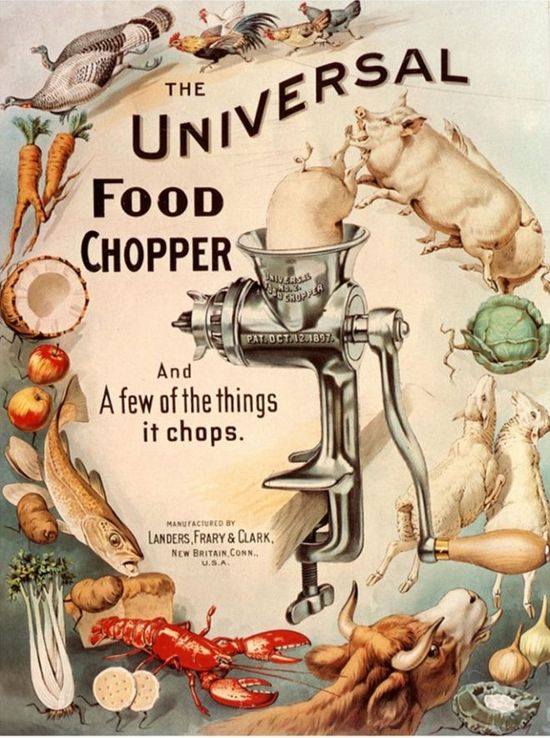
Ad illustration magic from the year 1890. Yep, just crank the handle and start grinding up the pigs and cows and turkeys and chickens and lambs and lobsters and running carrots and coconuts with legs and what the hell is that green thing lower right?
A Dish reader passes along an honorablemention from the present day.
Today on the Dish, Andrew laid into the MSM for missing the McChrystal story. Freelancer Michael Hastings and Jon Stewart did the same. Andrew also clarified his point about the indefinite occupation of Afghanistan and a reader got his back. Additional Afghan coverage here, here, and here.
In other media news, Weigel was outed by someone on JournoList and summarily ousted from the WaPo. Julian Sanchez and Phil Klein came to his defense. Goldblog went on the offensive and soon retreated, but not before Friedersdorf pushed back. Klein killed JournoList. In other news, the globe warmed at a worrying rate, a dude on the beach chronicled the tar balls, Van Susteren caved to McCain, and more of Palin's dirty work surfaced. She also saw the president as Hitler.
In assorted commentary, Geoffrey Aronson looked back at the punishment of Gazans, Daniel Berman penned a postmortem on the Australian PM, Bruce Bartlett missed H.W. on deficits, Kinsley vented, and Felix Salmon questioned parking space. A reader sounded off on South Park machismo and another defended soldiers on the same.
Our continuing coverage of animal masturbation here. Malkin Awards here and here. Colbert bait here and hilariously creepy ad here. MHB here, VFYW here, and FOTD here.
Thursday on the Dish, Andrew continued to wring his hands over the post-McChrystal situation in Afghanistan. He also sparred with a dissenting reader. More analysis from Fred Kaplan, Reihan, and tworeaders in the military. In other news, police raided an archbishop's home, polls showed that the American public is divided over the flotilla, KIPP charter schools saw some success, and Conan got the last laugh. Team USA update here and coverage of the North Koreans here, here, and here.
In assorted commentary, Josh Green found that Americans actually want an angry black man to lead, Dylan Matthews assailed agricultural subsidies, Tom Schaller laid out the demographic crisis for the GOP, Karl Smith added on, Mark Oppenheimer opined on debate team, and Drezner dreamed of zombies. Zach Anner made a push to become the first major host with palsy. A reader contributed a recession view, another shared a story about real-life Team America, and another talked Marty McFly and hoverboards.
Bristol earned some hathos here, gay/guido coverage here, and beard-blogging here. More viral vids here and here. An especially good MHB here, VFYW here, and FOTD here. And what everyone was surely waiting for: an update on animal masturbation.
Wednesday on the Dish, the president removed General McChrystal but not COIN. Reax here. Andrew's take here. Pre-announcement analysis here, here, here, here, and here. Beinart examined the MacArthur analogy. The Rolling Stone reporter responsible for it all shared the secret of his craft.
In other news, Australia selected its first female PM, the Bartonites dugin, and we provided polling on Obama here, here, and here. Team America kicked ass at the last minute to keep the dream alive. Other Cup coverage here and here.
In assorted commentary, three bloggers from the Dish stable debated the power of the presidency, DiA doubted that citizens change their minds based on reason, Bernstein didn't relent over criticizing tea-partiers, and Balko kept up his campaign against canine-killing cops. Vaughan Bell relayed some fascinating trends among the divorced, Bundled showed how much we spend on gas, Jonah Lehrer explained why computers suck at Jeopardy!, Drum joined the discussion on kid flicks, and Andrew overshared over animal masturbation. A reader watched a goat get off, others extended the public execution thread, and another sent in a stirring video of dancing with cancer.
Derbyshire served up some more racism while Steyn contributed some cant. MSM bashing here and here, great acts of journalism here, and dissent of the day here. Recession views here. Colbert bait here and badass Palin bait here. More ex-gay hilarity here. MHB here, VFYW here, and FOTD here.
In assorted coverage, Saletan studied the blood ban for gays, Adam Serwer antagonized the GOP over Faisal Shahzad's guilty plea, Plumer preferred climate change legislation over EPA intervention, Chris Good looked ahead on Prop 8, Steinglass suggested decriminalization over legalization, and Friedersdorf praised Continetti for having the courage to say that Roosevelt wasn't a fascist dictator.
In other commentary, Jonah Lehrer disagreed with Clay Shirky over cultural consumption, Steven Zeitchik noted a surge of kid movies, a Dish reader cheered them on, and cancer survivor Ananda Shankar Jayant shared her love for dancing. Readers continued the discussion on public executions and others contributed to the fall of the fourth estate. Seth Masket wondered why the right hates soccer. Incredible goal here.
Von Hoffman award here and cool ad here. Ex-gay hathos here, Haggard's tweets here, and Colbert bait here. MHB here, VFYW here, and FOTD here. The latest winner of the VFYW contest here.
Monday on the Dish, we passed along BP's latest duplicity on the extent of the leak, processed the easing of the Gaza blockade, spotlighted the latest evils to emerge over Maciel, and blogged the tweeting of an execution in Utah. The new coalition in Britain laid out its views on gay equality while Kagan stiffed gay rights. A view of the violence in Afghanistan here.
Chait pushed for the EPA to bypass Congress on climate change and worried about Sharron Angle. Frum predicted that the Tea Pary will lose the GOP seats, Ariel Levy put her money on Huckabee in '12, and Larison poured cold water on Palin's chances. Kinsley criticized Krugman over the debt. Friedersdorf blegged over what could replace local newspapers and a reader responded.
In other commentary, Steven Berlin Johnson critiqued Nick Carr's new book, Evgeny Morozov went toe-to-toe with Clay Shirky over his new book, Shirky sounded off on the publishing industry, Wilkinson countered Bryan Caplan over having lots of kids, and Dreher felt sorry for child geniuses.
World Cup crack here and here. Uber pwnage of a politician here, delicious unicorns here, and Bieber-looking lesbian coverage here. MHB here, VFYW here, and FOTD here. Andrew gave Hildog some love.
A festival-goer relaxes in a hammock at sunset during Day 1 of the Glastonbury Festival on June 24, 2010 in Glastonbury, England. This year sees the 40th anniversary of the festival which was started by a dairy farmer, Michael Evis in 1970 and has grown into the largest music festival in Europe. By Ian Gavan/Getty Images.
It's unclear what would happen if California did legalize marijuana. The ballot measure doesn't legalize the substance completely throughout the state: it allows for counties to legalize on their own, creating what the ballot initiatives backers hope would mirror "wet" and "dry" counties elsewhere, in which alcohol is legal or illegal.
At the end of the day, it could come down to manpower. If the measure passes, county cops can enforce the laws of their counties, while federal law enforcers could come in to enforce the Controlled Substances Act. If many counties legalize, it could come down to whether the DEA and FBI have enough officers and the inclination to enforce marijuana's illegality in California while there's a drug war raging in Mexico that's already demanding drug-enforcement resources.
This thread reminds me of a quote by Max Planck that I found in Thomas Kuhn's "The Structure of Scientific Revolutions":
A new scientific truth does not triumph by convincing its opponents and making them see the light, but rather because its opponents eventually die, and a new generation grows up that is familiar with it.
Ambreen Ali responds to DiA's inability to "think of an instance where voters on any side have been persuaded by a reasoned opposition on any issue":
Here's one: the civil rights movement.
In addition to boycotts and sit-ins, leaders such as Martin Luther King, Jr., debated opponents publicly to persuade Americans to back the cause. Historian Kevern Verney writes about this in his book, "The Debate on Black Civil Rights in America":
[King's] intelligent and articulate responses in media interviews contrasted painfully with the uncouth and intemperate outbursts of some of his best-known segregationist opponents. In print he lucidly and persuasively explained the intellectual basis of his beliefs and showed these were rooted in the core values of western philosophy, demonstrating both his erudition and the moral justification of the civil rights cause.
The movement's iconic marches and sit-ins are remembered most today, but ideas and arguments formed its basis.
To be fair, our colleague does credit the "gravitational pull of mounting social change" for helping causes such as gay marriage. But we feel this misses the point: That amorphous gravitational pull comes about only after years, and sometimes decades, of activists making the case for social change.
Many friends after seeing my video "Tarantino vs Coen Brothers" requested me to do a new video duel of directors, so I decided to do now a tribute to my two favorite directors, Stanley Kubrick and Martin Scorsese, were 25 days re-watching 34 films, selected more than 500 scenes, and a hard work editing.




 The Dish