How Will Petraeus Deal With Karzai?

Joe Klein asks:

How will Petraeus see Karzai: as the boss (the final arbiter of military action), a partner or a subordinate? The latter is clearly out–those who've gotten into fights with Karzai, like Holbrooke and Ambassador Karl Eikenberry, have lost. But the former isn't getting us anywhere. Petraeus had some dicey moments with President Maliki in Iraq, but he managed to build a successful partnership. Can he do the same in Afghanistan? (One big problem: Maliki was the exact opposite of Karzai, pushing for more aggressive military action–and it was his unilateral decision to attack Basrah that finally made him a credible president in the eyes of Iraqis.)
When Deficits Mattered

Bruce Bartlett remembers George H.W. Bush fondly:

Twenty years ago, the last serious Republican effort to reduce the budget deficit took place when George H.W. Bush agreed to negotiate with congressional Democrats on a budget deal. As a consequence, many Republicans disowned his efforts and abandoned him in 1992, leading to his defeat. Today, the idea of cooperating with Democrats on deficit reduction is viewed as a total loser by all Republicans.  Until that perspective changes, the elder Bush will remain the last Republican who took fiscal responsibility seriously.

Making Oil And Water Mix

Josh Harkinson examines the connection between fishing and oil in Louisiana:

The two industries have developed a comfortable, sometimes symbiotic coexistence. Pearce says the best fishing is often around the artificial reefs created by new and abandoned rigs. And when fish prices are low or the catch is down, people flock to the rigs for temporary work; when oil prices dip, they go fishing. Shell Oil is a longtime sponsor of the annual Shrimp & Petroleum Festival in Morgan City, whose website says it will prove "that oil and water really do mix." Fishermen praise Shell for its largesse following Hurricanes Katrina and Rita, when it gave them close to $1 million in direct grants and funding for critical infrastructure. "That was the first actual money fishermen got in their hands following Katrina–before the state or federal government," Smith says. "They literally put one of our fishing communities back on the map overnight."

"There is a back and forth relationship there," Pearce says. Yet the seafood industry is dwarfed by the oil industry, which pumps a $65 billion into the state economy annually and directly supports around 60,000 jobs.

Dave Weigel Quits, Ctd

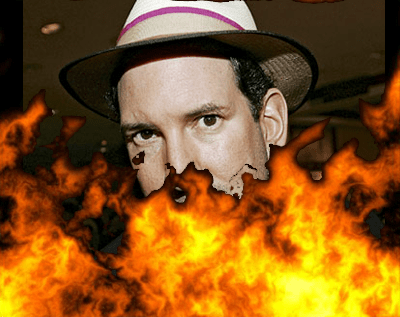
Drudgeonfire

Julian Sanchez, a good friend of Dave's, zooms out:

If the Princess-and-the-Pea brigade now cheering his departure would bracket their persecution complex for five minutes, they'd realize that he was consistently delivering coverage about as fair and sympathetic as could reasonably be hoped for.  What they apparently wanted was a movement hack to dole out indiscriminate praise to anyone claiming the mantle of conservatism–whereas Dave took the right seriously enough to make distinctions between what he saw as its credible thinkers and its nuts and opportunists. Memo to my friends on the right: If you bristle at being stereotyped as an undifferentiated bloc of racists and crude blowhards, maybe you shouldn't take automatic umbrage when someone points out particular individuals who are.

You Are Being Watched

This is what the standards of toilet-trained reporting amount to:

Nothing is really off-the-record.

Really? There's more:

I've been leaked postings from JournoList before — wonderfully charming things written about me, as you might have guessed — and I haven't had the opportunity to use them, but would be happy to if the need arose.

Wow. No wonder the list-serv is now over.

The End Of JournoList

Ezra writes the obit:

It was ironic, in a way, that it would be the Daily Caller that published e-mails from Journolist. A few weeks ago, its editor, Tucker Carlson, asked if he could join the list. After asking other members, I said no, that the rules had worked so far to protect people, and the members weren't comfortable changing them. He tried to change my mind, and I offered, instead, to partner with Carlson to start a bipartisan list serv. That didn't interest him.

In any case, Journolist is done now. I'll delete the group soon after this post goes live. That's not because Journolist was a bad idea, or anyone on it did anything wrong. It was a wonderful, chaotic, educational discussion. I'm proud of having started it, grateful to have participated in it, and I have no doubt that someone else will reform it, with many of the same members, and keep it going. Hopefully, it will lose some of its mystique in the process, and be understood more for what it is: One of many e-mail lists where people talk about things they're interested in. But insofar as the current version of Journolist has seen its archives become a weapon, and insofar as people's careers are now at stake, it has to die.

Mental Health Break

Born Ruffians – What to Say (HD) from Jared Raab on Vimeo.

Oscilloscopes are used for viewing voltages, primarily in the sciences, medicine, engineering, telecommunications and industry. Though other people have reprogrammed oscilloscopes to display images in the past, the “video to scope” process used in this video is the first of its kind. The images you see are made up of a single point of light, moving quickly across a screen in order to draw shapes – that means the entire Born Ruffians video for “What to Say” displays vector images made from only one continuous line.