We Are Being Warned

Temperature_gis_201005

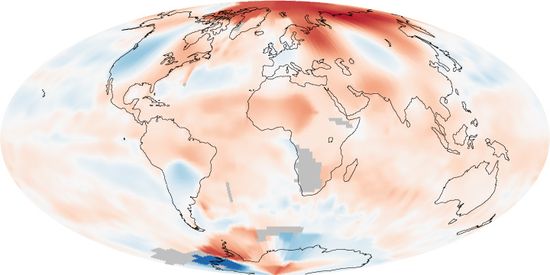
This is a map of global temperature anomalies for last month. Pretty uneventful until you get to the Arctic, where the feedback loops of warming, loss of ice-reflection, more warming and so on are looking scary. Earth Observatory notes:

Temperature anomalies in May continued a much longer trend. GISS compared the January–May mean surface temperature anomalies for 2010 to those of 2005 and 1998 (the two warmest years on record). January–May anomalies show 2010 to be the warmest out of 131 years (2005 is the fourth warmest and 1998 is the fifth warmest). Moreover, Arctic temperature anomalies are especially pronounced, and have been since the turn of the twenty-first century.

“Ongoing temperature anomalies like these are strong evidence of the Arctic amplification of global climate change,” says Ted Scambos, lead scientist at the National Snow and Ice Data Center. The Arctic environment is very vulnerable to warming because of feedbacks that amplify the initial change. Sea ice retreat and snow melt reduce Earth’s albedo, which can lead to increased warmth and further melting. Scambos explains that, although the Northern Hemisphere experienced significant snowfall in early 2010, spring melt was rapid, exposing land surfaces to sunlight sooner than usual.

It's real. And we still do nothing. In fact, the American political system seems incapable of even absorbing the data.

How Do We Spend Our Time? Ctd

Daniel Hamermesh picks up on the American Time Use Survey. He notes:

In this recession, average work time (including school) dropped by 15 minutes a day.  Of this drop, 6 minutes went to additional sleeping; and another 6 minutes went to additional TV-watching.  The average American actually spent 2 minutes less on household production. The recession didn’t shift work from market to home activities that we think of as productive; the drop in market work went into activities that, at least at the margin, most of us would view as unproductive.

You mean watching Jersey Shore is inefficient? Whatever. I do what I want.

Wastes Of Space

Tom Vanderbilt illustrates his case against too many parking spots by noting that Purdue University researchers found that if "all of the vehicles in the county were removed from garages, driveways, and all of the roads and residential streets and they were parked in parking lots at the same time, there would still be 83,000 unused spaces throughout the county." Felix Salmon agrees:

For me the biggest and most invidious cost of parking lots is also the most difficult to measure: the way that they kill any attempt at decent architecture, both on the level of individual buildings and on the level of city development more broadly. Your favorite buildings, your favorite cities, and your favorite vacation destinations all have one thing in common: a distinct absence of massive parking lots. So why are these things mandated by zoning regulations across the U.S.? It makes precious little sense, and it’s high time that minimum parking requirements died a long-overdue death.

How Do We Spend Our Time?

Laura Vanderkam, who wrote a new book on time management, delights in the release of the American Time Use Survey (ATUS). Lots of interest at the link:

Nearly a quarter (24%) of employed persons did some or all of their work at home, and 84% did some or all of their work at a workplace. By my calculation that would mean that about 16% of workers are pretty exclusively operating out of the home-office (unless the ATUS found a huge contingent operating out of Starbucks!). Men and women are equally likely to work from home.

The Daily Wrap

Today on the Dish, Andrew continued to wring his hands over the post-McChrystal situation in Afghanistan. He also sparred with a dissenting reader. More analysis from Fred Kaplan, Reihan, and two readers in the military. In other news, police raided an archbishop's home, polls showed that the American public is divided over the flotilla, KIPP charter schools saw some success, and Conan got the last laugh. Team USA update here and coverage of the North Koreans here, here, and here.

In assorted commentary, Josh Green found that Americans actually want an angry black man to lead, Dylan Matthews assailed agricultural subsidies, Tom Schaller laid out the demographic crisis for the GOP, Karl Smith added on, Mark Oppenheimer opined on debate team, and Drezner dreamed of zombies. Zach Anner made a push to become the first major host with palsy. A reader contributed a recession view, another shared a story about real-life Team America, and another talked Marty McFly and hoverboards.

Bristol earned some hathos here, gay/guido coverage here, and beard-blogging here. More viral vids here and here. An especially good MHB here, VFYW here, and FOTD here. And what everyone was surely waiting for: an update on animal masturbation.

— C.B.

Fearing The Ego

  ObamaGettyImages
A reader writes:

I am writing from Afghanistan as a Special Forces operator.  I have a staff job at the moment, so I’m working a desk that has allowed me to follow the fallout from the McChrystal article.  I have to say, this whole thing has been absolutely baffling. It is all everyone – and I mean everyone – is talking about here.  I read your initial response, and although I know you are blogging in the heat of the moment, I think your initial reaction – in particular the extrapolation of a larger “real vs. fake” argument from the “real soldier” quote given by one of my colleagues – is not quite as seamless as you make it sound.

There are two separate issues here from my vantage point: the dynamic issue of Afghanistan and the static issue of power versus ego. With regard to Afghanistan, every morning I sit in briefs and listen to the latest sitreps, and while I’m focused on executing whatever task is immediately in front of me, I always seem to have two thoughts in the back of my mind:  1) I can’t believe how absolutely, ridiculously complex, and multi-faceted, this whole operation is, and 2) even with that knowledge, there’s always going to be another hundred variables I haven’t thought of. 

This is the context for the second issue, which I think is more relevant: this whole thing is more about power and ego than it is Afghanistan.

Anyone who has gotten as far as General McChrystal in any field – but particularly those that wield power in the public eye – is invariably going to have an huge amount of self-confidence, to the point where the specter of self-delusion looms.  I’m not saying the General is delusional, but it seems like the same ego that gives people the determination to succeed, excel, and desire high-ranking positions is the same ego that leads them to believe that their worldview is undoubtedly correct, that their beliefs are so accurate and necessary that things like articles in Rolling Stone are beyond a good idea – they are a window into righteousness.  It’s the same thing that went on in Secretary Clinton’s campaign, and Palin's.

The problem here doesn’t seem to me to be that General McChrystal, a man of undoubted talent, has the wrong view of Afghanistan necessarily. It's that he felt his worldview was so correct that it didn’t matter if he let his aides mouth off, it didn’t matter if he slandered his chain of command, and it doesn’t matter if the other bureaucrats are pissed off, because his beliefs are the correct ones, and therefore the only ones that matter.  Does his formative experience in the military, and more specifically SpecOps, contribute to this?  Probably. But you don’t have to search hard to find other people in public positions of power to find similar traits.

One thing that has impressed me about President Obama is that he seems to be very aware of this problem.  He undoubtedly has a massive ego, but also appears, at least from a distance, to have a healthy fear of this ego. Hence, we see his constant desire for consensus, his reliance on experts who may not be popular with the public, and his pursuit of the best ideas wherever they may come from.  In short, he believes that his ideas are not infallible.  Seems a conservative notion, eh?

(Image: Hiroko Masuike/Getty Images. )