Joe Barton. Republican.

Yes, they talk a good game. But Barton will keep his top Republican spot on the House Energy Committee. More conservatives are following Rush Limbaugh's lead. And Steve King is on board:

"I think there will be a few that, like me, will agree with JB's words, and his description, and there will be a lot of others that privately agree with what he said."

Obamacare: Where’s The Bump?

Obamacare

Gallup checks in on the popularity of the healthcare bill. Age is a major factor:

New Gallup polling finds that Americans remain about equally divided in their reactions to Congress' passage of healthcare reform legislation earlier this year. Seniors — who were among the most widely opposed to the legislation prior to passage, given their broad satisfaction with the status quo under Medicare — have not relented in opposing the bill. And while one might expect the highly charged views of partisans to remain fixed, as they have, it is noteworthy that support among independents has not grown.

Ezra Klein has a glass-half-full moment:

The Affordable Care Act is popular among the people it will actually affect, and unpopular among the people who are worried it will harm the much-more statist health-care system they depend on. Extremism in defense of statism is no vice, but nor is it a rousing win for conservatism.

How Does Obama See The War?

Joyner is basically where I am:

My takeaway from all this was that President Obama had come to believe, as had I, that the very ambitious set of goals articulated by his predecessor were unattainable but that he believed saying that was politically untenable.  Since he had campaigned on Afghanistan as a "war of necessity" that the Bush administration had under-resourced to pursue a "war of choice" in Iraq, he couldn't very well say, mere months into his term, that Afghanistan wasn't worth it after all.   Further, bugging out before the job was done would lead to charges of weakness that no president, particularly a Democratic president with no military bona fides, wants to fight…

[The McChrystal controversy does] provide yet another opportunity for the president to decide what it is he wants to accomplish in Afghanistan and what resources he's willing to put into it.  The two should mesh. Further, the critics are right:  Whatever the ultimate plan, the key players have to be on the same sheet of music.  So pick people committed to the president's agenda, whatever that may be.

If McChrystal Gets The Boot

Live-tweeting on the situation at #McClusterfuck. Ackerman looks at what happens should the general resign:

Training the Afghans to take over security responsibilities is a consensus position within the administration and across party lines in Congress, as it signifies the most likely prospect for extrication from a stable Afghanistan. But there’s a lot more work that needs to be done, and the next commander will have to balance how much of his resources he’s willing to devote to the training mission with how much he’s willing to devote to warfighting. Since Obama is unlikely to back away from his July 2011 deadline for beginning to transfer security responsibilities to Afghan forces, it’s a resourcing question that could cut either way: either accelerate fighting ahead of July 2011 or double down on training to ensure confidence in the transition.

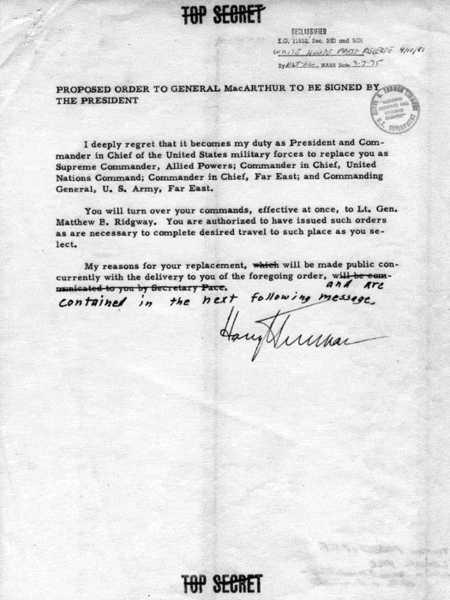
The MacArthur Analogy

450px-Truman-fires-mcarthur-49_04

Peter Beinart nails it:

Truman didn’t just fire MacArthur because the general treated him with disrespect. He fired him because MacArthur wanted to do whatever it took to liberate the Korean peninsula, including bombing mainland China, whereas Truman came to realize that Korea must be a limited war, fought merely to preserve South Korean independence. In insisting that America’s Cold War strategy be the containment of communism, not the rollback of communism, Truman kept the pursuit of military victory from destroying American power.

In that sense, McChrystal's self-immolation is a big opportunity for the president. He needs to restate his commitment to a limited war that begins to wind down next year. He gave the COIN version of neo-imperialism its best shot and it shot itself in the foot. Now: leave.

How Powerful Is The President?

Greenwald, Chait, and Jonathan Bernstein are in the middle of a three-way cage-match over the question. Chait calls Greenwald "a fanatic" for letting his "sense of betrayal in issue areas where Obama wields tremendous influence to bleed over into issue areas where he does not." Here's the end of Greenwald's response to Chait:

As I've acknowledged from the start, the President does have some constraints in the area of domestic policy and will not always be able to move Congress to do what he wants.  The complaint has been not that Obama is omnipotent and thus failed to get good progressive bills, but that he did not use his substantial leverage to try (again, just contrast what the White House did on the war supplemental bill).  But the claim that he has virtually no leverage to influence what Congress does on domestic policy is silly, and to see how true that is, just look at the central role the White House played in killing the public option and — according to its own Treasury official — is now playing by dictating which progressive provisions will be killed from the financial reform bill and which ones will remain.

Bernstein reiterates his argument, which is more modest than Greenwald makes it out to be.
America: Fuck Yeah!

A goal in injury time!

90+1 min: GOAL! USA 1 – Algeria 0 (Donovan ’91) USA counter with extreme pace, the ball is threaded through to Altidore, it’s squared across goal, and it’s broken free… and THERE HE IS! DONOVAN SLIDES IT HOME! THE USA ARE AHEAD!

89 min: I just can’t see where the USA goal is coming from. They’re looking nervy and uncomfortable in front of goal and the heads are down. But, there’s four minutes of added time.

That’s an instant Von Hoffmann right there.