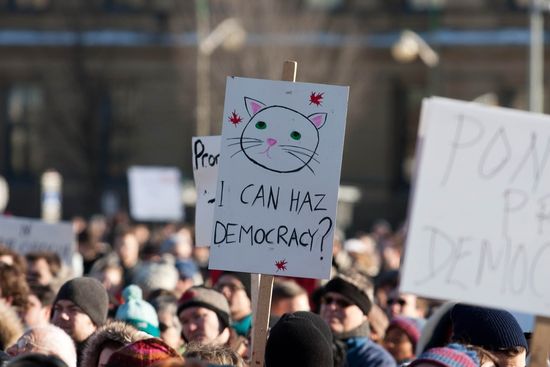
Lolcats vs Democracy?

Lolcats

Evgeny Morozov continues his series of disagreements with Clay Shirky by bashing Shirky's new book on the cognitive surplus:

As Markus Prior points out in his excellent 2007 book Post-Broadcast Democracy, today’s environment of information abundance splits the public into a small cohort of news junkies, who know everything there is to know about politics, and a much larger contingent of entertainment fans, who know the names of the latest YouTube celebrities and their favorite lolcats, but not of their home senators. “Although it is comforting to know that [viewers] finally get to watch what they always wanted to watch,” Prior writes, “their newfound freedom may hurt both their own interests and the collective good.” That is the case of those South Korean Internet users, who helped to spread panic that harmed their country’s diplomatic standing.

Shirky, of course, would never talk about viewers’ interests: that is not populist-speak. Populists prefer to make normative claims about the need to break up the traditional media without specifying how we should nurture responsible citizenship and promote good public policy in their absence. This just happens, apparently.

(Image by Flickr user Shortfin)

As The Fourth Estate Crumbles

Friedersdorf praises journalists who have exposed local government corruption. He wants to know who will take over that role as print dies:

I am pessimistic about the ability of a lot of newspapers to survive. So I'd like to suggest that, however you feel about newspapers, it's important that we generate ideas for replacing the local watchdog functions discussed in this post. Are there any readers who've observed viable replacements for the beat reporter in your community? Does anyone have ideas that are as yet untried?

What Do Those Extra Pounds Cost?

While arguing for a soda tax, Leonhardt digs up a study:

Mr. Goldman and his U.S.C. colleagues have made an estimate that takes into account both higher short-term spending and reduced longevity (including the fact that the government does not have to pay for as many years of Social Security when someone dies prematurely). In their work, they assume that obesity returns to its 1978 level. If that happened, the federal government would save about $17 billion a year. That’s equal to about 3 percent of Medicare’s and Medicaid’s current budget.

AIPAC’s Latest Email

Josh Block continues the new campaign by the pro-Israel lobby to demonize Turkey and equate this critical bridge between West and East with Ahmadinejad and Assad. Why? Because Turkey has criticized Israel, of course. Here’s the email:

From: jblock@aipac.org [mailto:jblock@aipac.org]

Sent: Friday, June 18, 2010 10:38 AM To: xxx@xxx.com

Subject: Funny Video!! The Three Terrors – Erdogan, Ahmadinejad, Assad sing in a trio

OK, this is another video, but a really funny one:

The Three Terrors – Ahmedido Domingo (aka Ahmadinejad), Erdogano Pavarotti (aka Erdogan) and Assad Carreras (aka Bashar Assad) singing about the benefits of terrorism.

full text:

Based on Funiculi Funicula

Sung by the Three Terrors:

Erdogano Pavarotti, Assad Carreras and Ahmedido Domingo

Erdogan: I say — it’s time that I restore the Empire

Let’s get to work (let’s get to work!)

Because in Europe everybody knows that

I’m just a jerk (he’s just a jerk!)

Assad: And I , the serial killer who should spend all

his life in jail (oy vey oy vey)

To reach the hearts of all the world media

We found the trail (hurray hurray)

Erdogan: Terror, Terror, that’s my cup of tea

Terror gains us love and sympathy

To beat the West, to be the one

From Tripoli to Teheran

Yalla yalla, ya — Jihad is sweet, Jihad is fun

All: Terror, Terror, that’s how you convince

That you’re cool and charming as a prince

To beat the West, to be the one

For Hezbullah and Erdogan

Yalla yalla, ya — Jihad is sweet, Jihad is fun

B.

Ahmedi: So now, the UN has imposed the sanctions

(Ironically) Oh my, oh my… (oh my, oh my)

Together here we stand, no opposition,

I hung them high (he hung them high)

I wish to thank Obama for his patience,

For playing dumb (for playing dumb)

Coz now I got the peace of mind to build me

The nuclear bomb (The nuclear bomb)

Terror, terror, that’s my cup of tea

Assad: Terror gains us love and sympathy

Erdogan: To beat the West, to be the one

From Tennessee to Teheran

Yalla, yalla ya, Jihad is sweet, Jihad is fun

All: Terror, Terror, gets us all the grants

Terror makes you all piss in your pants

To beat the West, to be the one

From Tennessee to Teheran

Yalla yalla, ya — I hit the switch and you are gone

When Manhattan Sold For $24

Tony Perrottet checks out the housing market and land deals throughout the ages:

The colonial era is full of subversive deal-making, but the world’s most notorious real estate coup occurred in 1626, when the energetic Dutch settler Peter Minuit, as an agent for the West India Company, purchased the unimproved woodland “island Manhattes,” covering 15,000 acres, for 60 guilders worth of goods (around $24 today). The 300 resident Native Americans, referred to in documents as the Manhatesen, were not aware they were selling their island paradise at all, thinking instead they were simply allowing the Dutch to share it. As related by Russell Shorto in The Island at the Center of the World, the chief, Sackimas, deemed that the Dutch access to Manhattan’s resources was a reasonable exchange for a valuable array of European items — knives, axes, hoes, awls, cloth, and coats, but probably not beads — and the additional promise of support by the Dutch against enemy tribes. For 40 years, the casual sharing arrangement worked well, with Indians still hunting and fishing in the forests and river-fronts. But then the Manhatesen were squeezed out to a less enviable site off-island — forests in the north, now known as the Bronx. Still, the Dutch were no visionary real estate geniuses: In 1644, they traded Manhattan for Surinam.