[Re-posted from earlier today]
What are the odds that Obama's huge success yesterday in getting BP to pledge a cool $20 billion to recompense the "small people" in the Gulf will get the same attention as his allegedly dismal speech on Tuesday night? If you take Memeorandum as an indicator, it really is no contest. The speech is still being dissected by language experts, but the $20 billion that is the front page news in the NYT today? Barely anywhere on the blogs.
This is just a glimpse into the distortion inherent in our current political and media culture. It's way easier to comment on a speech – his hands were moving too much! – than to note the truly substantive victory, apparently personally nailed down by Obama, in the White House yesterday. If leftwing populism in America were anything like as potent as right-wing populism – Matt Bai has a superb analysis of this in the NYT today – there would be cheering in the streets. But there's nada, but more leftist utopianism and outrage on MSNBC. And since there's no end to this spill without relief wells, this is about as much as Obama can do, short of monitoring clean-up efforts, or rather ongoing management of the ecological nightmare of an unstopped and unstoppable wound in the ocean floor.
I sure understand why people feel powerless and angry about the vast forces that control our lives and over which we seem to have only fitful control – big government and big business. But it seems to me vital to keep our heads and remain focused on what substantively can be done to address real problems, and judge Obama on those terms. When you do, you realize that the left's "disgruntleist" faction needs to take a chill pill.
Take Iran. Everyone – part from still-delusional neocons – accepts that this is a hugely difficult issue. To read the neocon right, you'd think all our problems would be solved by the president declaring the regime "evil" and launching military strikes all over the country. Sound familiar? In the real world, most of us understand that the military option is madness, that the machinery of repression is strong enough for the coup regime to survive – but only just. Since Obama was elected, the legitimacy of the Tehran regime has been shredded – and I'd argue that removing America from the equation helped Iran's opposition, rather than stymying it. Most of us knew, moreover, that Russia and China would oppose any and all sanctions.
But in fact, after a painstaking process in which Khamenei and Ahmadinejad have been successfully cornered in world opinion as the transgressors, sanctions, with Russia's and China's support, have passed the UN Security Council. More focused sanctions are in force against the financial interests of the Revolutionary Guards, and will soon come from the US Congress and European capitals. The price of Ahmadi's paranoia will be high, which may explain his recent fulminations. Will this pragmatic step resolve the situation immediately? Of course not. Does it make a lot of pragmatic sense? Yes it does. Is it the best we can truly do? I suspect so. In other words: Obama and Clinton got difficult shit done. I think part of the message of "Goodbye To All That" as a core rationale for the Obama presidency is acknowledging when a president does difficult, messy but necessary things.
My own provisional judgment is the same on the economy, where Obama's actions helped prevent what could have been a Second Great Depression. Historians will fight over this, but it seems pretty clear to me right now that Obama picked most of the least worst options and is prepared, unlike the GOP, to speak honestly about the deficit in the next two years. In the bank bailouts (much more successful than we first thought), the stimulus (still working), the health insurance reform (a real start on a deep and vexing problem across the developed world), and even the swarm of issues around Gitmo (torture has ended, while necessary, lawful military detentions and renditions continue), you see the same pattern of emotionally unsatisfying but structurally deep changes in the orientation of the ship of state. This is very gradual change we can believe in.
In other words, while I haven't scanted on occasional criticism, I remain an enthusiast for this presidency's competence and long-term direction. Even on gay rights, where I have whined the loudest, we have achieved an end to the HIV travel ban, and the legislative end of Don't Ask, Don't Tell, with a buy-in from the top brass. Broader progress is coming, as it should, not by presidential diktat but by the decisions and actions of those in the trenches, most notably the current work of Ted Olson and David Boies in grasping the core matter at hand: unconstitutional, arbitrary, animus-based, government-imposed discrimination against a minority. In less than two years, on another obvious policy of irrationality – the war on marijuana – the Obama years have also seen a deeper sea change than any of us expected.
I don't see all this as ideologically liberal or leftist – which is where I agree with some of Obama's sternest critics. But I never saw Obama as such and never supported him as such. He may, however, end up a liberal hero. To see why check out Michael Tomasky's sharp essay in Democracy Journal. Money quote:
Our political culture affects the way we think about the past as well. Too often, when progressives think of American history, we think only of the snapshots: those glorious moments when a historic bill is signed into law, or when the great progressive leader thunderingly confronts the forces of reaction. It’s good to remember those; they are our lodestars. But they are moments. Actual history is slower, more tedious, and certainly less uplifting. It’s not for Obama’s sake, but for liberalism’s over the long haul, that we need to consider this reality and proceed in full awareness of it. It’s only by seeing this fuller picture that we can know how history actually unfolds in real time and place our present experience within that context. We don’t do nearly enough of that. Cable news and op-ed pages and websites are a kind of modern-day camera obscura, giving us an image to be sure, accurate in a way, but upside-down.
The changes we want to see won’t happen in 18 months, or in two years, or four, or probably even eight. Indeed, the entire Obama era, if it lasts eight years, is best thought of not as a culmination, or a self-contained time frame that should be judged a failure if X, Y, and Z don’t happen. It’s the start of a process that may take 16 years, or 24; that may be along the way interrupted or undone; that will be fought tooth and nail, as we’ve plainly seen these recent months, by others whose idea of America is incomprehensible to us but who are citizens too, with the same rights we have. They (and by the way: no despair on their side! There is rage, to be sure, but judging from the Tea Party events I’ve been to and watched, it is a joyful rage) and the corporate interests and the elected representatives on their side have a lot of power. Liberal despair only reinforces their power and helps to ensure that whatever gains are made during the Obama term could quickly be rolled back. And if that happens, we are back, ten years from now, to fighting the usual rearguard battles.
And that's why Obama's incrementalism, his refusal to pose as a presidential magician, and his resistance to taking the bait of the fetid right (he's president – not a cable news host) seems to me to show not weakness, but a lethal and patient strength. And a resilient ambition.
Know hope.
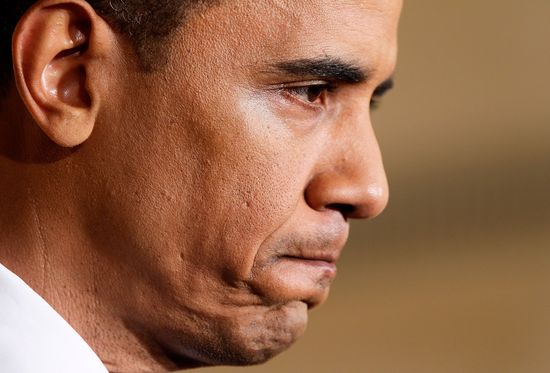
(Photo: Alex Wong/Getty.)

 The Dish