Another Neda

Cameron Abadi reveals that a famous photo of Iranian martyr Neda Agha-Soltan isn't of the right woman:

A woman named Neda did indeed die last summer on the streets of Tehran, gunned down by members of an Iranian militia. Her full name was Neda Agha-Soltan. But mixed in with the tragic footage of that Neda's death, broadcast around the world in a viral video that galvanized world opinion against the Iranian regime, was a compelling Facebook snapshot of a smiling young beauty in a flowered headscarf.

Her name was Neda, too — Neda Soltani.

What follows is the incredible story of what happened when the age of social media collided with political upheaval in a land behind a curtain — and how it even forced a 32-year-old graduate student into political exile.

The Final Day Of The Prop 8 Trial

Closing arguments are today. You can read the plaintiff's and the defendant's answers to Judge Walker's questions here. Brian Leubitz summarizes:

So what are the proponents’ [of Prop 8] advantages? Well, if you read more than a page of their responses you see what they think is their strong point: rational basis scrutiny. In other words, Pugno and the gang believe that because gays and lesbians have never been considered a “suspect class” under the law, they are the ones defending the strategic ground. They only need to prove that there was some “rational basis” for the state to enact the legislation, nothing more….

[The opposing argument from the plaintiffs is that] they believe that a) gays and lesbians are/should be a suspect class and that b) the proponents must prove their case accordingly. Now, I should point out that in In re Marriage Cases, the 2008 decision that made my marriage possible, the California Supreme Court said that sexual orientation is a suspect class under the California Constitution. That doesn’t apply to the federal courts, who are interpreting the federal Constitution, but it is worth noting. However, no federal court has ruled that the federal Constitution does view sexual orientation as a suspect class. This case seeks to change that. It’s a broadening of the law, but one that is reasonable considering recent jurisprudence.

FDL is live-blogging. So is the Courage Campaign and the San Jose Mercury News.

Palin And Pot

Scott Morgan embeds a clip of Palin and Ron Paul talking about marijuana:

Though unwilling to support legalization, Palin clearly has some sympathy for marijuana users on privacy grounds and sort of gets the fact that marijuana enforcement is a stupid distraction from important police work. But you can't have it both ways. As long as police and prosecutors hold the power to pursue and punish people for pot, they'll continue to do so, and they'll say they were just doing their job when some poor soul gets their dog shot over a dimebag. There exists a rather fundamental incompatibility between prohibition and politeness.

Still, Palin's comments are interesting in the context of the overall discussion.

The whole point of the segment was to bring together representatives of the Tea Party movement and debate some sensitive issues. Listening to Ron Paul's opposition to marijuana laws and Palin's reluctance to defend them, you start to wonder if anyone in the right-wing activist movement still cares about fighting a war on marijuana

The Stonewall Myth

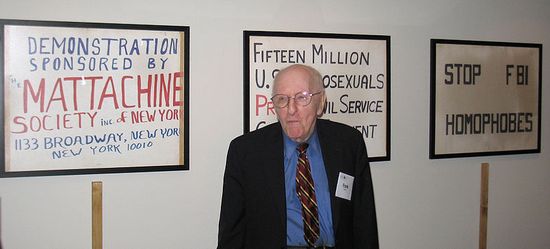
800px-Frank_Kameny_in_June_2009

The salience of the drag queen revolt in the West Village in June 1969 is not in any historical dispute. It was a cultural and psychological breakthrough – an empowering moment that clearly shifted something deep in gay America's psyche. But the notion that before this, there was no gay rights movement, that those amazing drag queens were the first gay Americans ever to stand up for their rights in public, is as preposterous as it is now deemed indisputable. Take this quote from Eric Marcus in the NYT today:

“Before Stonewall there was no such thing as coming out or being out,” says Eric Marcus, the author of “Making Gay History: The Half-Century Fight for Lesbian & Gay Equal Rights.” “People talk about being in and out now; there was no out, there was just in.”

Has Eric Marcus heard of Frank Kameny? Many Dish readers have. But for those who haven't, here's his Wiki intro:

Dr. Franklin E. "Frank" Kameny (born May 21, 1925 in New York City) is "one of the most significant figures" in the American gay rights movement. In 1957, Kameny was dismissed from his position as an astronomer in the Army Map Service in Washington, D.C. because of his homosexuality, leading him to begin "a Herculean struggle with the American establishment that would transform the homophile movement" and "spearhead a new period of militancy in the homosexual rights movement of the early 1960s". Kameny protested his firing by the U.S. Civil Service Commission due to his homosexuality, and argued this case to the United States Supreme Court.

Although the court denied his petition, it is notable as the first civil rights claim based on sexual orientation. Later that year he and Jack Nichols co-founded the Mattachine Society of Washington, an organization that pressed aggressively for gay and lesbian civil rights; in 1963 the group was the subject of Congressional hearings initiated by Congressman John Dowdy over its right to solicit funds.

There was "out" before Stonewall. It was a different kind of out. But I'd argue that the courage of a civil servant in a suit and tie marching outside the White House in 1963 deserves just as much respect and focus as Village bar patrons six years later. Kameny also coined the phrase "gay is good" a year before Stonewall, and had helped build the infrastructure for the entire gay movement before that. His tireless work in Washington DC over the decades didn't just end the sodomy law but has brought a predominantly African-American city to embrace full marriage rights – rights that are still unavailable in the city where Stonewall erupted.

He was a soldier, a patriot, and a ferociously brave intellectual and activist. His was not a politics of performance art, but of constant interaction, discussion, reason, argument, candor. And the concerted attempt to erase the history of this older, more centrist (and therefore more radical) gay politics is itself a political move – to co-opt the gay rights movement for the New Left, rather than seeing it as a much more complex and diverse movement, that often used radicalism and revolt, but also deployed argument and logic in the long and winding road to equal dignity. In fact, this fusion of proud and openly gay engagement with American society with sporadic revolt against it has been the key to the movement's astonishingly swift success.

The best essay on this aspect of the shaping of history remains Bruce Bawer's "The Stonewall Myth". Re-reading it more than fifteen years later, I am struck by how much has changed. The marriage question and the fight for military service did indeed transform gay politics and culture into something much more than counter-cultural revolt. You can see more clearly now the line that connects the gay rights movement of the 1950s and early 1960s with the gay rights movement that emerged in the 1990s and since. The counter-cultural and the integrationist wings together gave the movement flight.

Yet only one wing is truly celebrated in the gay community. That really should end. Even if Frank remains far too modest to say so.

“They Do Not Know It, But They Are Doing It”

Jay Rosen tries to pin down the ideology of the American press corps:

So: liberal or conservative? My answer: it’s complicated. One thing we can definitely say: political journalists are cosmopolitans, and they will see the world through that lens. They may also stop seeing it as a lens, and that’s when it becomes an ideology. But even if we had an x-ray machine that gave us perfect information about the beliefs of the journalists who report on politics, the ideological drift of the work they produce wouldn’t necessarily match the personal beliefs or voting patterns of the reporters and editors on the beat because there are other factors that intervene between the authors of news accounts and the accounts they author.

Julian Sanchez further complicates things:

Rosen pretty clearly regards most of these ideological tendencies as pernicious, and while I'm often inclined to agree, it's also worth at least asking whether, in each case, they're any worse than the plausible alternatives. Suppose, for instance, we agree that its both delusional for journalists to cultivate an attitude of being untouchably "above the fray" and that this attitude ends up warping coverage in undesirable ways. It might yet be the case that we're so naturally disposed to tribalism that it can only be avoided by cultivating a self conception as a member of the Savvy Tribe. It would be depressing if this were true, of course, but it can't be ruled out a priori. Sometimes our delusions serve useful functions.

Palin’s Next Prop?

Patt Morrison fumes over the former governor's angling to get a meeting with the Iron Lady:

Baroness Thatcher is suffering from dementia, according to her daughter, Carol. Writing in the Daily Mail more than a year and a half ago, Carol Thatcher chronicled her mother's decline: "On bad days, she could hardly remember the beginning of a sentence by the time she got to the end.'' For a woman of Thatcher's formidable intellect and unflagging energy, it's a sad decline. For Palin's camp to use her as a human prop, as in a photo op, it's unforgivable.

For one thing, Thatcher was never about female solidarity. For another, she did not suffer fools gladly; her exacting impatience with anyone not up to snuff was legendary. And what the woman who fought to become prime minister and fought harder to stay there might have said of a governor who walked away from her elected office can be vividly and acidly imagined.

Whoever agreed to this photo-op should rescind it. Claire Berlinski makes the obvious point about the vast differences between Palin and Thatcher:

If Palin hopes to style herself as the second coming she has a few things to learn. She might wish to study Thatcher's disciplined command of arguments, facts and statistics, for instance. By the time Thatcher was elected, she'd enjoyed a 20-year parliamentary career. Her clearly expressed views – clearly expressed, I stress – about every crisis, problem and debate of concern to Britain were a matter of public record. Palin has neither said nor written a line so far that would allow anyone reasonably to conclude that her opinions about economic and foreign policy are as cogent and informed as Thatcher's. No one (not me, anyway) can argue with her conservative instincts, but to compare her ability to express them with Thatcher's would be ludicrous.

This ability allowed Thatcher to dominate in unscripted interviews. When interrogated by hostile journalists she left them speechless and stuttering. She regularly ate Neil Kinnock for lunch during prime minister's questions. Her eidetic command of inflation statistics verged on the weird, suggesting the obsessive aspect of men who routinely memorise train schedules.

Berlinski notes how Thatcher shrewdly used her femininity to foil male pols. But that's vastly different from the kind of victimology Palin engages in. But the core point is surely this: Using an elderly woman with dementia to advance your own celebrity and political clout is as disgusting as using an infant with Down Syndrome. It's a form of abuse. Please, don't let her get away with this.

A “Wink” And A Bashing

If you wonder why the top brass remain leery of ending the gay ban:

[Witnesses] told police one of the men grew angry because he thought Daly was winking at him and struck Daly in the back of the head with his fist, knocking him unconscious.

Saturday night, from his bed at Memorial University Medical Center, Daly insisted he tried to convince the Marines he was not winking at them. "The guy thought I was winking at him," Daly said. "I told him, 'I was squinting, man. … I'm tired.'"

Daly said one of the men told him he demanded respect because he served in Iraq. And at least one hurled slurs at him as he tried to walk away. "That's the last thing I remember is walking away," Daly said.

Daly said after his friends performed cardiopulmonary resuscitation at the scene, he was taken to Memorial University Medical Center and diagnosed with bruises to his brain. He had two seizures immediately after the attack and was expected to remain at Memorial for several days.