Check, Please, Ctd

A reader writes:

The problem with people on the "terrorism watch list" being able to buy guns is a problem with the "terrorism watch list," not gun-rights advocates. There's no judicial process involved in the list, no legal way to get yourself taken off of the list once you're on it. (The ACLU's critique of "watch lists" is here.) Blaming the "gun rights lobby" for preserving the right of legally innocent, untried Americans to buy guns is akin to blaming the ACLU for protecting the right of Nazi sympathizers to hold rallies. They're doing exactly what they should be doing.

It's an easy, cheap shot to take ("terrorists buying guns, lol"), but I've known people who got thrown onto the watch list simply for showing up at anti-Bush protest rallies. At one point Ted Kennedy was on the no-fly list. Preventing people from buying a firearm – a constitutionally protected right – merely on the basis of chance allegation would set a horrible precedent, potentially allowing prior restraints on any number of other civil and constitutional rights on equally flimsy grounds. Don't defend this crap. The proper response to a legally innocent individual purchasing a firearm, when that person happens to be on a watch list, is to watch them, perhaps closely, not to strip them of legal rights without due process.

The passage in piece that addresses these concerns:

Senator Frank Lautenberg, a Democrat, and Representative Peter King, a Republican, have twice introduced legislation that would create such a list, and the Obama administration supports the effort. The legislation takes into account criticisms of the terrorist watch list—that it is bloated, for instance, and encompasses innocent people, including those who happen to share names with terrorist suspects—by including a due process provision for people who believe they've been wrongfully denied a gun purchase; they would be able petition to have the restriction against them lifted.
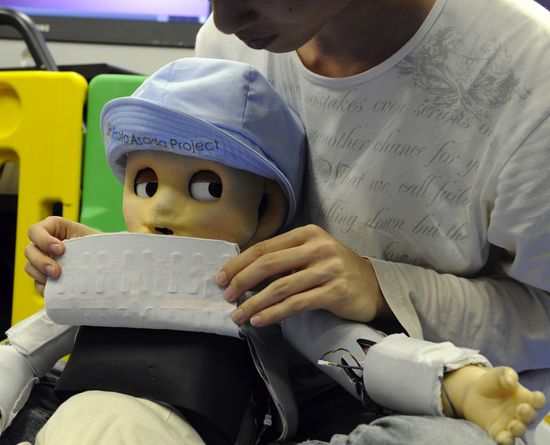

Face Of The Day

102100577_

Japanese post-graduate student Kosuke Nakamura shows off the robot baby named Noby (short for 'nine-month-old baby'), that is 71 cm in height and weighs 7.9kg, at a laboratory at the Tokyo University on June 15, 2010. The baby robot has two cameras and two microphones on its head and is also equipped with some 600 touch sensors in the artificial skin of his body. The robot is designed to simulate the behaviour and growth of a real infant, an invention it is hoped will help researchers better understand human development. By Yoshikazu Tsuno/AFP/Getty Images.

Iran – A Year Later, Ctd

Joe Klein reads Reuel Marc Gerecht's latest op-ed:

I do believe that Gerecht overstates the capacity of the Green Movement to succeed in toppling the current, odious regime. To win, the reformers will have to find an alliance with the quietist members of the religious community; the bazaaris, whose businesses are being hurt by Iran's increasing commercial isolation (not just the sanctions, but the unilateral decision by an increasing number of international corporations not to do business with this regime); and some of the more moderate "principleist" conservatives, who will be favored candidates in the next election.

Larison piles on. And the Leveretts dust off their old song and dance.

What Would Libertarians Do About The Gulf?

Edward Glaeser wants to know:

Consider the purely hypothetical case of a massive oil spill in the Gulf of Mexico. The traditional libertarian would argue that regulation is unnecessary because the tort system will hold the driller liable for any damage. But what if the leak is so vast that the driller doesn’t have the resources to pay? The libertarian would respond that the driller should have been forced to post a bond or pay for sufficient insurance to cover any conceivable spill. Perhaps, but then the government needs to regulate the insurance contract and the resources of the insurer.

Even more problematically, the libertarian’s solution requires us to place great trust in part of the public sector: the court system. At times, judges have been bribed; any courtroom can be influenced by the best lawyers that money can buy.

This strikes me as a critique of extreme libertarianism (which, alas, tends to crowd out other variants). I believe in strong and aggressive government regulation of this kind of thing. So that companies like BP do not walk into disasters like this one.

Hewitt Award Nominee, Ctd

Larison picks up on this Totten-Hanson exchange:

What is remarkable about the interview is that Totten and Hanson simply feed off one another and reinforce each other’s nonsense. There is not one probing or challenging question for Hanson in the entire interview. Totten does not object when Hanson says, “We’re only 65 years from the Holocaust. Europe is still anti-Semitic, and Israel is on its own except for the United States.” This sort of blanket condemnation of an entire continent for rank prejudice is as sloppy and false as it gets, and it gets dropped into the conversation as if Hanson were discussing the weather.

Neoconservatism’s Marxist Roots Are Showing

A reader writes:

Kristol's ideology reminds me a lot of Marxism. It's a theory that works only in an ideal world that doesn't actually exist. In Kristol's world, the US can muster the political will and economic might to build an enormous army akin to what we fielded in World War Two. He believes we can march that army into the heart of the middle east and impose our will on a country like Iran; that doing so would have no long term negative ramifications for our economy; and that any negative consequences to our standing in the world could be ignored because we are the all powerful hegemon.  Of course none of that is true. 

Whether Iran counter-attacked or not, the consequences for our country would be almost entirely negative if we attacked them.  There's no realistic scheme under which we could unleash the kind of overwhelming force Kristol suggests.  So our limited efforts would only secure the power of those currently in charge in Tehran and they would crush any straggling remnants of the green revolution. It would give an excuse to other nations to ease up on sanctions in the interests of making money from trade with Iran.  It would provide the justification for Iran to go really nuclear in the future and the means by which to do it.

This is true and familiar. The first generation of neocons were ex-leftists and the pattern of thought is identical. What's staggering to me is that this ideology has become even more rigid after the most obvious refutation of its delusions one can imagine. Iraq and Afghanistan were to be models of the power of military might to coerce change; they would prove that under the surface all humans were interchangeable and all culture and history would surrender to a particular version of individual liberty that was, for the neocons, a fact about humanity. The sublime popularity of the American model was self-evident; the impact of culture, of religion, of history were no matches for the "march of freedom".

As you watch Iraq today veer between a reprise of brutal sectarian warfare and a political class utterly uninterested in actual democracy, only a blind man or a fool can still believe what Kristol and others (including me) said before the war. As you observe Afghanistan returning to its entropic state, and the obvious delusions engaged in by the president just a few months ago, how on earth can you be still instinctively wedded to the notion of ever-increasing US military enmeshment in failed states, let alone a completely unpredictable and potentially catastrophic attack on Iran? Only ideologues or cynics can sustain this kind of insanity against this mountain of empirical evidence. 

Kristol, I suspect, is both: an ideologue and a cynic. Which is why his candidate is Sarah Palin. And why she will be her party's nominee in 2012.