Iran – A Year Later

Weepiran

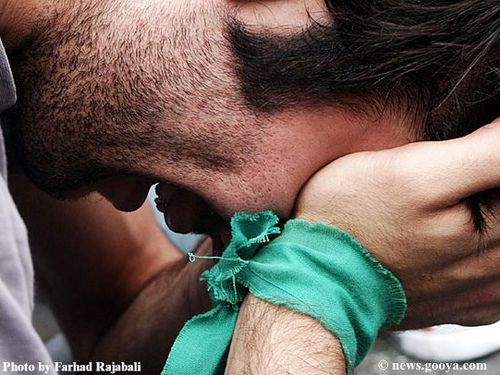
One way to see if an argument is worth its muster is to ask whether it addresses the core points of the best rebuttal. Reuel Marc Gerecht's op-ed completely fails this test today. The obvious reason that president Obama decided to keep his support for the Green Movement in Iran muted was … to help the Green Movement in Iran. His view – shared in large part by Mousavi and Karroubi – was that too strong a US public stand would backfire. It would allow the mullahs to play the Great Satan card more effectively, and marginalize the message of the Greens. Now, it's possible to disagree with that and see Iran as more like the old Soviet Union than a Muslim society with deep – and thoroughly understandable – suspicions about US meddling. But if so, you should make that case. Frankly, I remain unpersuaded that we should treat Iran like Czechoslovakia. I have learned something from this past decade which is that history and culture matter, that rhetorical grandstanding is no substitute for diplomacy and strategy, and that neoconservative projections about the Middle East have been proven spectacularly misguided, ill-informed and counter-productive.

Let's put it this way: Gerecht's op-ed this morning does nothing to change my mind.
Homeownership Ticks Down

Richard Florida sees a silver lining, while Felix Salmon's worry lines deepen. Avent isn't sure about the truism that homeowners benefit communities:

Homeownership, as I’ve mentioned before, is an undiversified, highly-leveraged, immobile, illiquid financial bet. Having made such a bet, homeowners become very risk averse. We can imagine situations in which new developments are likely to benefit local homeowners and increase the value of their properties, but have benefits uncertain enough that there is a small but real probability of a negative effect on local property values. Highly risk-averse homeowners may opt to oppose the project, despite the good chance that they’d benefit from it.

Iran, A Year Later, Ctd

Juan Cole believes that the Green Movement still has life left in it. Karim Sadjadpour does a Q & A:

Two things happened after the elections that impacted Tehran’s foreign policy. First, any lingering moderates or pragmatists were essentially purged from the decision-making structure, leaving Ayatollah Khamenei surrounded by a group of likeminded hardliners with two overarching political instincts: mistrust and defiance. Second, the ongoing internal power struggles made it even more difficult than usual for the regime to make decisions. 

Essentialism And Pleasure

Jonah Lehrer reviews Paul Bloom's new book:

The Yale psychologist Paul Bloom has written an excellent new book, How Pleasure Works, that I had the pleasure of blurbing. The book elegantly refutes the idea that our pleasures are mere sensations, or that our delight can be neatly reduced into some ingredient list of superficial perceptions. Instead, Bloom emphasizes the importance of essentialism, which is the instinctive belief that everything in the world has an underlying reality, or true nature, or essence.

The Least Peaceful Country

Globalpeace
Iraq claims the title for a fourth year:

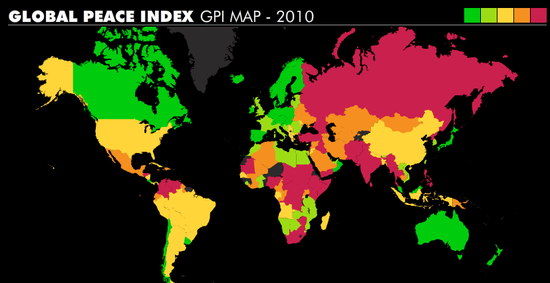
Iraq received the worst score because of the continued political and social conflict in the country. Despite security improving in 2009 and the holding of provincial elections at the beginning of that year, there were still 4,645 Iraqis killed according to Iraq Body Count. In comparison, the Brookings Institution recorded 2,259 Afghans that died that year. The country also had a high number of displaced and refugees, which have not returned home. Military expenditures also increased last year because Iraqi forces were asked to do more with the U.S. beginning to withdraw. The growth of Prime Minister Nouri al-Maliki’s power was given mixed reviews because while he provided leadership, he also led to internal problems with other parties and the Kurds. Overall, the Institute thought that while 2009 was an improvement over previous years, the continued tensions and violence within Iraq justified putting it at the bottom of its list.

Study and interactive map here.

Coupon Clippers

Meet your king:

My sister challenged me to try and eat well for a month spending only $1 a day for food. It probably would have been wise if I had thought about how much I hate shopping and cooking before I took on the challenge, but once I committed, nothing could stop me (not even a trip to the emergency roomtwo times — in the first week) I began May 1 with absolutely no food and managed to stay under my $31 budget for the month (I bought $597.96 worth of food and other stuff for $27.08 during the month).

If We Bomb Iran

Bill Kristol and Jamie Fly

If the Iranian regime is so concerned about their survival that they won't hit the U.S. after a military strike against their country, than they obviously aren't going to be using their nuclear weapons against anyone lest they invite a far more devastating attack. The same argument, in other words, that leads Kristol and Fly to conclude we can safely attack Iran can be flipped around to conclude that we can live with and contain a nuclear-armed Iran.

The True Cost Of Oil: $4.60

Ezra Klein does the math:

For all the complexity of calculating the true cost of oil…it’s unclear that it matters as much as some might think. I assumed that a world in which gasoline’s total costs were present at the pump would be a world in which our consumption was radically different. But almost all of the experts I spoke to said that wasn’t true. If an energy source as dirty as coal had to pay its true cost, we’d likely stop using it. But, disasters aside, that’s not the case with oil.

Years of regulation and innovation have made us better at finding, extracting, refining, and using oil. Oil might be cheap compared to its true costs, but adding those costs in wouldn’t make it unaffordable. That gets to the bigger issue, which is that energy sources are only cheap or expensive relative to one another. And the anchor beneath our reliance on oil is that, at this point, there’s nothing to replace it.