From June 10, this week:
Author: Andrew Sullivan
Watching America From Iran
Greg observes:
If I were an Iranian protester observing American political discourse since the Green movement began, what would I notice? During the last 12 months, the voices who claimed they want to see democracy take root in Iran were vastly more concerned with the foreign policy of a free Turkey than an unfree Saudi Arabia. I would notice that the voluminous output of anti-Semitism in Saudi Arabia was ignored, while the demagoguery of Turkey's leaders was treated as evidence of a nascent Islamist rogue state and regional competitor.
I would conclude that the same voices professing solidarity with my cause are less concerned with political freedom than with geopolitical orientation.
When Exactly Was This Intellectual Golden Age?
Steven Pinker counters Nick Carr:
It’s not as if habits of deep reflection, thorough research and rigorous reasoning ever came naturally to people. They must be acquired in special institutions, which we call universities, and maintained with constant upkeep, which we call analysis, criticism and debate. They are not granted by propping a heavy encyclopedia on your lap, nor are they taken away by efficient access to information on the Internet.
English Humour
Why do the British love fart jokes so much? Rude Britannia, a British comic art show at the Tate in London, sheds some light:
Going too far, getting away with it, pushing your luck – there's something schoolboyish about British rudeness, about being quite the naughtiest kid in the class. And how quickly the connoisseur of British humour moves from naughtiness to bodily functions. The Fifties cabaret duo Flanders and Swann had a routine called "Mum's Out, Dad's Out, Let's Talk Rude", which climaxed with the line: "Pee, poo, belly, bum, drawers". One looks at the high number of bottoms and willies in the Rude Britannia show, and marvels at how fundamental our sense of humour has always been.
A World Cup Primer
An Ethanol Bailout?
Oy:
The blowout of BP's Macondo well has given the corn-ethanol industry yet another opportunity to push its fuel adulterant on the American consumer. And unfortunately, the Obama administration appears ready and willing to foist yet more of the corrosive, environmentally destructive, low-heat-energy fuel on motorists.
Face Of The Day

Men march during the Gay Pride parade in Tel Aviv on June 11, 2010, as thousands turned out for the city's gay festival. By Marco Longari/AFP/Getty Images. And, no, this isn't replicated in Gaza.
The Limits Of Miscegenation Nation
Reihan stands at the crossroads of politics, religion, and race:
One wonders where this leaves the unassimilable or unmeltable ethnics, who choose not to intermarry or to convert to Christianity or some other "mainstream" faith. At present, there are 13 self-identified Jewish members in the U.S. Senate, and two more members with one Jewish parent. In an earlier era, this would have been all but unimaginable. Now we consider it entirely unremarkable, not least because the Jewish community has been part of the fabric of American life for centuries. Can we imagine similar representation of Buddhists or Hindus or Muslims? The obvious answer is no, at least not in our lifetimes. And that's entirely understandable. In any democratic polity, the voting public wants to identify with its leaders. But let's keep the fact that some of our citizens are too exotic for leadership roles in mind before we congratulate ourselves on our tolerance and our embrace of diversity.
Mitch McConnell And Constitutional Abuse
What exactly is his problem?
The View From Your Recession
A reader writes:
I work at a semi conductor company in the Dallas suburbs. We ate shit in 2008 after eating shit in painful restructuring of our own doing in 2007. We went from 21 people to 13, with the survivors taking a 50% pay cut for half of '08. The average age of our company has to be close to 60, so a lot of seniors looked at their 401(k)s wondering if there was another paycheck coming or how long they could hold their breath. As the controller I got a front row ticket in the raft going over the waterfall.
The last eight months, however, have been the best in the company's 30-year history. Sales are up 70%. Our pay is back to normal and we hired our fourth new employee on Monday. I attribute our success to pent-up customer budgets and being one of the few surviving competitors in our market.
Another writes:
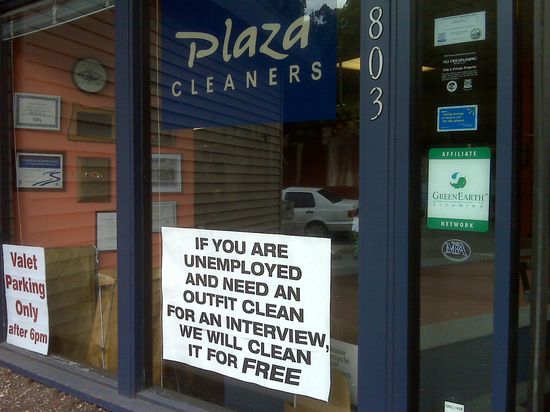
I dropped a suit off at the dry cleaners on Monday, and noticed this sign – a small but neat gesture from a dry cleaning outfit in Portland, OR
 The Dish