Why Israel Changed: Trauma

TRAUMAUrielSinai:Getty

A reader writes:

I don't believe that the shift in Israeli sentiment is the result of whacked out religious extremism, or a belief that God gave them all of the land, or even excessive paranoia. I think it's the result of their long experience with terrorist attacks. The whole point of terrorism is to create anxiety and even panic in civilian populations. Well, if you do that in a democracy, you get very strong support for some pretty brutal policies. People don't like being scared, and they'll demand that their government do something — anything — about it. We saw that here after 9/11, and we're seeing it in Israel.

Imagine that every time you walked around in Ptown you had the idea, in the back of your head, that a bomb might go off in public spaces. Every now and then one would go off, not when you're present, but perhaps in places you visit. A few people would be killed or injured. Not many. But a few. And you just lived that way for several years. My contention is that such an experience would change you. And that it has, in fact, changed the people of Israel.

I remember being back in Nebraska after 9/11, and listening to people talk about whether or not a bomb was likely to go off at a shopping mall. I'd say, "They don't even know where Nebraska is," and the person I was talking to would say, "You don't know that, the SAC headquarters are here, there's a large military base, we could be a target." I don't think it was reasonable or realistic to be afraid. But people were. And I think that has a lot to do with their embrace of all the shitty stuff we embraced as a country.

This is an explanation that doesn't really appeal to anyone. What I'm saying, basically, is that Israel has been traumatized, and that it's acting irrationally (and immorally) as a result. Supporters of Israel certainly don't want to hear that.

I'm pointing out that terrorism is really fucking evil, and really, really corrosive. No one backing the Palestinians wants to focus on that. Even really reasonable critics of Israel don't want to talk about that. You're not saying much about terrorism and what has happened in your comments. None of this excuses anything. Whoever put those four slugs in that kid's head is a murderer. But I think it explains it.

I'm sure it's a factor. What's strange, however, is that the current veer to the far right has occurred during a time when the risk to most Israelis from such terrorism, with the exception of Southern Israel, has declined. But no doubt the memory of that experience – when projected onto Hamas' war crimes against civilians in towns like Sderot – still operates. All I can say is: if we are not to lose our souls, we have to resist succumbing to this human temptation. It is to take terrorism's bait – and magnify its power.

I didn't always see things this way. The last decade has forced me to look into that abyss and turn back.

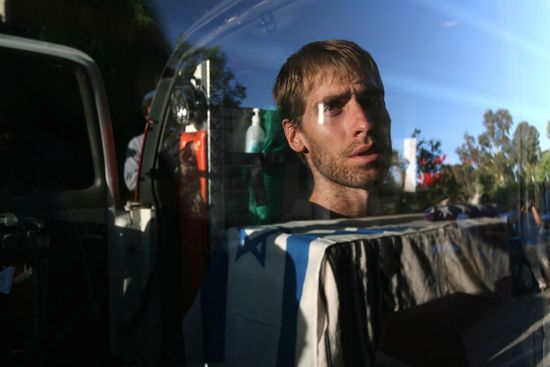
(Photo: A relative of Florida teenager Daniel Wultz looks at his coffin as it is taken away after a memorial ceremony for the 16-year-old Jewish youth May 15, 2006 at a synagogue in Jerusalem, Israel. Wultz was critically injured in a Palestinian suicide bombing on a Tel Aviv restaurant three weeks ago and succumbed to his injuries May 14. His body will be flown to Miami overnight for burial on May 16 in South Florida. By Uriel Sinai/Getty Images.)

Quote For The Day

"There is no simple answer to why my nomination failed. But I have no doubt that the OLC torture memo — and my profoundly negative reaction to it — was a critical factor behind the substantial Republican opposition that sustained a filibuster threat. Paradoxically, prominent Republicans earlier had offered criticisms strikingly similar to my own. A bipartisan acceptance of those criticisms is key to moving forward. The Senate should not confirm anyone who defends that memo as acceptable legal advice," – Dawn Johnsen, on her bid to lead the Office of Legal Counsel. 

The Birds, Ctd

A reader writes:

Yes, gruesome. Odd, however, that Think Progress is meticulously tracking the deaths of a few hundred birds, but never mentions that it favors attempting to replace oil with a technology – wind farms – known to kill up to 40,000 birds a year, every year, in a similarly gruesome fashion, leaving them to die in pain on the ground half-beaten to death. I guess the latter deaths aren’t as politically useful, thus not worthy of any attention. But, by all means, let us declare the end of oil because we can easily switch over to … um, well, something I’m sure. Oh, man, how come reality has to intrude on every great progressive talking point?!

PolitiFact backs up that claim – and then some:

The American Bird Conservancy estimated in 2003 that between 10,000 and 40,000 birds were killed each year at wind farms across the country, about 80 percent of which were songbirds and 10 percent birds of prey. “With the increased capacity over the last seven years, we now estimate that 100,000 – 300,000 birds are killed by wind turbines each year,” said Conservancy spokesman Robert Johns. By our math, that comes to 274 to 822 birds a day killed by wind farms across the country.

Update – more context from a reader:

40,000 or 300,000 birds is a lot – but a tiny number compared to some other causes of death. The US Fish and Wildlife Service estimates (PDF) that somewhere between 97-196 million birds are killed annually by collisions with building windows.

“A Convicted Serial Environmental Criminal,” Ctd

Tumblr_l3oh7t75Ec1qzlfumo1_500

We will have to wait for the full report on the Deepwater Horizon well to find out exactly what went wrong. But this is a fascinating industry press piece that damns BP:

Engineers contacted by Technology Review insist that conclusive answers will come with completion of the investigations, but criticize, for example, BP's decision to install a continuous set of threaded casing pipes from the wellhead down to the bottom of its well. "The only thing I can figure is they must have thought it was a cost-cutting deal," says Bommer of BP's well design.

This can be problematic in deep, high-pressure wells for two reasons.

First, it seals off the space between the casing and the bore hole, leaving one blind to leaks that sneak up around the casing pipe (as the BP Deepwater blowout is suspected to have done). Second, the long string gives gas more time to percolate into the well. A preferred alternative in high-pressure deepwater is a "liner" design in which drillers install and then cement in place a short string of casing in the lower reaches of the well before casing the rest of the well. This design enables the driller to watch for leaks while the cement is setting.

"It takes a more time and costs a little more but it's a much safer way to do it," says Geoff Kimbrough, vice president for deepwater operations at Houston-based drilling consultancy New Tech Engineering.

Kimbrough cautions that transforming corporate cultures will take time because choosing the more conservative operation can easily cost $10 million to $20 million. Not all companies have leaders who readily support these decisions, says Kimbrough: "The courage to do that doesn't come overnight. It comes from years and years of support from senior management."

If this pans out, we need to see these corporate criminals in the slammer.

(Illustration by Mike Mitchell.)

Why Doesn’t Krugman Fear The Debt?

Crook asks:

I think Krugman is correct to argue against "fiscal austerity now now now", especially for the US. But Galston's view, as I say, is consistent with this. It's the long-term outlook they disagree about. I don't understand why Krugman won't more fully acknowledge the long-term problem. Why not give equal emphasis to the need for further short-term stimulus combined with tax increases and/or spending cuts later? Difficult to do, of course, but what is the objection in principle?

Michelangelo Meets Reality TV

Edward Winkleman is underwhelmed by Bravo's latest:

The contestants are being judged on their rapid-response creativity, and that's not the same thing as making art. A work of art is completed when the artist says it is, not when the buzzer goes off. Time to fail, to make mistakes, and to correct them is built into the process. You wouldn't judge Michelangelo's David after only 12 hours of carving it, and in that respect the show needs to toss words like "great" or "masterpiece" (really?) around a bit more carefully in my opinion.

Why Are We Afraid Of Public Speaking?

Jesse Bering does the heavy lifting:

In a study published earlier this year in the journal Psychophysiology, University of Würzburg psychologist Matthias Wieser and his colleagues tried to make some evolutionary sense of why public speaking is so many people’s biggest fear. One of the reasons, they argue, is that the state of social anxiety generated by being the center of attention has an unfortunate adaptive effect—we become super-alert to the presence of angry faces. This limbically-driven attentional bias in which angry or unhappy faces are processed especially rapidly by a socially anxious brain would have been evolutionarily adaptive (and probably continues to be so) because it helped our ancestors to avert dangerous social uprisings that had the potential to ruin their reputations, reproduction and very survival.

Weed Goes Mainstream

Marijuanagoogletrends

Scott Morgan thinks that the marijuana debate has broken into the MSM:

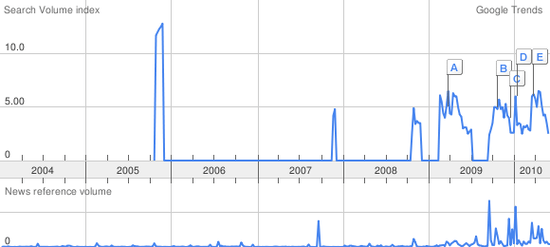
Everywhere you look, even the mainstream press is picking up on the fact that people want to talk about this. Just look at NPR's The New Marijuana series, which has churned out more marijuana stories this week than I have time to read. CBS has been doing the same thing with Marijuana Nation, CNBC had a big hit with Marijuana Inc., and even Fox News has recruited John Stossel and Judge Napolitano to trash the drug war on Rupert Murdoch's dime.

Google trends data on "marijuana legalization" here.