The Case For Means Testing, In Graph Form

Socialsecuritydivision
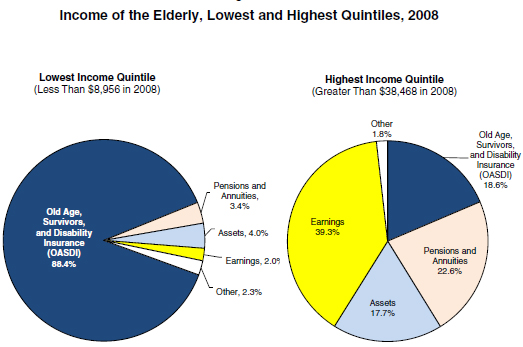
Catherine Rampell studies a new report on how much seniors rely on social security:

As you can seen, elderly Americans in the bottom income quintile receive 88.4 percent of their income from Social Security. Members of the highest income quintile receives less than a quarter of their income from this source.

I reiterate my longstanding position: social security should be seen as insurance, not investment. You pay in to ensure that you do not retire or die in penury. But if you have managed to find a way to live well without that security, you don't get your premiums back. I know this is not how it was sold in the first place; I know this violates core liberal principles about social welfare (but screw you, I'm not a liberal); but in a fiscal crisis where every dollar counts, means-testing the wealthy elderly seems to me an easy call.

California’s Jungle Primaries, Ctd

A reader writes:

I am a political scientist, and I know the literature Masket is citing in criticizing Prop 14.  And yet I voted for the proposition because the system here is so completely broken, and this is only way I had to vent my frustration with it.  Sure, there are uncertainties, but it’s hard to see how this ungovernable state could get any worse.

In addition, I think that third party voters are actually helped by this system.  Consider Green voters who want to vote for a Green candidate but prefer the Democrat to the Republican.  Do they vote their conscience, knowing that their preferred candidate cannot win, or strategically, to help the chances of their second best candidate?   Prop 14 eliminates this dilemma.  These voters can vote their conscience in the primary and then vote for their most preferred major party candidate in the general.

Another writes:

I'm a Californian who is somewhat mystified by the opposition to this measure.  I voted for it yesterday based on experiences of the past several years, during which politicians have had to take ever more extreme positions in order to get through the primaries. 

Arlen Specter quit the Republican party due to a primary challenge, Jon McCain has gone off to crazy land in order to prove he's not a RINO, and in the current California governor race Meg Whitman and Steve Poizner spent millions of dollars filling the airways with attack ads about who would be tougher on immigration in a state in which 36% of the population is Hispanic!

It's true that this solution won't be perfect, but the mantra that "perfect is the enemy of good" seems very relevant here.  The fears voiced by the bloggers you cited may have merit, but it's hard to see how that's any worse than a system in which moderate candidates have almost no chance unless they tack hard right or hard left.  Given a choice between the current madness and a possibility of something saner, I'd rather roll the dice and see how things turn out.

Another:

A lot of us are sick of being Republicans in Democratic-dominated districts, or vice-versa, where the only election that matters is the party primary.  True, under the new system you could end up with two conservatives, or two liberals in the final round.  But at least the whole electorate would get to express its choice.  And the charade of choosing between a Republican and a Democrat in the general election in certain districts is nonsense anyways.  Who cares if people in San Francisco end up choosing between left and left-er in the 2nd round?  That's probably the salient choice for them.

Another:

What should be noted is that redistricting reform is underway in California as well, which will remove redistricting from the Legislature and put it in the hands of a commission.  With districts that are not so precisely gerrymandered and hopefully more balanced, what we may see is that candidates will have to tack to the middle more often than not.  Clearly, this won't necessarily occur in Santa Monica, Berkeley, and some of the state's hard right communities.  But overall, the hope is that these two measures will complement each other and lead to some filling in of the no-one's land that currently is the political center in the legislature.  I made this point to an assemblyperson once, while they were busy bashing the open primary initiative, and they practically shouted me down.  There's a fear in the parties' machinery and their respective special interest groups of this potential future.

I Sound Like A Goddamned Hippie, But …

A reader writes:

Watching the Earth bleed and the Gulf die as a result of us humans is bracing to say the least. I'm all for being at the top of the food chain while cranking out some impressive art and science; but man, we're a nasty virulent organism.

Another adds a caveat:

I would say that the more precise description isn't one of addiction, but rather one of dependance. We have built our society in such a manner that, without oil and the energy fossil fuels provide, it would collapse.

Addiction implies that we simply must have oil, and that only oil can satisfy our craving. That strikes me as untrue – what we desire is the freedom cars and airplanes provide, heat in our homes, electricity for our computers, and so on. If an alternative energy source was truly a valid option, I don't think even the most stalwart "drill baby drill" chanter would be truly opposed to dropping oil and other fossil fuels entirely from our energy diet.

Dependency, however, implies that we need it because it is a necessary part of our societal structure, and this is when environmentalists begin to propose what looks, at least in my eyes, to a sort of forced austerity. Give up your cars and airplanes, a portion of the heat in your homes, the amount of electricity you use – this is what seems to be the basic anti-oil message. And right now, I don't think that is really an acceptable option, and I think most Americans, rightfully or wrongfully, are thinking along those lines.

What I think the oil spill did is indicate an absolute disregard for the method by which we procured this resource that we require. The blame is one we must all take – Americans in general did not demand the oversight necessary to engage in this kind of deepwater drilling, the government foolishly did not mandate or enforce the regulations that did exist, and BP did not care to adequately protect both its own purely selfish interests in profit and the national interest in protecting our shores from environmental catastrophe.

I do not think it follows that because of this disaster America, and the rest of the world for that matter, is quite in a position to truly break free of oil and fossil fuels being completely necessary for the maintenance of our current way of life. Until that changes, oil is here to stay.

I don't disagree as an empirical matter. And obviously, we need to keep the current system from being even less responsible than it need be. But few things have brought home to me the precariousness of this level of material well-being if it destroys the environment that makes it possible. Which, I guess, means to say that alternative energy is surely the highest imperative we could possibly have right now. And yet in refusing to re-price carbon, Americans are refusing to go there.

Grilling Michael Oren

The most penetrating political interviews on television these days are on Comedy Central. Stephen Colbert's grilling of Michael Oren last night was a classic. Deftly using comedy, Colbert got Oren to essentially admit that the blockade of Gaza is not just about the legitimate issue of restricting weapons getting through to Hamas. It's about collectively punishing the people of Gaza for using a democratic election to back Hamas. It's about turning the 1.5 million people there into helpless dependents on Israeli industry and the impoverishment of any private sector in that beleaguered de facto refugee camp. What, after all, does restricting snack-food, soda and shaving cream have to do with Israel's security interests? Money quote from Bronner's latest:

“I can’t get cocoa powder, I can’t get malt, I can’t get shortening or syrup or wrapping material or boxes,” lamented Mohammed Telbani, the head of Al Awda, a cookie and ice cream factory in the central town of Deir el Balah. “I don’t like Hamas and I don’t like Fatah. All I want is to make food.”

Of course this crude policy of trying to reduce support for Hamas by persecuting the entire Gaza population has failed. Well, duh. And the obvious achievement of the flotilla has been to expose this fact more clearly. McClatchy has also unearthed Israeli government documents that prove that this is not only a matter of security so much as an act of "economic warfare":

"A country has the right to decide that it chooses not to engage in economic relations or to give economic assistance to the other party to the conflict, or that it wishes to operate using 'economic warfare,'" the government said. McClatchy obtained the government's written statement from Gisha, the Legal Center for Freedom of Movement, which sued the government for information about the blockade. The Israeli high court upheld the suit, and the government delivered its statement earlier this year… The Israeli government took an additional step Wednesday and said the economic warfare is intended to achieve a political goal. A government spokesman, who couldn't be named as a matter of policy, told McClatchy that authorities will continue to ease the blockade but "could not lift the embargo altogether as long as Hamas remains in control" of Gaza.

To see what is in front of one's nose needs a constant struggle.

Iraq’s New Elites

Joel Wing finds that Iraq's top politicians make about 200 times what the average Iraqi earns:

Iraq’s politicians have made themselves the new elite of the country. There are no laws that regulate the salaries of Iraq’s top politicians, and parliament gets to vote on their own pay and benefits. Almost all of the information is also kept secret from the public, and only comes out when something is leaked to the media. Given that environment it’s no wonder that Iraq’s political class lives in such luxury compared to the rest of the country. The lack of accountability and transparency allows them to give themselves a plush life out of the country’s sight, while many Iraqis struggle. 

And the leading candidate to run the country is now bragging of the need for a "strong man." Yes, young Americans died for this.

Hewitt Award Nominee

"How would we react in America if people who decided to 'peacefully' overwhelm security at our airports to get on an airplane — for benevolent causes — and they stab or beat security agents at our airports. We don’t put up with that. Well, I don’t know. Maybe this administration would," – Congressman Louie Gohmert (R-TX), comparing the Israeli commandos to the TSA.