Sasha Frere-Jones peers into the future of music:
“Of the twenty hours a week that an average American spends listening to music, only three of it is stuff you own. The rest is radio,” [Pandora founder] Tim Westergren told me.
Sasha Frere-Jones peers into the future of music:
“Of the twenty hours a week that an average American spends listening to music, only three of it is stuff you own. The rest is radio,” [Pandora founder] Tim Westergren told me.
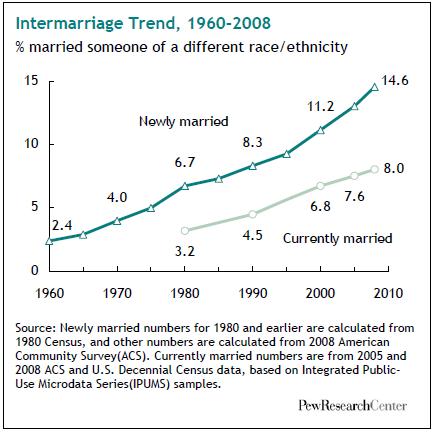
Pew has a new report finding that interracial marriages now account for one in seven new unions. Paul Waldman digs into the details:
The most common type of interracial union, making up 41 percent of the total, is Hispanic/white (black/white marriages are only 11 percent of all interracial marriages). 30.8 percent of Asians who married in 2008 married someone of another ethnicity — but it was heavily skewed toward women. While 39.5 percent of Asian women married non-Asian men, only 19.5 percent of Asian men married non-Asian women.
There are also some geographical differences (there's an interactive graphic here). While 21.4 percent of marriages in 2008 in the West were interracial, only 10.8 percent of those in the Midwest were. The highest proportion — 28 percent — was in Nevada. The lowest? Mississippi, at 5 percent.
Yglesias chimes in:
I think the upshot of this is that the country will be “whiter” in 2050 than naive demographic projections suggest and that will largely be because a very substantial portion of the descendants of today’s Hispanics and Asians will be considered white.
Ken Silverstein fumes:
Yes, the overwhelming majority of congress is going to be re-elected, because the rules are so heavily rigged in favor of incumbents–unless the member of congress is stupid enough to get caught in bed with a hooker or taking bribes, he or she is almost certainly going to win reelection. But concluding that this means that voters aren’t angry and frustrated misses the point by a million miles.
A reader writes:
You really should check out the album that the Shonen Knife track comes from: If I Were a Carpenter, a pretty successful revisionist tribute that helped take the guilty out of the pleasure for me. These alt versions help reveal that while Richard's production is soft and very much of its time (though excellent for what it was), no one can really match Karen's amazing voice. Two of my faves from the album are Grant Lee Buffalo's "We've Only Just Begun" and Sonic Youth's incredible version of "Superstar" (above).
Another writes:
I am enjoying your posts on alternate takes on songs by the Carpenters. The indie gay romantic comedy, “The Broken Hearts Club” (2000) features a soundtrack filled with the Carpenters songs performed by a variety of artists. It’s very entertaining. While the idea of soundtracks composed of the work of one pop group has become a cliché in “gay” movies (see “I Think I Do” – 1997 – with its full complement of soundtrack songs by the Partridge Family) the use of Carpenters music in “Broken Hearts Club” really complements the film’s mood. On the commentary track of the DVD, the director (Greg Berlanti) mentions that the one song they had the hardest time getting the rights to use was, oddly, “Sing A Song”. They had to go to Richard Carpenter himself for that one.
Another:
While on the subject of the Carpenters, please don't miss Superstar, Todd Haynes' beautiful experimental film using Barbie dolls to tell the story of Karen Carpenter's anorexic dissent. The film was banned from public viewing over licensing issues, but resourceful people might find it on Google. Watching it gives one a new understanding of anorexia and appreciation for the beauty of Karen's voice.
Oh, I won't forget seeing that. Part one is here (and you can find the others in the YouTube sidebar).
Terence Samuel writes some sane things about the politics of the BP disaster.
Megan and Ezra are fighting over drugs. Here's Klein:
If health-care reform increases total health-care spending — which is McArdle's first contention — then it should also increase profits for pharmaceutical companies, thus juicing innovation. This is what research by MIT's Amy Finkelstein suggested happened after Medicare was formed. In that world, McArdle's concerns that lost profits will lead to less innovation are moot. Profits are going to go up because spending is going to go up. The mechanism here — increased coverage leads to increased usage of health care by people who otherwise would be priced out of the system — assures it.
McArdle isn't so sure:
While it is certainly possible that higher health care spending will end up as more money for innovation, it's hardly a necessary corollary of the higher spending. My worry is that as costs rise, the sectors that aren't full of frontline health care workers become the easiest to squeeze–which is why you've heard a lot of bashing of Pharma and the insurance industry, and virtually nothing about hospitals, doctors, or powerful health care unions that have squeezed about a squintillion dollars from places like New York State. If that's the case, then higher profitability in the broader health care sector is the opposite of good news for pharma and medical device manufacturers–because they're the folks who will have their margins squeezed in order to pay for nurses and hospital beds.
Friedersdorf continues his long, doomed campaign against diamond engagement rings:
Why should women want to end diamond engagement rings? Well first of all, it's your money too, presuming the wedding eventually occurs, and more than that, you're the ones who are silently judged by status conscious people every time they look at the size of your rock — in other words, either you've got reason to feel bad about what other people think of you, or else you're complicit in a system that makes people with less wealthy fiances feel bad about themselves.
Larison yawns at the new sanctions against Iran and counters Yglesias's argument that even if "Iran continues to refuse to verifiably disarm, we want to make sure that other leaders of mid-sized powers still feel that a price is being paid that’s high enough to induce them to make other choices":
There are so few states with nuclear programs that need such dissuading that I doubt this matters very much. Even if we all agreed on this point, all of this hinges on Iran actually paying a high price. Aside from Obama loyalists and administration members, no one thinks that this round of sanctions does anything of the kind. Engagement advocates find the pursuit of a new round of sanctions misguided, but recognize weak sanctions when they see them. As the Leveretts correctly observe, this round of sanctions is very weak and had to be very weak to gain Russian and Chinese support. On the other side of the debate, Jackson Diehl points out all the reasons why these sanctions are not very significant. Many governments will not adopt the stricter financial sanctions and ship inspections that the resolution allows but does not require.
Today on the Dish, Andrew took a long look at the complex and troubled history of Israel. He also scratched his head at Michael Oren and Eli Lake. Gadi Taub pleaded with Israel to change course, Yglesias analyzed the latest sanctions against Iran, and John Collins Rudolf revealed the hidden damage of the oil spill. Prop 8 court updates here and here. Get your Palin fix here and here.
In electoral coverage, Josh Marshall checked in on the latest primary results, Ambinder addressed California's new jungle primaries, Taylor Steven made the case for an incumbent victory this fall, and Andrew hoped for a GOP comeback. Kaus campaign update here. In assorted commentary, Jeff Jacoby went to bat for petroleum, Edward Glaeser defended merit pay, David McRaney talked counter-culture and capitalism, Doug McCune visualized San Francisco's various crimes, Patrick examined the demographics of Internet users, and Alain de Botton warned of the perils of tracking the news.
Andrew meditated over death and conservatism while readers sounded off on fag hags. Lesbian PSA here, remixed movie posters here, and more music from the Carpenters here. Our chart of the day showed a shocking rate of incarceration. Recession view here. MHB here, VFYW here, and FOTD here.
We also announced the winner of our first VFYW contest and heard from a bunch of losers.
— C.B.
 The Dish