The Internet And Politics In America And Iran

Irantwitter

Dish eminence jeune Patrick Appel points out that internet users skew white, rich, educated, and young. Age is the greatest divide:

The young are more libertarian, pro-marijuana, and less religious than the American population generally. Millennials (pdf) are gay-friendly, racially tolerant, technologically savvy, welcoming of immigrants, open to government intervention, less hawkish, more accepting of non-traditional families, less inclined to marry early, and more optimistic about the state of the state of the nation. Thus, the consensus view among American Internet users may differ substantially from the result at the ballot box. This incongruity is amplified because senior citizens, the demographic least likely to have a robust online presence, has an outsized electoral footprint. 72 percent of American 65-to-74-year-olds voted in the 2008 election while only 48.5 percent of 18-to-24-year-olds exercised that right. We are in an era when the young have the most control over the dominant cultural medium while the old have the greatest say politically.

He also looks at the Iranian digital divide:

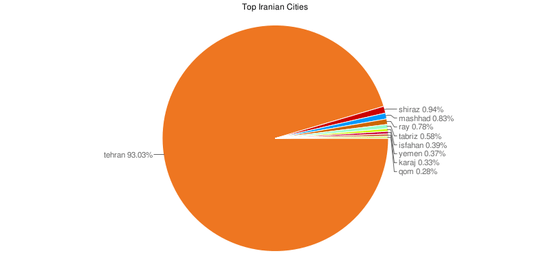
During last year's protests in Iran, Twitter was a primary means of receiving news from inside Iran. But how representative of the Iranian population were those tweeters? A few weeks after the protests broke out Sysomos found that 93 percent of Twitter users were located in Tehran, the center of the protests and one of Iranian opposition leader Mir-Hossein Mousavi's strongest bases of support.

Death And Conservatism

Decay

The Dish has had a spiritually enriching series (for me, at least) of the relationship of belief and unbelief to death, and the idea of death. But I think a deep appreciation of the centrality of mortality is also central to conservatism as I understand it. The first words of "The Conservative Soul" – "All conservatism begins with loss" – were my attempt to capture the existential realism of the conservative viewpoint and its reluctant acquiescence in all practical life as a form of inevitable and eventual failure. That is why the tersest description of a real conservative is Oakeshott's: someone who prefers present laughter to utopian bliss.

A reader notes a similar sentiment from Roger Scruton in his Gentle Regrets: Thoughts from a Life:

"The years of conflict have taught me that few will share my convictions, and that all attempts to conserve things come too late. But the philosopher who most clearly perceived this truth brought a message of peace: 'when philosophy paints its grey-in-grey, then is a form of life grown old. The Owl of Minerva speads its wing only with the gathering of the dusk.' Hegel's words describe not the view from that attic window in the Quartier Latin, but the soul that absorbed it.

It was not to change things, or to be part of things, or to be swept along by things, that I made my pilgrimage to Paris. It was to observe, to know, to understand. And so I acquired the consciousness of death and dying, without which the world cannot be loved for what it is. That, in essence, is what it means to be a conservative."

I wonder whether this is why conservatism – as opposed to pseudo-conservatism or American exceptionalism or populism or libertarianism – has had such a hard time putting down roots in America. There is something about late American capitalist culture, perhaps exemplified in the speech patterns and reflexes of Sarah Palin, that is always about progress, success, achievement, plowing through doors, seeing bright futures – even when decline is so apparent you need goggles to ignore it.

There is a core element of the tragic in conservatism. And yet America resists tragedy, denies it, moves past it, feels threatened by it. But until you have truly grappled with tragedy, you haven't fully grappled with reality.

The View From Your Window Contest: Winner #1

VFYWcontest_6-8

A reader writes:

I’ve been doing this for as long as I remember, and I’m pretty good.  But did you have to start with such a difficult and ugly picture? There are few clues in this one. I’d say it’s a view from a drug rehab halfway house in Texas or Oklahoma. Pretty cool that the inhabitant reads your blog.

We know our base. Another writes:

Canada, Newfoundland, St. John’s. Why? Assuming this photo was recently taken.  Buildings, windows, fence and trees look North American.  Flora seems to be more Atlantic side than Pacific.  Deciduous trees in background don’t have leaves.  Looks like there had been a lot of snow.  Has to be pretty far north.

Another:

The foliage looks sparse and bare, which leads me to believe that it was taken in the Southern Hemisphere – I’m guessing Victoria, Australia. That, or some drought-affected part of Central California!

Another:

The Faroe Islands. Reason: probably a high latitude judging by sky and shadow. Ivy on tree suggest north western Europe to me. No leaves on trees means far north.

Another:

Saskatchewan, Canada is my vote.  My first thought was the U.S. or Australia, but then I realized that it could be Canada as well; it’s a country with *room*.  The still-bare branches with short grass just sprouting up argue for a north-temperate zone location which favors Canada.  Of course, it could be Alaska or Russia but I’m sticking with Canada.  Europe is out.

Another:

Bratislava, Slovakia?

Another:

American window latch, American fencing and roofing. But not many leaves on those trees: either a drought or somewhere still very cold. Big prairie clouds. Pollarded tree, but a big one. I know that only from the US South. (Pollarded trees in France are smaller, garden size, not some huge pin oak or red or silver maple.) Texas? Argentina? Manitoba? But also a place with a Dish reader! Let’s say Stillwater, Oklahoma.

Another:

I’m guessing West Virginia.  The trees seem east coast US-y to me, and the locking system on the window looks comfortingly familiar.  Specifically West Viriginia, I’m sad to say, because the photo gives a sense of an area hard on its luck.

Another:

Spokane, Washington?  Pretty sure this is the States. This could be anywhere from Idaho to Nebraska to Maine I reckon. I figured I’d guess my home town since it was the first contest, and that is exactly where it reminded me of.

And then the paydirt:

Looks like my grandma’s backyard. Houses that look like sheds, signs of year-round drought, and Georgia O’Keeffe clouds gotta be Albuquerque, NM … no?

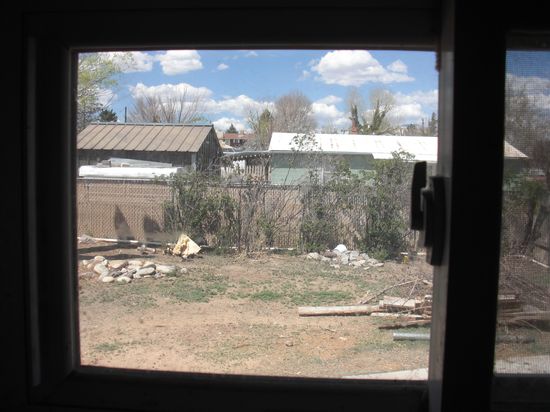
Close – Farmington, New Mexico, 4 pm. Española was the closest answer, submitted first by a reader with the initials P.L. – congrats!  And thanks to the hundreds of readers who participated. Shall we do this weekly?

When The Rump Votes, Ctd

Beinart thinks the GOP is "blowing their shot at a midterm landslide". Oddly, I think that would be better for them than a decisive win. Why? Because they may interpret victory this fall with victory for the Tea Party; and thereby be even more emboldened to take more radical anti-government positions. With a majority, moreover, they will have to take a position on spending cuts – and spell them out. If they are to resist any and all new taxes, the cuts will make the new British government look like the Bush administration. Which will doom them in 2012 and beyond, if Obama has any political skill at all.

And he has. Plenty.

Quote For The Day II

“Our critics don’t get it. In Jenin, we went house-to-house and sent 23 soldiers to their death. But if we’re going to be called war criminals no matter what we do, then maybe that changes our thinking,” – Michael Oren, Israel's ambassador to the US, threatening more military action less scrupulous than the Gaza bombardment.

This point just baffles:

"If the U.S. had an Israel in the Persian Gulf it might not have had to land troops in Iraq twice over the last two decades. Israel is the indispensable nation.”

Huh?

The pro-Israel lobby's latest fixation is a sudden demonization of Turkey. Eli Lake's latest really is a doozy. The only explanation for Turkey's horror at Gaza – shared by countless observers in the civilized world – is, for Eli, Islamization. Eli can write an entire article without ever referring to Israel's actions these past ten years, and using the Washington Times to send a warning to Turkey that AIPAC now sees Turkey as an enemy. And if AIPAC sees you as the enemy, who in Congress, do you think, could possibly demur?

When The Rump Votes

Josh Marshall's take on yesterday's results:

I think the big story here is Nevada. Harry Reid is weak. And Sue Lowden looked like a serviceable establishment GOP candidate who could take him out. But she self-destructed and the win looks like it will go to Sharron Angle, a hard-right Tea Partier who makes Rand Paul look like a bit of a trimmer. And no, that's not hyperbole.

This is the kind of result national Republicans have been desperately hoping to avoid. And it's the price of the 'energy' Republicans have been benefiting from on the right. In Nevada, you might say, their chickens are coming home to roost.

Was Israel A Mistake?

WESTBANKFIREJaafarAshtiyeh

So far, no luck on anti-Zionist columnists. And being critical of Israel does not mean you're an anti-Zionist. But a reader did note this 2006 column by Richard Cohen. Money quote:

The greatest mistake Israel could make at the moment is to forget that Israel itself is a mistake. It is an honest mistake, a well-intentioned mistake, a mistake for which no one is culpable, but the idea of creating a nation of European Jews in an area of Arab Muslims (and some Christians) has produced a century of warfare and terrorism of the sort we are seeing now. Israel fights Hezbollah in the north and Hamas in the south, but its most formidable enemy is history itself.

I was thinking recently how a Burkean could defend the establishment of the state of Israel in 1948. I'm not sure it's possible – which may say more about the limits of Burkean conservatism than Zionism. Although Jews obviously dwelled in Palestine for as long as anyone, their numbers were few in recent centuries until the grand experiment. Zionism began as an idea, another nineteenth century "ism", and was, like most radical ideas, controversial among Jews and Gentiles everywhere in its inception and since. It was radically utopian, an almost text book example of imposing an abstract concept – a settled Jewish nation after so long a diaspora – on a land already embedded with an existing geographic, demographic, religious and cultural reality.

Maybe you could see the emergence of Israel as a Burkean consequence of the Holocaust. But most Zionists are offended by this idea, and it seems to me that this makes sense as a Burkean defense of Israel for Europeans, but has little resonance for Jewish Palestinians, Arab Palestinians, Jordanians, Syrians, Persians, Kurds, and others more directly affected. I remain deeply committed to the idea of Israel, largely because the Shoah proved beyond any doubt that there was no security for Jews as a nation without a homeland. But the Burkean in me cries out prudentially against trying to coerce history – and tradition and settled populations – in this radical and sudden way. 

The lesson of this, it seems to me, is not, however, that Israel should be abandoned. The lesson is that its leaders and people need to be sensitive to history, not embittered by it, however justified the embitterment might be. A Burkean could just about defend the creation and endurance of Israel (ending it now would be an even greater rupture than its beginning) but he should also be utterly unsurprised by reaction, resistance and resentment. Conservatives of all people should foresee this. When the lives and homes of hundreds of thousands are permanently and suddenly altered without their permission and against their religious beliefs, they will react. When families are still turfed out of their homes to make way for strangers of a different religious background, rage is a perfectly defensible, and rational, response. History matters, as Cohen explained:

This is why the Israeli-Arab war, now transformed into the Israeli-Muslim war (Iran is not an Arab state), persists and widens. It is why the conflict mutates and festers. It is why Israel is now fighting an organization, Hezbollah, that did not exist 30 years ago and why Hezbollah is being supported by a nation, Iran, that was once a tacit ally of Israel's. The underlying, subterranean hatred of the Jewish state in the Islamic world just keeps bubbling to the surface. The leaders of Saudi Arabia, Egypt, Jordan and some other Arab countries may condemn Hezbollah, but I doubt the proverbial man in their street shares that view.

My additional point would be that this resistance to the other encroaching on sacred ground is not a unique feature of the Arab psyche. (It is, however, horribly compounded by Islam's fetish for religious exclusivity on its own territory. This insistence on a religious monopoly on actual regions is much more repellent, it seems to me, than the Jewish people's search for a small place of their own around their historic capital. Israel, after all, does not ban Islam; Saudi Arabia bans Judaism. Between the relative land-claims of Judaism and the totalist land-claims of Islam, I'm with the Jews, both proportionally and as a matter of simple equity.)

But it is prudentially idiotic for Israel to act as if Arab resentment has no legitimacy or no justification. It is tone-deaf to create a Jewish state in the middle of the Middle East and then behave as if it had been there for ever. Israel is not France or Egypt, or even Canada. It is a young and contested idea on ancient, contested land, whose original inhabitants did not all just disappear in a biological holocaust, as in America.

It does not seem to me therefore nuts to urge a certain respect and tact from Israel toward its neighbors and the populations it displaced – even when it is not reciprocated. I'm not going to go into the long and awful history of the way in which the Arab world has treated Israel from the get-go, but I am saying that to add to the original proposition an ongoing, unstoppable colonization of a further swathe of land won in wartime is obviously against the interests of the Jewish state, and compounds and deepens the resentment from 1948 and 1967 and 1974. Not to see this context, indeed to claim that any and all grievances against Israel's existence – and, much more significantly, ongoing expansion – are entirely a function of Jew-hatred is to lose any nuance in diplomacy or human relations.

That's where the Israelis have lost me and some others. It was revealed first by how petulantly even the Kadima-led government responded to Obama's election. The Gaza war, conceptually defensible, was practically gruesome (Hamas and Israel share that blame), but the unapologetic, almost triumphalist and revengeful manner in which it was conducted and defended was and is shocking, as is the contempt for the wounded and dead on the Mavi Marmara. When your heart is hardened against the corpses of children buried in rubble, it is hardened too much. And the job of a real friend is to point this out, not to enable it.

Keep holding the mirror, Mr president.

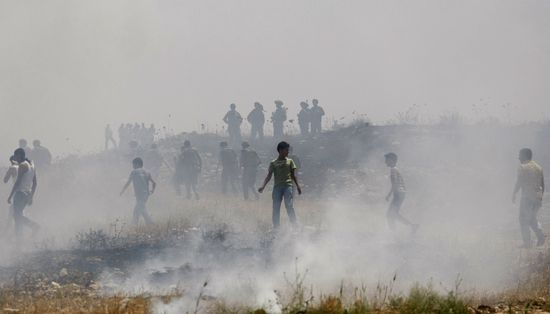
(Photo: Israeli soldiers (top C) and Israeli settlers (top L) watch from a hilltop as Palestinians villages try to put out fires after fields were set ablaze in the village of Asira al-Qiblyia in the northern West Bank on June 2, 2010. According to Palestinian villagers, Jewish settlers from the nearby Yitzhar settlement set on fire their olive and wheat fields. By Jaafar Ashtiyeh/AFP/Getty Images.)