We Are All Subcultures Now, Ctd

Dreher thinks I've misunderstood him:

What we are living through now is the aftermath of Christendom, by which I mean Christian civilization in the West. It is not the end of the world, but it is the end of a world. The reality that Ken Myers and I despair of, and that Andrew seems to celebrate, is the end of the idea of a moral hierarchy transcending and undergirding our daily experience. We despair of the death of the idea that Truth is something you discover and conform yourself to, rather than something you construct to suit your own desires and felt needs. I could be wrong, and welcome correction if I am, but I suspect that if you removed sex and sexuality from the discussion, Andrew, insofar as he is truly a conservative, would agree with much of this analysis. But it can't be done, not honestly, because to cast aside Christian sexual ethics as irrelevant to Christianity is like removing the cornerstone of a building and expecting it not to fall. And this fact reveals something about the nature of our disagreement here.

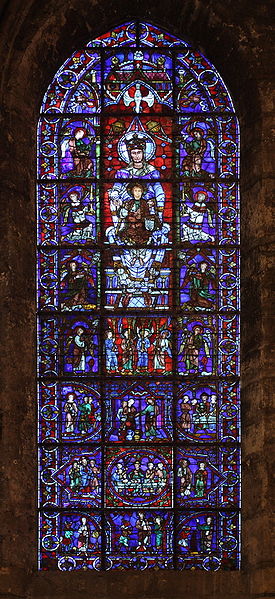
I think "celebrate" is much too positive for my position. I have much more respect for the world that we have lost than most moderns. I suspect that there was much more wisdom in its pre-modern forms, and celebrate 275px-Chartres_-_cathédrale_-_ND_de_la_belle_verrière the extraordinary cultural, literary, spiritual achievements of the past. I am not a Whig. But I am a chastened Tory. I also, however, feel completely comfortable in modernity, and see in its liberation of the human individual an astonishing achievement in the West. It is possible, I think, to marvel at the cultural vitality and cohesion of, say, 15th century England (which I studied diligently at Oxford) and yet also delight in a modern world that allows Rod and I to communicate across time and space, that has allowed me to live past 35, that has provided dignity to women, that has extinguished hunger in the West, and that has given us the option of choosing our ways of life and escaping our fates and turning them into ambitions.
I have some deep reservations. I wonder if modernity, in the grand scope of human history and pre-history, is not, in fact, a Tower of Babel, impossible to sustain, fueled by extravagance and untrammeled greed, addiction, loneliness, bewilderment and disillusion. I wonder if the life we have constructed on this planet in the last two centuries is actually sustainable – ecologically, spiritually. I read Macintyre with enormous sympathy. 

I certainly don't think that sexuality is my prime focus here, though it is surely apposite. Would I prefer to live in a world where sex was a form of ownership of men over women, when it led to constant disease and appalling death-rates in childbirth, where every sexual act could lead to pregnancy, where gay people were hanged or persecuted or forced into lives of untold misery and pain? No fucking way. And do I think that Christianity's sexual doctrines are a corner-stone of the faith? Not in the slightest. Jesus was uninterested in these matters. True faith is not fixated on sex; it has left sex behind – along with money and wealth and pride – in the pursuit of the divine. The only people fixated on sex are those who wish to use its power to control others.

I think Christian sexual ethics were formed in a different age and made sense when sex often equaled death or family collapse or ubiquitous disease. I think our new circumstances – specifically the pill – requires an adjustment, as did the vast majority of the Catholic hierarchy in 1968. And I think the church's fixation on sexual ethics is a sign of its corruption and decline. Only when this celibate, fucked up, disproportionately closeted clique running the church grows up will Christianity find a home again in its ancestral heart. Until then, it will have to live and breathe outside of Benedict's starched lace and pursed lips.

The core of our disagreement is simply our attitude toward modernity. I believe it simply is, will only be undone if the entire bubble collapses, and, meanwhile, is worth living in. One can both celebrate something new and irreversible without disdaining the wisdom and beauty and tradition of the past.

One can embrace Chartres Cathedral and the iPad.

On Evil

Richard Holloway reviews Terry Eagleton's new book:

If conservatives believe in original sin but not in redemption, then liberals believe in redemption but not in original sin. They are deficient in the tragic sense of life, which is why they tend to identify the source of the ills that beset us as not in ourselves, but in external impediments to human well-being: remove these external obstacles, goes the mantra, and the kingdom will come on earth as it is in the heaven of the liberal's imagination.

Radicals, on the other hand, try to maintain a precarious balancing act between these extremes. 'On the one hand they must be brutally realistic about the depth and tenacity of human corruption to date … On the other hand, this corruption cannot be such that transformation is out of the question.' Eagleton believes that what prevents the radical from sliding into despair is an understanding of what he calls materialism. 'I mean by this belief that most violence and injustice are the result of material forces, not of the vicious disposition of individuals … The opposite of materialism here is moralism – the belief that good and bad deeds are quite independent of their material contexts.'

What he is proposing, in fact, is a materialist understanding of original sin.

A Quieter Christianity

A reader writes:

Though I enjoy your blog, I tend to pass over the many posts you do on Christianity and the meaning of Christian faith, being neither a Christian nor a person of faith.  I tend to associate Christianity with people like Sarah Palin.

Last weekend, I found myself for various reasons in York, England, and while sightseeing stumbled into the Minster in the middle of an ordination ceremony.  It was a revelation, in its way, as an education into what Christian faith can mean for believers. The most impressive lesson for me was about what one might call the "quiet" of Christianity.  It seemed — at least to me, as an outside observer — to be an intensely personal faith and not the kind of carnival tour "Christianity" barked by the American right.  

So I think I have a slightly better appreciation for the discussions in which you engage, and I thought you might find some grist for the Daily Dish mill in what follows.

On the Archbishop's website (naturally!) one can read the personal stories of the new priests, and this one — the story of the Reverend Matt Martinson – really struck me as demonstrating what Christ can mean to the believer:

"My father was an alcoholic and a drug addict, and used to knock me about. Inevitably…it was join the army or go to prison. The army didn't work out, and eventually I came out of the army and ended up taking drink and drugs seriously. My life became violent…and I ended up sleeping rough in York. I progressed into the criminal scene, and ended up in a real mess.

"It was at that point that I made a deal with God. I said to him, 'If you get me caught alive, I will bow my knee to you', because at that time I was getting involved in armed robbery, and with the firearms issues the violence was growing, and it was a very dangerous world. I'd come to the point in my life when I'd had enough, I couldn't take any more. I tried to commit suicide, but it didn't work.

"God got me caught alive. When I was caught, I was put in a police cell up in Carlisle, and instead of being interviewed straight away, I was left in the cell. I heard God speak to me – not audibly – and say 'Make a choice'. And I knew then that that was one of those eternity moments, and I had to choose whether I was going to accept God or not. And I just said 'Yes.'

"Coming out prison was hard. My whole life changed. One of the chaplains broke the rules, and allowed me to stay with him, but the adjustment coming out was just horrendous. I got work with a marquee firm, putting up tents. It was a great job, but I wanted more of God. At that time I was going to Christ Church in Bridlington, where I met my future wife, Haley. Our eyes met across a crowed pew! We've been married for ten years now, with a little boy called Seth.

"God spoke to me when I was in prison, and told me 'Someday, you'll be an ordained vicar'. I laughed! But this sense of calling just kept growing, and through all I've done, it's progressed to where I am now. Seeing the fruition of that calling is just – wow. God still takes my breath away."

What I found so affecting about this is the absolute lack of militancy in faith — of the kind we associate with Islamists, jihadists, and the Taliban Right in the U.S.  This is his Christianity — not one he assumes he can simply elaborate to society writ large.  And in that way it was refreshing indeed.  I don't suppose one would ever see it catch on here, unfortunately, but at least it allows — indeed, compels — me to paint "Christians" with a more sophisticated brush.

I am grateful for my reader's open mind; and I certainly hope the Dish can be a forum in which a more confident and less neurotic Christianity can be explored. That's one reason, by the way, I refer to Palin's politicized Christianity as Christianism. Not because I loathe Christianity, but because I want to make it clear to non-believers that the religious right is not all that Christianity is. This is not proselytizing. It is about explaining why reasoned, intelligent human beings in the modern West can and do find the message and the person of Jesus integral to our lives.

A Closed Fist Or An Open Palm?

Marc Lynch and Kristen Lord warn:

If Obama genuinely believes in the urgent strategic imperative of rebuilding relations with the world's Muslim communities, he must quickly–and personally–address the ongoing blockade of Gaza and use the crisis as an opportunity to underscore the need for a peace process and the delivery of humanitarian aid to Palestinians. If he tries to ignore the issue or simply defend Israel's actions, then the first anniversary of the Cairo speech will also be its epitaph.

From the very beginning of Obama's election, it seems to me that the prime objective of the Israeli government – both Kadima and now Netanyahu – was to use Gaza to destroy the U.S.'s attempt to reach out to the Muslim world. This is a chance to fight back – for the sake of broader American interests.

Tribalism On The Right

Powerline's Scott Johnson attempts to deny the citizenship of the Turkish-American killed on the flotilla because "Scott Rasmussen published a poll this morning that found 58 percent of voters favor the abolition of birthright citizenship." Serwer counters:

The only constant moral principle in this brand of conservatism is tribalism. There is an "us" and a "them," and there are simply no rules protecting those deemed outside the tribe that those inside are obligated to follow or respect. 

O’Reilly’s Equivalence

Dan Savage is pissed at the Fox News host:

Because, you know, gay teenagers with schoolboy crushes on classmates and the kind of Islamic fundamentalism that inspires Islamic regimes to execute gay teenagers and Islamic immigrants to bash gays and lesbians in France—hey, pretty much the same thing.

I also have to take issue with that statement by the French McDonald's executive: "There's obviously no problem with homosexuality in France today." If that's the case… why isn't this insanely cute gay teenager out to his gruff-but-loving dad? If the ad had ended with the teenager saying, "Dad, there's something I have to tell you…" and then we saw Dad lean across the table as the camera pulled back to put a hand on his son's shoulder in a clearly supportive manner, well, maybe then you could argue that everything's wonderful for gays in France.

The YouTube remix was made before O'Reilly's Al Qaeda comment.  Original ad here.