Why else suck up to the likely next governor of Iowa?
Author: Andrew Sullivan
A Constant Struggle
Ambinder mediates on the difficulty of reporting the truth:
If you assume that you know everything, nothing will satisfy you. When a journalist makes a judgment based on experience and on seeking out as many different sources of information as possible, if you are predisposed to agree with the outcome, then you will not complain of bias. If you disagree with the judgment, you will find some way to attribute it to blatant bias, or to a pack mentality, or to a savvy village, or whatever.
Earlier in the day, he answered those readers who charge him with stenography:
I've found that I enjoy trying to figure out the difference between what the Obama administration is saying about what it is doing and why it is actually doing what it is doing. So I often write posts that explain what the powers that be are trying to accomplish even if — especially if — they're presenting a different face to the public. For this I am often accused of stenography. If pointing out complicated motivations and explaining policy choices is automatically assumed by the reader to be a validation of said explanations and policies, then, well, I'm one hell of a stenographer. Occasionally, my prose trips me up, but more often than not, the small minority of readers who don't get it simply don't get it. They're the ones who will e-mail, write and comment, so they're the ones I try to engage with, usually fruitlessly.
Artur Davis And The Unraveling Of Identity Politics, Ctd
TNC looks at the lessons drawn from Davis losing the black vote to a white opponent:
The point isn't that black voters are never tribal, it's that they are no more tribal than any other group of voters. Indeed, by necessity, they are often less tribal. Everyone remembers Barack Obama sweeping up the black vote against Hillary Clinton during the 2008 primary. No one remembers John Kerry doing the same to Al Sharpton in 2004.
He later reflects on Davis's announcement that he's leaving politics for good.
The Jobs Report
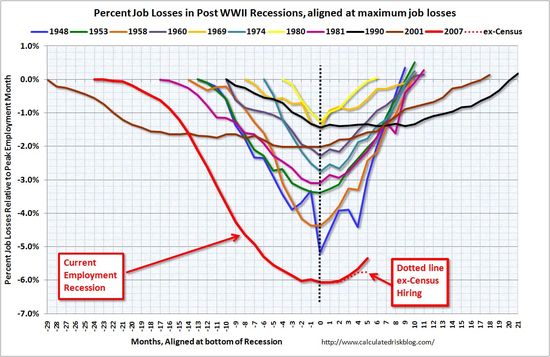
Leonhardt passes judgment. He digs further into the details here. Felix Salmon eyes the unemployment rate:
Expect unemployment to remain over 9% through the midterm elections — compared to a rate of just 6.9% in November 2008, when Obama was elected. It’s that number, rather than anything going on right now in the Gulf of Mexico, which is really “Obama’s Katrina”.
Calculated Risk provides the graph above. On how to read it:
Notice that the 1990 and 2001 recessions were followed by jobless recoveries – and the eventual job recovery was gradual. In earlier recessions the recovery was somewhat similar and a little faster than the decline (somewhat symmetrical).
The dotted line shows the impact of Census hiring. In May, there were 564,000 temporary 2010 Census workers on the payroll. Starting in June, the number of Census workers will decline – and the two red lines will meet later this year.
Ezra’s Model – And Mine

Young Mr Klein makes an obvious point. It doesn’t matter whether he owns his own URL or whether the WaPo owns it. Because his blog is him, and entirely him, the Post could hardly keep running it without Ezra. So he de facto owns it, and since the WaPo can’t own him (since the Emancipation Proclamation), they have to essentially rent his blog. The same is pretty much true of the Dish, since it’s so marinated in me and my own sensibility, it would be very hard to imagine it run or written by someone else entirely, even though Patrick and Chris are huge and constant contributors to the ideas, links, photos, videos and research we try to include. So maybe my contract, in which I retain all the rights to my URL and can redirect the traffic automatically to any other site when the contract expires, is superfluous.
But perhaps not for reasons Ezra notes. The Dish over the years has become a bit of an online community, somewhat independent of me. The readers sustain it with your emails, tips, arguments, experiences and dissents. It has a variety of features built over ten years of improvisation, from its awards to its window views and reader threads and mental health breaks.
I don’t know where this will lead – and never have for the past decade. But from the beginning, my hope was not just to reach readers directly, but to make a living off it at some point. I chose to piggy-back off bigger media entities – my jump to Time was one of the first – and now make a real living doing what I do. Sometimes, you look back and see the mountain you’ve climbed. Chris Bowers notes:
It was, really, inevitable. Avant-garde, “outsider” developments which prove to have real support are invariably co-opted by any successful, institutional establishment. At the same time, these avant-garde movements are often willing to be co-opted, since established institutions usually have vastly greater resources than the independent, shoestring distribution networks of the avant-garde. Before I became a blogger, I was an ABD graduate student in English, and I was going to write my dissertation about this phenomenon in 20th century American poetry. I am quite thrilled that instead of writing that dissertation, I was able to participate in a real-life example of it.
Anyway, kudos to Nate Silver, and RIP to the amateur progressive blogosphere. It provided a regular feeling of revolutionary ecstasy while it lasted, but there was no way it could last very long. It was a transitional period into a new media and political paradigm, not a new paradigm unto itself.
This goes too far, I suspect. Because the next generation of journalists will come from the blogosphere, and tomorrow’s leaders are only just getting started. I think of the amateur blogosphere as a huge pool of talent to be enjoyed and read and eventually rented. Instead of newspaper editors selecting columnists, they will soon find existing bloggers with existing readerships and rent them and thereby get their readers. This is more meritocratic, depends less on connections and more on raw talent and the ability to create and nurture an audience. In that sense, the professional blogosphere and the amatuer blogosphere are not in tension; they are part of the same process – and the one will continue to feed the other.
But I do think it presents an interesting quandary for media companies who rent such entities. Since the companies don’t have editorial control, they are essentially super-brands that sell advertizing. So who in the end is running the new journalism? The old editors and owners or the bloggers and their readers?
Cue Deck Chairs
Gabe reacts to the news that James Cameron was brought in to consult on the BP leak:
We’re fucked. Boys, if you could play us out that would be great. I mean, I know that James Cameron has the world’s most extensive collection of Titanic figurines, and that one time he wore a fanny-pack to Brazil so that he could hug the jungle back together, but I am pretty sure that if the nation’s leading Actual Ocean Scientists and Trained For Real Oil Spill Disaster Relief Experts are running so thin on ideas that we are inviting “the dude who made Abyss” into the chambers of power to try and, you know, mix it up, I for one am saying goodbye to my loved ones and climbing onto the roof of my building with a life-preserver around my neck and a gun with one bullet in the chamber tucked into the waistband of my HAZMAT suit.
Image elaborated here.
On The Other Hand
Avent is beginning to lose faith in the political process:
Honestly, I’ve just about given up on the idea that an increase in the gas tax is possible. The Gulf of Mexico is filling up with oil, and no one in Washington is even mumbling under his or her breath that maybe now is a good time to think about an increase. But this is the easy answer — policy-wise if not politically. You tax gas, you reduce consumption, and you raise the money to once-again provide the country with a first-class transportation system.
Obama has made some gestures in this direction, but in my view, he should do much more. The way to seize this moment is not to attempt to control what you cannot – the gush of oil from the open wound in the floor of the Gulf. It is to remind people of the lax regulation that allowed this to happen – this is Bush-Cheney's second Katrina – and to make the case more passionately than ever that we need a strategy to get off our oil addiction.
In the end, BP is merely the pusher. We are the addicts. If this isn't hitting bottom, what is?
Car Culture, RIP?
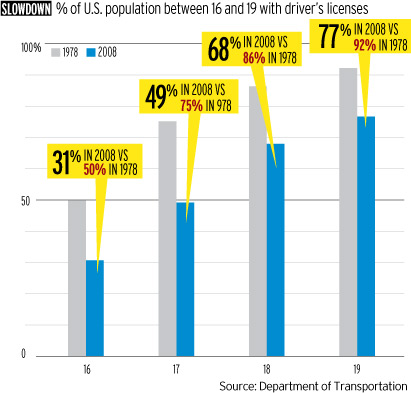
Nate Silver and Jack Neff argue that American's love of cars is in decline. Richard Florida puts this in context:
Younger people today — in fact, people of all ages — no longer see the car as a necessary expense or a source of personal freedom. In fact, it is increasingly just the opposite: not owning a car and not owning a house are seen by more and more as a path to greater flexibility, choice, and personal autonomy.
Underlying all of this is not so much a shift in "car culture" values but a shift in economic realities. Owning a car and a house are very costly, for individuals and the economy as a whole. What distinguished "savers" from "spenders," according to a Canadian study (.pdf), is outlays for housing and especially for cars. The amount of money the average American family spends on housing and cars went from 22 percent in 1950 to 44 percent by the 1980s to more than half today. It's not so much that America is a society of wanton over-consumers — though some surely fit that bill — it's that they've been trapped by the housing-car-energy complex that once stood at the very heart of the U.S. "Fordist" economy. And as any number of studies have shown (.pdf), America's over-investment in housing has badly distorted its economy.
But what this also shows is that change with the right incentives is possible. Imagine the impact of a dollar tax on a gallon of gas, balanced by a FICA cut.
The View From A Career Counselor, Ctd
Many readers are jumping aboard this thread. One writes:
Your reader wrote, "I have a great distaste with the idea of having to "brand" or "market" myself in order to even land an interview … since when do my qualifications not speak for themselves?"
While I sympathize with this perspective, this is a pretty unrealistic view of the job scene. Everyone has to market themselves – that's what a resume is. Still, in my experience, both perspectives have a little truth.
After I was laid off, I spent roughly a year hopelessly looking for work online like everyone else. Nabbed a few interviews, never made it to round 2. By the end I had so much anxiety I was getting heart palpitations. Finally, a friend of mine asked me to come in and temp at her production office for one week. I had actually interviewed at her office before and got passed on, but I jumped at the chance to feel legitimate again – even if I would be working next to the guy they hired over me, doing some demeaning office work.
I put my sweat and blood into that temp job. And they liked my work so much, they asked me to stick around. Eventually they bumped me up to bigger responsibilities, gave me more hours. 6 months later, they made me a fulltime Associate Producer. Not only do I have benefits, I'm hiring people.
Networking got me in the door, but it was my work ethic that helped me stick around. And hiring people has totally challenged my former concept of the job market. The central thinking running through HR's mind? We know you're qualified. Now are we going to actually like working with you? You have to find a way to answer this question as soon as possible. Call it marketing, call it whatever. Just try and imagine how you would fill a position if you had 50 qualified resumes in front of you. Your e-mail attachment will never speak for itself in this economy.
Another writes:
What makes this reader think that having or making personal contacts within a company is the same as bullshitting? I've had to interview and provide input into hiring numerous people, and there's no way we would have hired someone who was unqualified simply because they knew someone in the company. Instead, we were often faced with a number of seemingly qualified candidates, so having someone on our team personally vouch for one of them made a huge difference.
"Marketing yourself" does not mean lying, it means using every tool at your disposal to get a job. If your reader refuses to do so, he or she should not complain about losing job offers to those who will.
Another:
I almost wrote after I read the initial advice from Career Counselor, but then I thought that maybe I'm just an exception and a little rigid due to my position. But after reading today, I wanted to assure one reader that not everyone these days must be "a professional marketer and kiss-ass."
I work for a small but highly profitable niche investment firm. Though my title is Executive Assistant, due to the small size of our office a lot of duties fall to me, among them handling the preliminaries when we are looking to hire, including being the initial contact person and weeding out the resumes. As you can imagine, even when we post a job on just a few elite schools' MBA job boards, we get hundreds of resumes. And even though the posting specifically requests no calls, I still get dozens of calls every time. I am not a dedicated HR person. I have a LOT to do. When I say "no calls", I mean "no calls." I don't want to chat with someone about where our industry is going and what my firm is doing. I don't have time for their flattery or to refer them to other people, or to hand-hold them about whether their experience is right for the job. If someone calls me after I've specifically requested that they don't, I do dig their resume out of the pile. And then I put it on the bottom. I figure that someone who can't follow simple instructions, who thinks that they are the exception to the rule and that being pushy gets them what they want isn't really someone I want to work with in the first place.
I will say that the counselor got one thing right: jobs are filled via personal connections and relationships. We had at least 25 qualified candidates for our last position; any one of them had all the requirements and would have done a fine job. The person who got the position was recommended by a professor who was an old friend of the boss. But trying to force a personal connection by cold calling and nagging isn't going to help you, and a lot of times it can hurt you.
Another:
I've found your postings on readers trying to land jobs very interesting. Thankfully, I have a job with the Federal government and have held onto it during the past few years.
Regarding the aggravation many of your readers seem to have regarding the nepotism and self-marketing required to land a job, I believe at least in this sense the Federal government stands out as a much more meritocratic system. I got my job without knowing a soul in the organization, after responding to a posting on usajobs.gov. It took a while, but I was contacted for an interview, and the rest is history. Most of my colleagues report similar experiences. I've had friends ask me if there is anything I can do to help them land a job here, and I can honestly say no, there isn't. At least where I am, there's nothing I see where I can push to have friends be considered for jobs ahead of anyone else. Some is luck, but mostly you have to stand on your accomplishments.
So for all the moaning about "big government" I think they actually have a much more egalitarian hiring process than the private sector.
Another:
Since I've been freelancing for so long, I take for granted the need to market myself and deal with the fact that I don't know where my next job is coming from. It's hard, yes. But stop being such a baby, and become relentless and shameless in seeking out work directly, rather than looking on job boards. Luckily, in the theater, most people seem to return emails, and if they don't, I keep bugging them anyway. Most people I've come across don't mind being bugged, they're just busy and if you catch them at the right time, you'll get the job.
Reality Check
Ben Smith thinks Palin's war with the media is catching up to her:
She's vanished into Facebook at heavy expense to her national image. Her many supporters still love her, her voice still carries some power — but the [the print, broadcast, and online media] filter has proven that it still has its bite. She's become an object of analysis and, sometimes, mockery without being present in the conversation. Her approval ratings are steadily falling, and her unfavorable ratings are rising.
But to get the nomination, she only needs the 38 percent. And that 38 percent is so devoted – from former gay men still devastated by losing one diva (Clinton) to, well:
"We would literally walk across hot broken glass for this woman," says Nicole Coulter, a frequent contributor to the most prominent pro-Palin web site, Conservatives4Palin.com, which serves as an up-to-the-second source of news and analysis of all things Palin. "She represents something very powerful. It's deeper than politics. It's much, much deeper than politics. It's cultural. It's just this zeitgeist of raw emotion, kind of what our country is all about."
Of course, other national politicians attract passionate support, but with Palin's biggest fans, the devotion to the former Alaska governor resides on a deeply personal level that seems unique in American life.
"She's our family, and you protect your family; it's like the mafia," Coulter says. "She's just one of us, and when they insult her, they're insulting millions of us."
It's hers to lose.
 The Dish