The Housing Trap

Felix Salmon wants to avoid it:

The difference between Germany and Spain, when you get down to it, is that Germans work for companies which provide goods and services that the rest of the world wants. In doing so, they make good money, which they save up. That’s how they became rich. The Spanish, by contrast, have massive unemployment, and most of the country’s GDP growth in recent years has come from the construction industry. Their main export is tourism, if that counts as an export, and the main way that Spaniards have become rich in recent years is by sitting back and watching the value of their real estate grow exponentially.

The U.S., going forwards, needs to be less like Spain and more like Germany. So let’s not subsidize housing. That way lies fiscal disaster.

From The Annals Of Chutzpah

71862426

Palin accuses environmentalists of endangering the Earth because they won't allow drilling in ANWR:

Extreme deep water drilling is not the preferred choice to meet our country’s energy needs, but your protests and lawsuits and lies about onshore and shallow water drilling have locked up safer areas. It’s catching up with you. The tragic, unprecedented deep water Gulf oil spill proves it. … There’s nothing clean and green about your misguided, nonsensical radicalism, and Americans are on to you as we question your true motives.

Chait picked apart this argument when Krauthammer made it last week. He gives Palin the same treatment.

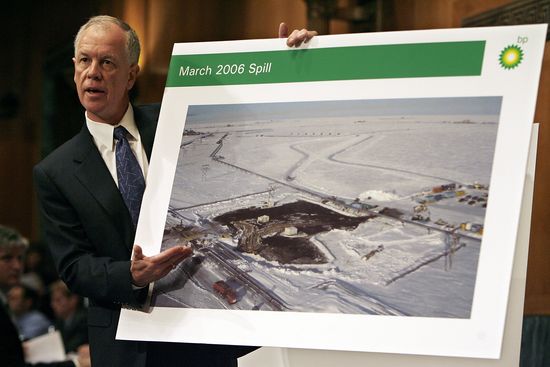
(Photo: BP Exploration Alaska President Steve Marshall holds up a photograph of a March 2006 oil spill while testifying before the U.S. Senate Committee on Energy and Natural Resources about BP pipeline failures in the Prudhoe Bay Oil Field, Alaska, on Capitol Hill September 12, 2006 in Washington, DC. Marshall and BP American President and Chairman Robert Malone took full responsibility for the pipeline failure and outlined what they planned to do in the future to prevent accidents in the field.  By Chip Somodevilla/Getty Images.)

The Voice Of The People

Bernstein continues his crusade against majority rule:

Because there really aren't natural majorities in the U.S., at least most of the time and on most issues, it is difficult to argue that (for example) the Democrats should, on democratic grounds, be able to automatically pass their legislative agenda after winning the 2008 elections. All we know from the elections is that a particular set of candidates won. We don't know whether people supported Obama and the Democrats because of their positions on health care, or Iraq, or terrorism, or torture, or gay rights, or abortion, or climate, or energy, or any number of other issues.

And of course a good number of people may have been just throwing the bums out and didn't think about specific policies, and others may have supported Obama for reasons of ethnic solidarity, or because they thought he would be a more pleasant TV presence than John McCain, or for any number of other non-policy reasons. So we cannot conclude that a popular majority supports any particular policy proposal. Nor does the argument based on accountability make sense. Even if the majority party was able to easily enact whatever they wanted, there are simply far too many issue areas, and only one vote per person. Suppose a voter wants to reward the president for his actions on health care and DADT, but punish him for his actions on Afghanistan and the economy. Only one vote! It just doesn't work. That doesn't mean that elections are useless — I certainly don't believe that — but it does mean that they're a blunt instrument, and more useful in providing the proper incentives for pols than they are for giving voice to what The People want.

Artur Davis And The Unraveling Of Identity Politics

Davis

Steve Kornacki eulogizes the gubernatorial bid of the man who some thought might become the country's first black president (before Obama came on the scene):

In the House, Davis was given a frosty reception by members of the Congressional Black Caucus who had been close to [the unseated] Hilliard and who resented the post-Civil Rights brand of politics favored by Davis (and celebrated by his many white supporters). It didn't help that Davis worked hard to create a moderate image, distancing himself from the liberal CBC in an effort to make himself appealing to the conservative white voters he'd someday need in a statewide race. He also maintained the alliance with the pro-Israel community that had been so helpful to him in '02, providing public support to their cause when they most needed it.

All of this helped Davis enhance his national profile last decade. But it came back to haunt him in this campaign.

Davis voted against healthcare reform in the House back in March, calculating that a "yes" vote would kill him with the Alabama general election audience of 2010. This may well have been accurate, but he forgot that he also faced a Democratic primary — and Democratic voters were none too happy to see him siding with the GOP and against Barack Obama (even if the White House was privately understanding of Davis' vote). His years of tacking to the middle made it impossible for him to get the benefit of the doubt. Leading civil rights groups ended up backing Sparks, who is white, over Davis. When the returns came in on Tuesday night, it wasn't even close.

TNC reads reports of low turnout among African Americans:

The underlying premise seems to be that Davis was somehow entitled to black votes. This despite the fact, as Michael Tomasky points out, that Davis reps a majority black district where one in five people lack health-care, but voted against the health care bill. You don't get to just stand in front the people and say "Hey I'm black and smart" and then wait for the torrent of civic pride.

Abigail Thernstrom looks closer at the racial politics of the race and concludes:

Davis is a young man (41). He lost his first congressional bid and came back to win two years later. His political career is not necessarily over, and [John] Lewis may yet see Davis occupy the office once held by the man who declared “segregation forever.” Politics, not race, defeated Davis; different politics on a different day may hand him the victory he sought yesterday.

Ben Smith highlights the local issue that could have trumped everything else. 

(Flickr photo by Pendarvis Harshaw.)
Guilty Of Being Gay, Ctd

A reader writes:

"Come to America"?  This couple risked everything by performing an engagement ceremony, so maybe they should seek asylum in a county that doesn’t still consider same-sex marriage an unnatural act.  No point continuing to be considered a second class citizen.  I would suggest Canada, where their incredible courage can be recognized!

Will The Public Blame Obama For The Gulf Spill? Ctd

Nate Silver's reading:

Mostly I simply think that the disaster is reinforcing people's frustration — an emotion that has become very widespread within the country, and which crosses most demographic and political boundaries. If that remains the prevailing mood of the country in November, the risks to the incumbent President and his incumbent party are mostly to the downside.

Covering the same ground, Steve Lombardo lays out reasons why the spill isn't comparable to Katrina:

Team Obama has something that Bush never had with Katrina: a villain. A large international oil company. What better villain could you ask for? Team Obama will maximize this to its political advantage over the coming weeks. With Katrina, Bush was the villain.

Democratic Or Pro-American?

Greg Scoblete asks what happens if those categories are mutually exclusive:

As I said earlier, it's very difficult to be an honest proponent of Middle East democracy and an advocate for perpetual American hegemony in the region. The emergence of true democracies is likely to reorient the geopolitics of the region in a manner that the staunchest hegemonists would sharply disapprove of. I wonder which aspiration they'll jettison first.

Larison greatly expands upon that thought.

Breaking Links

Nick Carr started a mini-kerfuffle by making the case against hyperlinks. Carr links to his critics in a follow up. Felix Salmon nips the argument in the bud:

A blog entry with links at the bottom has aspirations to being self-contained, like say a newspaper column: the links are optional extras. I never have such aspirations and anybody looking to make full use of the power of the internet is doing themselves a huge disservice if they start thinking that way. In these days of tabbed browsing, there’s a difference between clicking and clicking away: most of us, I’m sure, control-click many times per day while reading something interesting, letting tabs accumulate in the background as we find interesting citations we want to read later.

Someone writing online should no more put their links at the end of their essay than a university professor should first give the lecture and then run through the slides. It makes no logical sense, and it does no good for the consumer of the information.

The Wandering Blogger

Steve Coll reflects on the blog he is now giving up in favor of more long-form work. He's onto something here:

By far the most fun I had with this format came when I was on the road. Last summer I was in Africa and Indonesia. Taking half-assed digital pictures for Think Tank and writing diary entries redoubled the already uplifting experience of reporting from those places. If the new journalism arising from digital formats can compensate a person adequately for wandering the world in a taxi with an iPhone, I will happily surrender my nostalgia for newspapers, magazines, and books. I’m not suggesting that the writer’s satisfaction arises from the same work as the reader’s, but even so…

Travel-blogging really needs some support. In my view, foreign correspondents should be encouraged to blog – or better still ex-pats in distant lands should become free-lance bloggers, telling us about the worlds they know, and finding aggregation outlets to disseminate their insights.