Should Washington Rank Colleges? Ctd

Several readers sound off:

From inside higher ed (at the community college level), there are several problems with college rankings. First, everyone already knows which is better than what. Four-year research institutions (Duke, Stanford) are better than four-year liberal arts schools, which are equal to or better than four-year state schools, which are better than two-year schools. Our school charges $100 a credit; Temple University charges roughly $800 a credit. Why? Because they can and we can’t. I highly doubt our school costing one-eighth the per year total will rank in the government rankings as “a better buy” than Temple or Drexel, much less the University of Pennsylvania.

Second, public tax support has collapsed over the last 40 years.

Technically (as in legally and constitutionally from the founding of the college), the state and the county are supposed to provide 66 percent of our operating budget, with the school providing the rest. Currently, public funds provide less than half that. Consequently, salaries and benefits have stagnated, forcing the school to rely more on adjuncts and forcing the young and the talented to look elsewhere. Tuition has gone up, shutting out the poorest students from public education.

If the federal government is going to rate us, what about forcing the states and counties to adhere to their obligations? How well can we do with one-third of the support we’ve been promised?

Also, be aware that 80 percent of our students come out of high school without the ability to read, write, or do math at grade level. Our Reading 1 is a third-grade reading level and has 15 percent of our students. Math 1 is basic fourth grade arithmetic – 20 percent of our students are in that. We have high numbers of poor students, immigrant students, and first-generation students, and increasing numbers of special education students, all of whom are expensive to educate and many of whom would not even have been in college 40 years ago when public funding was comparatively greater. Will all of that figure in?

The third factor is that politics and money go hand in hand. Is anyone seriously thinking Harvard won’t get an A? Princeton won’t be tops in everything? Is anyone really going to say Stanford or Duke should be $10K a year? Is anyone going to force the states to fully finance their obligations? The crisis in public pensions suggests not. And even if the whiff of possibility arose – especially for highly financed politically active “for profit” charters/colleges – we have the Indiana example of changing grades to help donors. So who is it really helping? What’s the play?

Another reader:

I understand that there are predatory administrators, that there are colleges offering terrible returns on investment, and that the whole system suffers from structural inequality. These are real concerns, especially for those in the worst situations. But rarely does the conversation turn to what education is supposed to achieve, or what its goals might actually be. Despite the great hubbub about educational reform, about new techniques of education, about technology in the classroom, the underlying thought remains the same: education is what we do in order to get money.

It beggars the modern imagination to think that someone might offer up some (or even all) of their material well-being in order to get an education which does not immediately result in more material well-being. A person considering getting a liberal education, particularly in a field without firm practical applications, is considered slightly daft – or is granted a pardon on account of already being rich. But this underscores the problem. Liberal education has become a luxury of the rich, rather than a prerequisite for free people living in a free society.

I don’t have a policy recommendation or a favored author (save maybe Plato) to tout. This problem is as large as the world and as complicated as people themselves. But I do think, before we start enumerating the virtues of our colleges and, thereby, driving a stake through the heart of “impractical” liberal education, that we should stop to consider what we hold highest.

Another’s two cents:

I’m an engineering professor. I have indeed seen colleges do unwise things with funds. I am a little bit concerned, though, about university ranking systems because they can drive unintended consequences. The proliferation of fancy sports facilities, for example, was in some measure a response to the US News rankings. Universities compete for students. Those that are highly ranked get more and better students, and they can justify higher tuition. If state support is going to disappear (as it pretty much has already in some states), we have to expect universities to market themselves and rankings to drive the marketing. I cannot predict how exactly, but I know this will not end well.

Update from a reader:

In regards to the person who seemingly works at the Community College of Philadelphia, where he/she commented that they charge $100 a credit whereas Temple University charges $800, simply because Temple can.  C’mon, that’s an apples and oranges comparison. Temple is a university that can bestow graduate and doctoral degrees, is a world-class research center, has or at least had some of the top schools in the country for communications, education, art, has a medical center graduating nurses, NPs, PAs, doctors, and dentist. A law school that is ranked #2 for trial advocacy and #11 for international law. Provides on campus housing for 12,000 students, is the force behind the revitalization of North Philadelphia (it can be debated how much the local community benefits but it is vastly improving). As with other major institutions of learning it also provides for a whole range of extracurricular activities from sports programs to a radio station.

I’m not knocking CCs; a lot of student wisely choose them to knock out their core requirements at a lower cost. I doubt there is any noticeable difference between what you can learn from History 101 at Temple or at CCP. But TU (and other major institutions) charge that rate because they offer more than just History 101, they provide access to many more courses than one could get at a CC, access  to top rate research centers, professors, in the case of TU campuses in Japan and Europe, to some extent connections (TU has over 250,000 alumni), sporting events, concerts, the social life, etc. etc.

Is it overpriced and is that price set simply to cover the cost of education? I don’t know. I do think universities have bloated their administrative staffs to unprecedented levels and that payroll expense is passed on to the student base. Probably more so at the Ivies than anywhere else, you’re paying to have that name and the connections and opportunities it provides on your resume. I think you can make the argument that there’s not much of a difference, scholastically, between a Princeton and TU, but to imply that a CC and a University are on the same level except for the course fees is a bit ridiculous.

(And full disclosure, yes, I am a TU grad, as is my wife and all 3 of her siblings. But I’m not arguing specifically for TU, you could replace the schools with University of RI and RICC and the argument stands.)
The Best Of The Dish Today

Perhaps the real “scandal” in the Bowe Bergdahl affair was simply optics. The administration – including Hagel and POTUS – seemed to think a prisoner release would be unalloyed good news, without fully absorbing what servicemembers had learned about Bergdahl and the resentment his apparent AWOL and possibly deserter status had generated. Chuck Todd even reports that they expected euphoria. Allahpundit writes:

This seems to boil down to a fundamental misunderstanding by the White House of military culture. If soldiers had reacted the way O expected, celebrating the release of a POW, it really would have tamped down the criticism of Bergdahl. For obvious reasons: If the men who risk their lives defending America are willing to forgive him and welcome his return, who are the rest of us to question him? But that’s not how the men who served with him reacted; in fact, unless I missed it, not a single member of Bergdahl’s unit has spoken up in his defense. Obama gambled heavily that both veterans and the media would keep quiet. He lost.

But that doesn’t, of course, get to the core of the issue: should the president have seized a chance to rescue the service-member or not? When you posit the alternative – leaving the guy with apparently iffy health in enemy hands for ever – you can see the POW flags flying everywhere. So, yes, on this as on many issues, the president cannot win. I’m sure he’s used to that by now.

Today, I tried to absorb the news of a mass grave of 800 neglected children in a septic tank – victims of a brutal, evil Catholic legacy in Ireland and of the sexual teachings that have so come to distort Christianity. And we explored the actual costs of curtailing coal’s damage to the planet.

Plus: shit-faced monkeys; the delights of smoking cigarettes; the college adviser who wants you to kill yourself; and Jonah Hill’s impersonation of Alec Baldwin.

The most popular posts of the day were The Palin Tendency and Bowe Bergdahl, followed by Catholicism’s Crimes Against Humanity.

Several of today’s posts were updated with your emails – read them all here.  You can always leave your unfiltered comments at our Facebook page and @sullydish. 27 more readers became subscribers today, and we’re so close to 29,000 mark – only 31 short. Subscribe here to get us there by midnight. (And drop us an email; we always like hearing from new subscribers.)

See you in the morning.

How To Forget An Atrocity

Beijing is on lockdown as tomorrow’s 25th anniversary of Tiananmen Square approaches:

Government control and interference is evident every year around the anniversary. China has referred to June 4 as “Internet maintenance day,” taking so many sites down for “fixes” that it is unclear which sites are being targeted with restrictions, reports The Washington Post. But this year, the crackdown has reached new levels.

Amnesty International reports arrests and detentions have been on the rise. Scores of activists, lawyers, students, academics, and relatives of those killed in 1989 have been detained, put under house arrest, or questioned, reports Time. Security around the public square has been so strict that tourists have had security officials bar them from the grounds, reports Time. Google services – including Gmail and translation services ­– have been interrupted since late last week, reports Bloomberg.

Lily Kuo remarks on how successfully the Chinese government has erased the events of June 4, 1989 from the collective memory:

[C]ontrary to what some activists might have hoped, the state-mandated erasure of the incident has been extremely effective. Only 15 out of 100 university students in Beijing recognize the iconic picture of “Tank Man” a demonstrator blocking the path of a line of tanks, according to The People’s Republic of Amnesiaa new book on the topic by NPR correspondent Louisa Lim. …

Scouring the Chinese internet for references to June 4 has become an annual event for the government’s censors, but this year’s efforts have gone further than ever before. All Google services in China, including gmail, are now being blocked on the mainland. … As in previous years, even circuitous mentions of June 4 on social media—including the Chinese characters for six and four together, for the date of June 4, the search term “four, open fire” or “25 years“— are being swiftly deleted by censors. China’s version of Wikipedia, Baike, has no entry for the entire year of 1989.

An anonymous Tea Leaf Nation contributor explains why the Internet has not made it any easier for Chinese youth to talk about the crackdown:

The immense interest among those jiulinghou [Chinese children of the 90s] who are in the know has not translated into active discussion, let alone action. Not all of us think it was wrong to use force against the protesters. And we certainly do not all think China should adopt Western-style democracy. But whatever our views are, we dare not openly discuss them online, in public forums, or even in private chats. And since the Internet is where my generation goes to communicate, we are essentially deprived of the chance to engage in civil discourse.

The Internet has chilled an honest reckoning with Tiananmen, not enabled it. While the web has given rise to a level of pluralism China has never seen before, and minted new, grassroots opinion leaders, it has also made everything we write, both in public and in private, more easily surveilled. Before the digital era, officials didn’t have the ability to eavesdrop on every conversation. But now, if I post something politically sensitive online, the conversation is digitally recorded. Everything becomes part of our permanent record.

But Ellen Bork suggests that “China’s communist leaders may find their efforts to suppress memory backfire”:

According to Min Xin Pei, a scholar of totalitarian transitions at Claremont McKenna College, half of China’s population was born after 1976. They don’t remember the chaotic and violent Cultural Revolution in which millions were sent to perform manual labor in the countryside, as marauding Red Guards sowed paranoia among family and friends. Might this contribute to a change of rule one day? “The basis of rule of all authoritarian regimes is one simple fact—fear,” Pei told an audience at the National Endowment for Democracy. “A psychological shift can come very very quickly.” What that shift will bring, no one can say for sure. But the world will have had at least 25 years to prepare for it.

Meanwhile, Heather Timmons contrasts the mainland’s information blackout with the scene in Hong Kong, where the event is well remembered:

Hong Kong is gearing up for its annual candlelight vigil to mark the anniversary, which is expected to attract more than 150,000 people. Local universities are sponsoring exhibitions and talks by witnesses and journalists (including the “Tank Guy” photographer). The Foreign Correspondents Club is screening a documentary featuring interviews with witnesses and journalists who covered the protests.

On a more personal scale, hundreds of groups of Hong Kong families and friends are expected to gather in their homes on the evening of June 4 to commemorate the eventThat will include many people from mainland China, tens of thousands of whom have obtained Hong Kong residency since 1989. At the candlelight event, “in recent years we have noticed more people from mainland China,” said Richard Tsoi, the vice-chairman of the Hong Kong Alliance in Support of Patriotic Democratic Movements of China.

Mariam The Martyr, Ctd

A PhD candidate in Islamic studies lends his expertise:

Finally, a topic I can write to you about without talking completely out of my ass! In a recent post, you quote a Foreign Policy article to the effect that the Sudanese regime’s decision to execute Mariam Ibrahim for apostasy is “a calculated and direct threat to the role the United States has been playing in the world,” and that it is lashing out now because it is “bitter at the United States’ role in the loss of what is now South Sudan.”

Bullshit. As a left-wing academic steeped in postmodern gobbledygook, nothing would please me more than to blame America for the Bashir regime’s behavior. The reality is that the regime is doing what it is doing for reasons entirely internal to Sudan and that have absolutely nothing to do with the US, the international community, or even South Sudan (the creation of which, I would add, owes relatively little to American efforts – that prize goes to regional negotiators like IGAD).

Over the last decade, the fragile coalition of Islamists, military leaders, and businessmen that rule Sudan has been coming apart at the seams. In early 2012, it nearly collapsed all together when some of the most respected Islamists in the governing National Congress Party wrote a scathing letter to Bashir, accusing him of corruption, incompetence, and betraying the Islamic cause. Since then, Bashir has been desperate to prove his religious bona fides to the younger generation of Islamists on which he has increasingly come to rely (see here for a terrific analysis). That means, among other things, sanctioning outrageous judicial decisions like this one.

I’d also add that it seems unlikely the government will actually follow through on Mariam Ibrahim’s death sentence. It feels inappropriate to make predictions about something so horrible, but people need to understand that this isn’t the first time the regime has done this sort of thing, only to backdown at the last moment. In fact, since the apostasy law first went on the books in Sudan in 1991, not a single person convicted under it has been executed. To this day, the only person in Sudan to be executed for apostasy was the famous reformer Mahmoud Muhammad Taha, but he was hanged before Bashir came to power and for reasons that had nothing to do with apostasy.

Sorry for going on at such length, but you’re finally talking about something I actually know something about and I’m desperate to show off.

It’s what Dish readers do best.

Inside The Kink Community, Ctd

A reader can relate:

I liked your post on Playing the Whore and would like to share some insight into Seattle’s Kink community, of which I am a member. The first thing that struck me about the community is how safe it feels. The guiding principle is that anyone can give or take away consent at any time without judgement. This is not something you can expect in the outside world, but it is non-negotiable in here. It’s this level of security that has given me the confidence to explore situations I would not otherwise attempt and has allowed me to derive pleasure in ways I never expected.

I know some people get off on the perv-factor, but nothing I’ve witnessed or engaged in has felt perverted or deviant to me, and I think the open, non-judgmental atmosphere is what enables the seeming normality of it all.

Another factor, to my mind, is that we’re all just regular people; we’re the gal you see on the bus or that guy who works at your bank. You see kinky people everyday going about their normal lives, I get to see them do much more than that and it makes me feel special.

There is something I engage in, however, that I think would be very difficult for outsiders to understand, and that’s okay because I don’t think I would have understood it myself if not for the opportunity to try it in a safe place with people I trust. I like to engage in impact play, on both sides, which results in bruises, wounds and all manner of battle scars. I take great pride in my marks and often photograph them to share, as many others do. I know that my photos can sometimes make it appear as though I were a victim of a violent crime or domestic abuse. I don’t have fantasies about being abused or beaten.

The thing that surprised me most the first time I tried it was that the process is not humiliating or degrading in any way. On the contrary, it can actually be very beautiful. Perhaps it’s because I tried it first as a top and found that I can fulfill this request from another with tenderness and completely without malice resulting in something both intimate and sublime. I guess if I tried to explain it to someone that would be it, the difference is matter of hitting someone out of anger/desire to control vs. hitting someone out of love/desire to please. Different worlds, similar results.

Thanks for shining your spotlight on this world and keep up the good work!

Face Of The Day

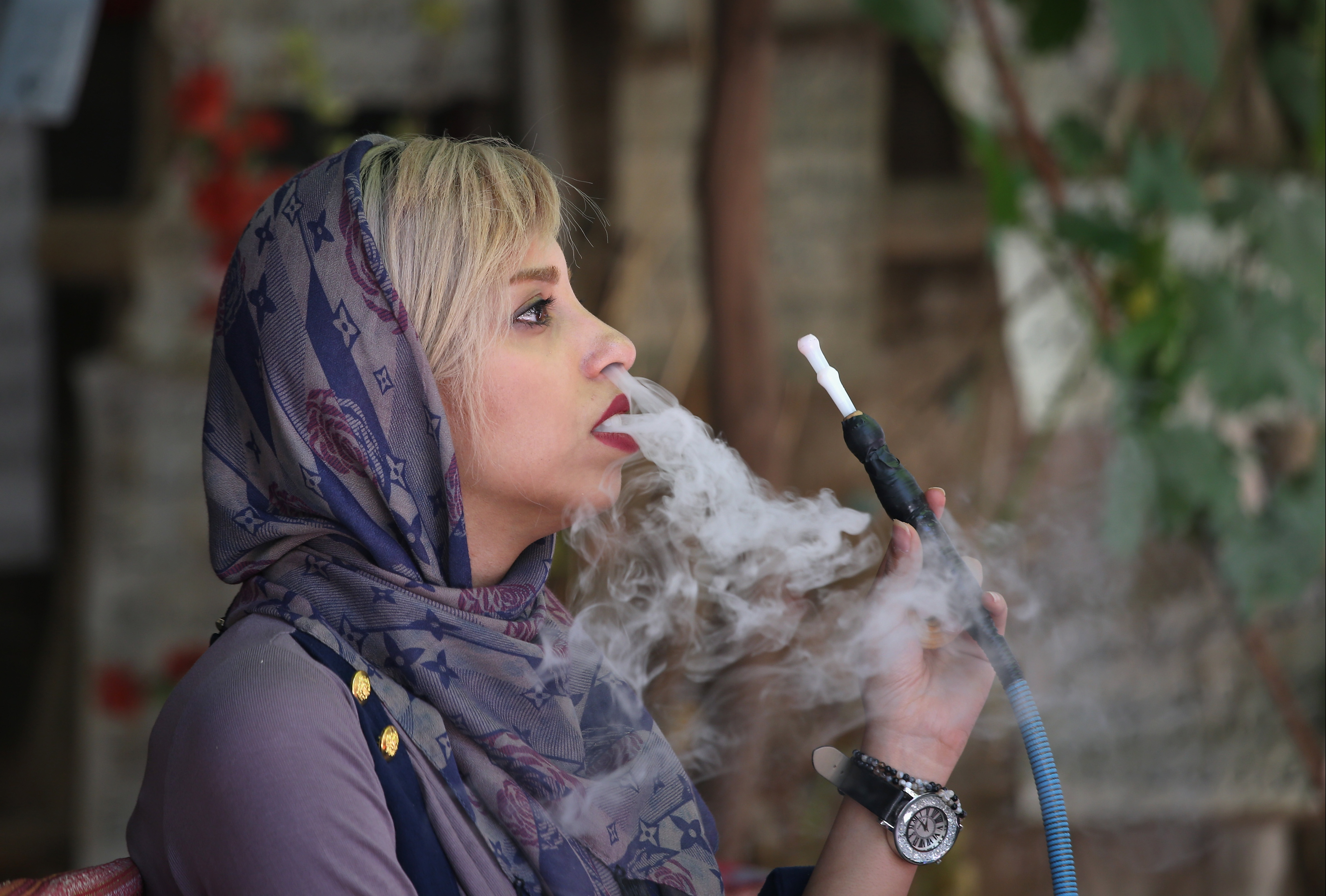
A Trip Through The Heart Of Central Iran

A woman smokes a hookah while visiting a poetry calligraphy workshop in Shiraz, Iran on May 29, 2014. Shiraz, celebrated for more than 2,000 years as the heartland of Persian culture, is known as the home of Iranian poetry and for its progressive attitudes and tolerance. Like all of Iran, this week Shiraz observes the 25th anniversary of the death and continued legacy of the Ayatollah Khomeini, the father of the Islamic revolution. By John Moore/Getty Images.

The Ripple Effects Of An Iran Deal

Gary Samore checks in on negotiations with Iran:

[Khamenei] sees a nuclear deal as a way to relieve the immediate threat of economic sanctions, but not as an opening to improve overall U.S.-Iranian relations, much less a strategic decision to abandon Iran’s longstanding nuclear weapons program. Other Iranians, of course, have different hopes. Some Iranians whisper that the United States should be lenient on nuclear terms to help President Rouhani achieve a victory so that he can defeat hardliner factions in the November 2015 legislative elections and ultimately shift Iranian foreign policy in a more moderate direction. Even if true—and it might be—President Obama cannot sell a nuclear deal on the basis of secret promises from closet reformers. He needs to be able to demonstrate real, long-term constraints on Iran’s ability to produce fissile material, and so far there’s no sign President Rouhani can deliver, even if he wanted to. If a deal is to be had, the supreme leader will have to be convinced to sacrifice his nuclear achievements to save the economy.

Michael Young considers Iran’s role in the Arab world:

In some countries where it sees the possibility of controlling the commanding heights of decision-making, the Islamic Republic will perpetuate dynamics of unity. Lebanon is a good example.

However, in countries where political, sectarian and ethnic divisions make this impossible, Iran will exacerbate fragmentation. In that way, it can control chunks of a country, usually the center, while enhancing the marginalization and debilitation of areas not under its authority. Iraq and Syria are good illustrations of this version of creative chaos.

Whether the Iranian approach has been an effective one is a different question altogether. Certainly, it has given Tehran considerable latitude to be a regional player and obstruct outcomes that might harm its interests. But there is also fundamental instability in a strategy based on exploiting conflict and volatility, denying Iran the permanence it has historically achieved through its creation of lasting institutions.

Elliot Abrams adds:

[I]n the Arab world, the critical Iran issue is not its nuclear program but Iran’s aggression, subversion, and interference in Arab countries’ politics. And the fear is widespread in the Arab world that any U.S.-Iran nuclear deal will only give Iran greater resources (when sanctions are lifted) and more freedom of maneuver. Nothing President Obama said in his West Point speech [last] week will diminish that fear; in fact, the President’s words will likely increase the sense in the Arab world that his interest in an Iran nuclear agreement may lead to a bad deal and to acceptance of other Iranian misconduct as part of the price for an agreement.

The Scandal Of The GOP And Climate Change, Ctd

A reader zooms out:

I totally agree with you that it’s scandalous how the GOP has gone insane on climate change, but unfortunately they’re not the only conservative party that has done so.  Especially in the so-called Anglosphere, other ruling conservative parties have more or less gone the same way. The current Tory-led coalition in the UK has appointed “climate skeptic” Owen Paterson as Environment greenpower-SD-cropMinister, and he’s slashed climate change spending by 41% in 2014 as compared to 2013.

In Canada, the conservative Harper government is increasingly addicted to revenues from tar sand oil exploitation, professes to believe in climate change but in reality has done absolutely nothing to limit carbon dioxide emissions. See Grist from late 2013 here.

And in Australia, in less than a year since being elected to the majority in September 2013, conservative Tony Abbott has made aggressive moves to dismantle Australia’s carbon tax and slash spending on climate change programs enacted by the government he defeated.

It is worth noting that all these conservatives don’t go in for the complete climate denial engaged in by Ted Cruz, Marco Rubio, et al, but they are just as committed to dismantling even tentative efforts to address the issue.

Quote For The Day II

“In the eyes of history, President Barack Obama’s legacy will be tainted by his 2009 decision that the Justice Department would ‘look forward, not backward’ on torture. This denied justice and attempted to cover up a dark chapter in American history, putting us at risk for repeating this immorality in the future. It also allowed people like Rodriguez and his former minions to go to the press and repeat their lies over and over again.

This is not to say that the Justice Department has done nothing. After I blew the whistle on the CIA’s torture program in 2007, I became the subject of a selective and vindictive FBI investigation that lasted more than four years. In 2012, the Justice Department charged me with “disclosing classified information to journalists, including the name of a covert CIA officer and revealing the role of another CIA employee in classified activities.” What I had revealed was that the CIA had a program to kill or capture al Qaeda members—hardly a secret—and that the CIA was torturing many of those prisoners. I’m serving 30 months in a federal prison,” – Jon Kiriakou, whistle-blower on waterboarding, from jail.