Quote For The Day I

"I don't want to see us descend into a nation of bloggers…I think we need editorial oversight now more than ever. Anything we can do to help newspapers find new ways of expression that will help them get paid, I am all for,"  – Steve Jobs.

As someone who spent my first five years blogging while also having to explain to every person I knew what a "blog" was, it is pretty staggering to see how swift the revolution has been. We have gone from being contemptible poseurs to being a lethal threat. But nothing has persuaded me more of the value of blogging than watching old media companies try to adapt. If MSM editors are so smart and so essential, why didn't they see this coming? And why have they been, with some exceptions, so inept in integrating it? And it's these losers who hold the key to journalism's future? The same people who helped bury it?

The Real Issue: The Embargo, Ctd

Larison's view of the blockade:

The blockade is a policy aimed at the steady immiseration and deeper impoverishment of Gazans. This not only deflects attention from Hamas’ abuses and misrule, but it also ensures that there will not be enough prosperity in the future to foster any sort of viable political opposition against Hamas. That tells me that Israel is actually quite willing to tolerate a Hamas-run enclave on its doorstep so long as it can keep the people living there poor and dependent.

A Blinded American, Ctd

Eh1 Eh2

A reader writes:

I can confirm that Emily Henochowicz, a 21-year-old Jewish American student, was seriously injured while protesting the Israeli raid on the flotilla.  I went to school with Emily; she was in my sister's class and her older sister was in mine.  She's currently in the hospital and has lost her left eye as has been reported on numerous sites.  There are horrific and graphic pictures from ISM and another site.  It goes without saying that this is a sobering experience for me.  Having studied the conflict, I've seen pictures of protesters surrounded in clouds of tear gas, but I've never known anyone personally to be attacked.  Emily is an amazingly strong woman and she has an incredible amount of support behind her, but this is an appalling act.  There was absolutely no reason that for a tear gas canister to be shot into her face. 

While Emily will have a long recovery, there should be accountability for this act.  I'll be writing our representative, Chris Van Hollen, but this unacceptable.  I won't let this die down without recognition and I hope you'll do all you can to keep this present in people's mind.  That Emily's government will not be outraged on her behalf, for standing up for her beliefs and the beliefs of her country is a typical hypocrisy, but one I cannot accept in this case.

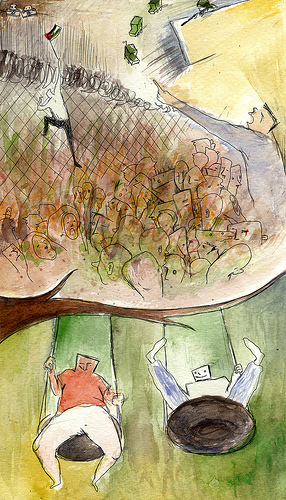
The diptych drawing is from Emily's blog. Her caption:

Memories from two weekends ago…

Walaja
As we leave a demonstration that would ultimately end in arrests and beatings, two men obliviously chit-chat on tire swings.

Sheikh Jarrah
Amongst the chaos of the military and settler's attempts to squander our ability to paint a mural, a little girl sadly sits on the swing set.

How High Can The Retirement Age Go?

Room For Debate addresses the question. I'm with Veronique:

Americans over the age of 65 are in remarkably good shape compared to those of previous generations. Their average net worth has increased almost 80 percent over the past 20 years; they form a larger share of the high-income group and a smaller share in lower-income group than their predecessors; they are far better educated, and they live longer and healthier lives.

…The best option is to cut benefits. One way to do that is to raise the age of eligibility to at least 70 and then progressively increase it to track with life expectancy. This won’t be popular, but Americans’ dependency on government programs is less entrenched than that of Europeans.

The Animal That Imagines

Paul Bloom has a wonderful article on the workings of the imagination:

The emotions triggered by fiction are very real. When Charles Dickens wrote about the death of Little Nell in the 1840s, people wept—and I'm sure that the death of characters in J.K. Rowling's Harry Potter series led to similar tears. (After her final book was published, Rowling appeared in interviews and told about the letters she got, not all of them from children, begging her to spare the lives of beloved characters such as Hagrid, Hermione, Ron, and, of course, Harry Potter himself.) A friend of mine told me that he can't remember hating anyone the way he hated one of the characters in the movie Trainspotting, and there are many people who can't bear to experience certain fictions because the emotions are too intense. I have my own difficulty with movies in which the suffering of the characters is too real, and many find it difficult to watch comedies that rely too heavily on embarrassment; the vicarious reaction to this is too unpleasant…

At every level—physiological, neurological, psychological—the emotions are real, not pretend.

I take the point and cannot watch Ordinary People or Sling Blade (do your own psychoanalysis on that one). And then one recalls Oscar Wilde's imperishable line:

One must have a heart of stone to read the death of little Nell without laughing.

And one feels a little better.

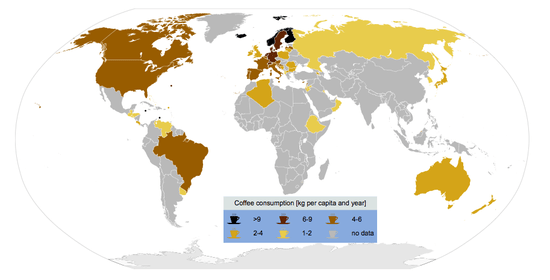
The Caffeinated World

CoffeePerCapita

Yglesias searches for a good cup of coffee:

The Swedes are actually a bit less coffee-mad than the Finns, Norwegians, Danes, or Icelanders but as you can see here all the Nordic peoples drink a ton of coffee, in the Swedish case a bit less than twice as much per capita as Americans do…Personally, I drink way more coffee than the average American and find this aspect of Swedish life congenial. Even I, however, had to balk at the extreme quantity of coffee I was served in Finland where consumption is absolutely off the charts.

China, conversely, has been a real coffee dystopia where American junketeers stagger about zombie-like and decaffeinated.

The Pre-Obituary

P. J. O'Rourke wants to implement it:

With the Pre-Obituary we can abandon pusillanimous constraint and false hope and say what we think about the lives of public nuisances when their lives are not yet a dead letter. And we won’t be stuck in the treacle of nostalgia and sentiment. We won’t find ourselves saying of some oaf, “His like will not pass this way again.” Or, if we do say it, we can comfortably add, “Thank God!” The precept of Diogenes isn’t “Do not speak ill of the living.”

Or we can do it all while the corpse is still warm and be done with it. One little innovation I tried at TNR when I was editor was an honest obituary column, called "Now That You've Gone." It didn't last, of course. But it was fun for a while.