Pivoting off the furor about building a mosque near the World Trade Center, Adam Serwer crafts "a more perfect mission statement for the torture wing of the GOP."
Author: Andrew Sullivan
The First Eye-Witness Reports
300 of the passengers are still detained by the Israelis. Those who have been released say they had to abandon all "cameras, laptops, cellphones, personal belongings including our clothes." One claims that the Israeli commandos initiated the conflict with shooting. More:
Dimitris Gielalis, who had been aboard the Sfendoni, told reporters: "Suddenly from everywhere we saw inflatables coming at us, and within seconds fully equipped commandos came up on the boat. They came up and used plastic bullets, we had beatings, we had electric shocks, any method we can think of, they used."
Michalis Grigoropoulos, who was at the wheel of the Free Mediterranean, said: "We were in international waters. The Israelis acted like pirates, completely out of the normal way that they conduct nautical exercises, and seized our ship. They took us hostage, pointing guns at our heads; they descended from helicopters and fired tear gas and bullets. There was absolutely nothing we could do … Those who tried to resist forming a human ring on the bridge were given electric shocks."
So there were tasers?
The Tamil Tigress
NYT Magazine's Lynn Hirschberg sparked a feud with hip-hop artist M.I.A (aka Maya Arulpragasam) in a scathing cover story:
In the press, Maya was labeled a terrorist sympathizer by some; others charged her with being unsophisticated about the politics of Sri Lanka. “People in exile tend to be more nationalistic,” [Ahilan Kadirgamar at Sri Lanka Democracy Forum] said. “And Maya took a very simplistic explanation of the problems between Sri Lanka’s Sinhalese government and the Tamils. It’s very unfair when you condemn one side of this conflict. The Tigers were killing people, and the government was killing people. It was a brutal war, and M.I.A. had a role in putting the Tigers on the map. She doesn’t seem to know the complexity of what these groups do.”
Ackerman plucks out the more provocative passages. M.I.A. retaliated by tweeting Hirschberg's cell phone number, which the writer called "infuriating" but not surprising. And the rapper has already come out with a song about the spat.
The Most Powerful Force
Like many observers, George Packer views the flotilla attack as a media victory for Israel’s enemies:
Sunday night’s incident showed again that the most powerful force in international relations today is neither standing armies nor diplomatic councils, but public opinion as shaped by media. The presence of an Al Jazeera crew on one ship proves that the pro-Gazans understand completely the main arena in which they’re operating. The American military learned this truth slowly and the hard way in Iraq and Afghanistan.
No one else cared if it was insurgents dressed as ordinary men who triggered an attack; what always shaped the world’s judgment was footage of soldiers retaliating with overwhelming firepower. (The recent WikiLeaks video is a good example; Raffi Khatchadourian has more about WikiLeaks this week in the magazine.) For years, the military would release self-justifying (and often misleading) statements that only inflamed opinion and strengthened the hand of the insurgents. Over time, American soldiers learned that they had to care what the world—especially Iraqis and Afghans—thought. They started trying harder to avoid such incidents, and, when that failed, to control their effect by owning up faster to their own responsibility.
Deeper and Deeper
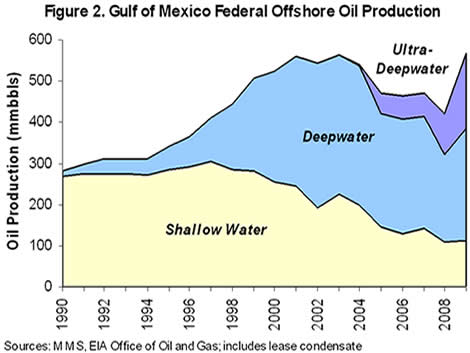
Niraj Chokshi runs the numbers on the amount of oil in the Gulf of Mexico:
Calculations based on the BP and government estimates reveal that somewhere between 0.94 and 1.48 percent of the Macondo reservoir has been depleted.
Tulane University Professor Eric Smith cautions that the 50 million barrel figure is not a terribly good estimate, though. BP's well was a preliminary "discovery well," said Smith, who is also an associate director at the Tulane Energy Institute. And calculating the amount of oil in the reservoir is difficult: "it's a geometry problem to define what the enclosed volume is."
Left unattended, the Macondo prospect would fully deplete because the pool of oil sits under the weight of thousands of feet of ocean and rock, he said: "The earth is providing the pressure."
Paul Kedrosky provides the above graph on depth of oil rigs. TPM takes a closer look at the last major spill in the gulf:
The Mexican company running the Ixtoc I rig attempted a slew of now-familiar remedies — they pumped mud into the well, capped it with a metal "sombrero," shot lead balls into the well and drilled relief wells — but it took 10 months to stop the leak even though the drilling was taking place just 160 feet below the surface.
The Deepwater Horizon, which blew on April 20, was drilling 5,000 feet underwater.
The Plutonomy And The iPad
Reihan thinks that Apple's days as the largest tech company are numbered. But that depends on Steve Jobs' keeling over. Meanwhile – wheeee:
The rise of Apple illustrates a number of social trends. Consider that Apple, a company that serves relatively affluent consumers and a handful of electronics-obsessed imbeciles (that's me), is now worth more than Walmart, a company that serves a far larger number of working- and middle-class Americans. Apple's success amidst the downturn, fueled by robust sales of the iPhone and more recently the iPad, is an almost perfect illustration of Plutonomics at work.
As Ajay Kapur first observed in 2005, in a report written for Citigroup, the United States has become a Plutonomy, in which the richest fifth of the population is responsible for as much as three-fifths of all spending. And if anything, the painful economic transition we're living through now will only reinforce this tendency. Middle-class households are carrying an extraordinarily heavy debt load.
One study, citing 2007 data from the Federal Reserve, found that while households in the top tenth had a manageable debt-to-disposable-income ratio of 116 percent, the next 40 percent of households had a debt-to-disposable-income ratio of 205 percent. Basically, it is that top tenth that is buying the bulk of Apple's products. As long as this slice of the population fares well, there's reason to believe that Apple really will live up to the outsized expectations of investors.
Mental Health Break
Junior Robert Downey Jr:
IRON BABY from Patrick Boivin on Vimeo.
Will The Public Blame Obama For The Gulf Spill?
Yep:
[V]oters tend to be influenced even by such things as good and bad weather. Drought? Damaging storms? Blame the incumbent politicians. Now, I happen to be an optimist about democracy, but realistic optimism requires accepting findings about voters, and the picture often isn't very pretty.
Shades Of Crazy
Steinglass argues that returning to the gold standard is significantly nuttier than the war in Afghanistan.
Guilty Of Being Gay, Ctd
Over the weekend, Tiwonge Chimbalanga and Steven Monjeza were pardoned by the Malawian president after he met with the UN secretary general. Joe My God is joyous. Queerty cautions:
[W]hile pardoning them and asking for their unconditional release, [president] Mutharika made sure to add, "These boys committed a crime against our culture, our religion and our laws." Malawi culture still considers their engagement ceremony an unnatural act of gross indecency and just because they're released doesn't mean that other Malawi LGBTs won't ever face a similar fate. … [Chimbalanga and Monjeza] may still love their country. They should get out of it while they can.
Indeed, the couple is considering asylum to escape retribution from neighbors. Come to America.
 The Dish