“A Sick Feeling In My Stomach”

D.B. Grady profiles Michael Yon:

Yon's outlook [on the war in Afghanistan] is bleak. "Even if the President commits more forces [next year], they will not be effective until 2012.  By that time, more allies likely will have peeled off, requiring us to commit even more forces to cover down. We lost crucial time in building the Afghan National Police and Afghan National Army and so forth, and today we are paying the price. This is not to mention that the Afghan government is sorry at best and criminal at worst."

He concludes, "The trajectory of this war leaves a sick feeling in my stomach.  It's as if I've watched a space shuttle liftoff while sitting at launch control, with full knowledge that it will abort to the Indian Ocean. We are trying to reach orbit with insufficient fuel."

Attacking First

McArdle is basically where I am:

This morning a bunch of people are trying to defend Israel by saying that the protesters attacked first.  No, they didn't.  Boarding someone's ship in international waters is an attack.  To put it another way, how many of the people mounting this defense would criticize Israeli sailors if they attacked a bunch of armed Palestinians who were airdropping, one by one, onto their ship, after firing tear gas grenades in to soften them up?

Netanyahu’s Dysfunctional Government

This is remarkable:

Senior ministers have been sharply critical of the fact that the decision to seize control of the flotilla to Gaza was made after two meetings of the forum of seven senior ministers but without official deliberation by the inner cabinet, the body that has the authority to approve military actions of this scale.

The Real Issue: The Embargo

Beinart doesn't blame Israeli commandos for what happened yesterday. He instead points his finger at the Israeli embargo of Gaza:

Israel does not deserve all the blame for Gaza’s impoverishment. Gaza’s other neighbor, Egypt, imposes an embargo of its own, though less effectively. And Hamas has been known to confiscate goods meant for Gaza’s poor. But none of that excuses Israel’s role in keeping Gaza destitute.

Far from a well-crafted policy, the Gaza embargo has become something you might find in a University of Chicago seminar about the perversions inherent in interfering with free trade. As Haaretz detailed in a remarkable investigative report last summer, the embargo is not merely arbitrary (Gazans can import cinnamon, but not chocolate), it is corrupt. When Israeli farmers have surplus supply, they seek loopholes for the goods they wish to sell. Israeli officials allow Gazans to import Israeli products, but not the materials necessary to make those products themselves, since that would threaten Israel’s hold on the Gazan market. As the Israeli human-rights group Gisha has noted, Gazans can buy Israeli-made tomato paste, but cannot buy the empty cans necessary to preserve and market their own, which would compete with Israeli suppliers.

If all this were actually turning the people of Gaza against Hamas, perhaps—perhaps—it might have a cold-blooded justification. But if there is anything that the U.S. has learned from its half-century long embargo of Cuba, it is that policies of collective punishment don’t turn people against their regimes. To the contrary, they usually offer those regimes an excuse for their inability to govern.

Running Out Of Options

Bpb-600x376

Now that the "top kill" has failed, Robert Reich implores Obama to take control of the operation:

The Obama administration keeps saying BP is in charge because BP has the equipment and expertise necessary to do what’s necessary. But under temporary receivership, BP would continue to have the equipment and expertise. The only difference: the firm would unambiguously be working in the public’s interest. As it is now, BP continues to be responsible primarily to its shareholders, not to the American public.

Oy. Sounds like anti-corporate grandstanding to me and won't help stop the gush. It seems pretty obvious to me that BP has every incentive in the world to stop this leak. It's just that it's incredibly hard to do. Andrew Revkin looks at the next strategy:

[BP] is moving to cut away the tangle of pipe from the well and install a small containment cap, called the “lower marine riser package." Engineers say the hope is that the device, far smaller than the ineffective white metal structure installed over one gushing leak earlier in the month, can catch the escaping oil without clogging with the methane slush that thwarted that earlier attempt.

Reich notes that the "highly risky" method could increase the flow of oil as much as 20 percent.  (More visual translations of BP's fake Twitter feed can be found here.)

Israel Calls Everyone’s Bluff

BIBIGaliTibbon:Getty

Jim Henley offers some hard truths:

The raid is the latest case of Israel choosing militarism over liberalism, which Beinart identifies as the core issue…

Israel not only no longer faces any enemies who pose an existential threat, it doesn’t even have enemies who can thwart any strongly held Israeli policy aim. No state is going to go to war to “destroy Israel.” I doubt any state particularly wants to. Certainly no state that might want to can do so. But beyond that, no state is going to go to war on behalf of the Palestinians and the Palestinians lack the power to launch an effective war on their own behalf.

Every time Israel takes major, disproportionate action, the “counterproductivity corps” tells us that very soon now Israel’s high-handedness will cost it essential allies, alienate the United States and set the country on the road to ruin. Every time, the furor passes. In particular, the United States has attempted no material rebuke of Israel since the administration of Bush the Elder, and these days barely bothers with rhetorical rebukes…

This is not Israel “shooting itself in the foot.” This is Israel winning. Be for that or against it, but at least recognize it.

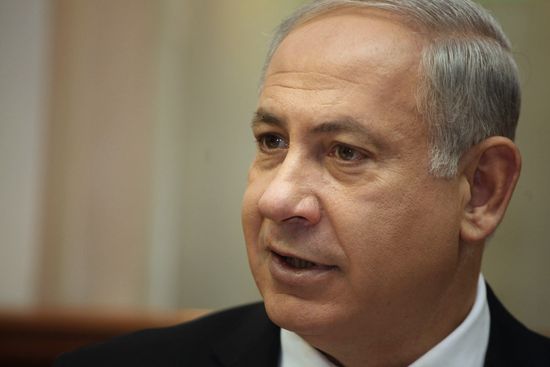
(Photo: Benjamin Netanyahu by Gali Tibbon/Getty.)