The Curious Case Of Bond v. US

Yesterday, SCOTUS ruled that the federal government cannot use a law implementing an international chemical weapons treaty to prosecute a private citizen. Garrett Epps describes what the court called “this curious case”:

This is the second installment of the soap opera of Carol Anne Bond. Bond’s husband and her best friend conceived a child. When she found out, Bond, a trained laboratory technician, turned to the hostile use of 10-chloro-10H-phenoxarsine and potassium dichromate, both deadly poisons. She smeared them on various doorknobs and car doors at Hayes’s house, on one occasion giving Hayes’s thumb a nasty burn. She also unwisely smeared them on Hayes’s mailbox, which is by law part of the U.S. Postal System. Postal inspectors posted security cameras and caught her on video. Federal prosecutors proclaimed this “a very serious, scary case,” because Bond had stolen four pounds of potassium dichromate from her workplace. They charged her with theft of the mail—and violation of 18 U.S.C. § 229, the Chemical Weapons Convention Implementation Act of 1998.

On Monday a six-justice majority, in an opinion by Chief Justice John Roberts, told the government it had misread the statute to “sweep in everything from the detergent under the kitchen sink to the stain remover in the laundry room,” and “make[] it a federal offense to poison goldfish.” Roberts was joined by Justices Anthony Kennedy, Ruth Bader Ginsburg, Stephen Breyer, Sonia Sotomayor, and Elena Kagan. All nine justices agreed that the government had gone too far in prosecuting Bond. The majority said the indictment violated the statute; Justices Antonin Scalia, Clarence Thomas, and Samuel Alito would have held the prosecution unconstitutional.

Amy Howe explains how the justices split on the constitutional question:


Because the Court held that the federal ban on chemical weapons does not apply to Bond, it left for another day whether Congress – relying on its constitutional power to approve treaties – can also pass laws to put a treaty into effect in the U.S., even if no other provision of the Constitution would have given it the authority to do so.  (The Court will often refrain from deciding a question involving the Constitution if it can decide the case on some other, non-constitutional ground – a principle known as “constitutional avoidance.”)

But Justices Scalia, Thomas, and Alito all would have weighed in on that question, because in their view it was “clear beyond doubt” that the federal chemical weapons law applied to Bond.  They would have struck down her conviction for another reason:  that the mere fact that the Constitution authorizes Congress to approve treaties does not automatically mean that laws passed to put the treaties into effect are constitutional.  And here, in their view, the federal ban on chemical weapons is not.

Noting that “the court was unwilling simply to say that it was interpreting the law flexibly to avoid an absurd result,” Noah Feldman worries that the ruling, though narrower than Scalia, et al. would have liked, will still have broader consequences than it ought to:

See, Congress’s power to pass the chemical weapons law derived from its authority to pass laws implementing treaties. Everyone agrees such authority exists, even though it isn’t expressly stated in the Constitution. But not everyone agrees on whether Congress can use this power to pass laws that might trench on states’ rights. And arguably, the authority to regulate ordinary assaults is within the states’ exclusive power. Drawing on all this, the court, in a 9-0 decision, announced that the law must be found ambiguous in what it called “this curious case” because read literally the statute would be improbably broad, even “boundless,” and would potentially impinge state prerogatives. It held that it would have needed a “clear indication” that Congress intended to apply the law to this conduct — and indication the court found lacking.

If this sounds fine, it isn’t. Despite the court’s apparent preference to cabin its holding to these strange facts, the decision will probably be read to limit Congress’ ability to legislate based on its power to implement treaties. In the future, it can be argued that a given statute shouldn’t be applied because Congress hasn’t been “utterly clear” that it does. This may not bother the states’ rights justices, but it should bother anyone who cares about the U.S. fulfilling its international treaty obligations.

Posner reads Scalia’s opinion as a strategic move meant to head off a very particular threat:

The unstated target of the opinion is the international human rights treaty. Those treaties ban all kinds of police-powers-related stuff. The Senate ensured that they were not self-executing, but I suppose that the next time Democrats control the government, they could pass laws that implement them. At least in theory, a Democratic sweep could result in ratification of a human rights treaty that bans the death penalty, and then implementation of it through a federal statute. Not likely to happen anytime in the next few decades if ever, but you can’t fault Scalia for failing to think ahead.
Quotes For The Day

“Suck my dick, you faggot,” – Jonah Hill, yesterday, to a paparazzo.

“This is a heartbreaking situation for me…I’m upset…From the day I was born, and publicly, I’ve been a gay rights activist…This person had been following me around all day saying hurtful things. I played into exactly what he wanted and I said a disgusting word…It’s bullshit and I shouldn’t have said that. I’m happy to take the heat for using this disgusting word. What I won’t allow is for anyone – it would break my heart to think that anyone – especially with all the work that I’ve done and all the loved ones that I have – that I would be against anyone for their sexuality,” – Jonah Hill, today.

A text-book case of slur and apology. Alec Baldwin take note.

When The NRA Isn’t Pro-Gun Enough

https://www.youtube.com/watch?v=OxGDoWS9Ess

Grace Wyler reviews how some well-armed gun rights advocates took their activism so far that the NRA asked them to tone it down:

For the past few months, zealous Second Amendment lovers, led mostly by the group Open Carry Texas, have been staging demonstrations at various chain restaurants, arriving en masse at places like Chipotle and Chili’s and demanding to be served while brandishing long guns. In some towns, Open Carry Texas members have also taken to wandering around busy intersections armed with rifles and handing out tiny copies of the Constitution to passing drivers.

It’s not totally clear what these protests are supposed to accomplish, but it’s safe to say that they’re not working. Mostly they’ve managed to frighten fast-food workers and customers and get guns banned from eateries that had previously tolerated firearms. … Perhaps sensing a backlash, the NRA is now asking the open carry enthusiasts in Texas to please tone it down before they ruin the Second Amendment for everyone. In a statement released Friday, the notorious pro-gun organization applauded the Lone Star State’s “robust gun culture,” but pointed out that ordering a burrito with an assault rifle slung across your chest is “just not neighborly.”

Morrissey agrees that OCT’s antics were simply unnecessary:

It’s a little unclear exactly what point OCT had in staging these demonstrations at retailers who either supported or at least tolerated firearms on their premises. The protests made them a target for anti-gun activists, and raised their profile to the point where they had little choice but to respond. Whatever one thinks of carry issues, few dispute that private-property owners have at least some legitimate rights in setting conditions for service and access. and these protests made it significantly more difficult for common-sense gun owners to do so in these establishments for no real clear purpose … other than gaining attention.

Francis Wilkinson lampoons the NRA’s response:

[NRA leader Wayne] LaPierre has detailed the overwhelming threats Americans face from “terrorists, home invaders, drug cartels, carjackers, ‘knockout’ gamers, rapers, haters, campus killers, airport killers, shopping mall killers, and killers who scheme to destroy our country with massive storms of violence against our power grids or vicious waves of chemicals or disease that could collapse as a society that sustains us all.”

Is it any wonder that open-carry advocates would fear going into a Chipotle or Starbucks without a loaded semi-automatic rifle to keep themselves safe from the horrors LaPierre so exhaustively describes? Yet here is the NRA last week discouraging Texans from being on their guard at every moment.

Dara Lind stresses that the NRA’s objection was pretty circumscribed:

The blog post, posted on the website of the NRA’s Institute for Legislative Action — its lobbying arm — lumps the Texas open-carry demonstration in with proposed “smart guns” legislation. Both of them, the post says, make it harder to be a responsible gun owner. But while the case against “smart guns” takes up most of the post, the NRA doesn’t mince words in dressing down the Texans for showing up to Chipotle armed to the teeth. In fact, the NRA calls that (emphasis in the original) “downright weird.

The NRA thinks the Texas gun owners’ true faux pas was the type of guns that were used, not the demonstration itself. Apparently, it’s not “bad manners” to brandish a pistol in a Chipotle, but brandishing a “tactical long gun” crosses the line.

Nonetheless, Open Carry Texas responded by slamming the NRA as unfriendly to gun rights:

“The more the NRA continues to divide its members by attacking some aspects of gun rights instead of supporting all gun rights, the more support it will lose,” the group wrote. “Already, OCT members are posting pictures of themselves cutting up their life membership cards. If they do not retract their disgusting and disrespectful comments, OCT will have no choice but to withdraw its full support of the NRA and establish relationships with other gun rights organizations that fight for ALL gun rights, instead of just paying them lip service the way the NRA appears to be doing.”

The Dish Model Spreads

First TPM and Slate make a bid for actual subscribers, and now, following far behind, even Commentary is taking the plunge:

To join the 28,962 members of the Dish model, subscribe! Maybe we can make it a clean 29,000 by day’s end.

The Golden Age Of Maps, Ctd

A reader shakes his head:

I can easily argue with your snickering reader who claims that paper topographic maps are good only as “wall decorations,” having “been rendered essentially useless by the Internet.” By the Internet? He clearly doesn’t get out much, at least he doesn’t get out in wild places, either on foot or in a canoe. I just spent four wonderful days backpacking with my sons in the woods of north-central Pennsylvania. We carried everything we needed on our backs. I can assure your overly connected reader that the paper topo maps we used (30 years old) are still terrifically useful technology. They helped us to figure out where we were and where we should camp, and allowed us to find alternate trails when high water made certain areas impassable. And they are lightweight to boot, which is important when every ounce must be carried. All the cell phones and tablets in the world would have been dead weight in our packs – essentially useless.

Your reader forgets that there are still large swaths of the continent where cell service is sketchy to non-existent. I’ve taken extended wilderness trips in northern Minnesota, the Adirondacks, Georgian Bay in Ontario, and the mountains of New Mexico – no cell phone service in any of these places. Furthermore there are no electric outlets at night for that convenient re-charge. When exploring wild places, I think I’ll hang on to my topo maps for now, thanks.

Previous Dish on the debate here and here.

The Flight Of The Monarch

Yesterday, Spanish King Juan Carlos de Borbón abdicated the throne in favor of his son, Felipe. Fernando Betancor offers a detailed look at the abdication, its timing, and why it matters in a country where the monarchy is nowhere near as popular as it once was:

[A] generation of Spaniards grew old with Juan Carlos as the king that restored democracy; and another generation grew up with no direct experience of Franco’s rule, only of the monarch’s light touch in daily political life. The monarchy enjoyed widespread support across most segments of the population and especially among the survivors of the fascist regime. Even most supporters of Republic were perfectly willing to let Juan Carlos conclude his reign before pushing for change. That base of support has been eroded in recent years. …

The King has abdicated to save the monarchy and pass his inheritance intact to his son before his waning popularity gave out; but the action has sparked the most intense debate in the nation over the future of Spain. Demonstrations were organized immediately through social media in Madrid, Valencia, Barcelona, Bilbao and other major cities. Supporters of a Third Spanish Republic came out in large numbers last night, waving the republican flag and calling for a referendum on the future of the monarchy.

They will not get their wish before Felipe becomes King; but if Felipe is more popular today than his father, he also enjoys gets none of the credit for the transition to Spanish democracy. Popular discontent with the monarchy and calls for its abolition are not going to go away.

Jon Lee Anderson reviews the scandals that led to Juan Carlos’s fall from grace, beginning with an incident two years ago in which he broke his hip on a secret elephant-hunting expedition in Botswana. These scandals, he observes, have been accompanied by a change in the attitude of the Spanish press:

Spain’s media had been generally obsequious toward the royal family. When I published an article about Juan Carlos for this magazine, in 1998, I mentioned that the King was known to have had an affair; a Spanish journalist who had spoken to me for the story was so worried about his career that he called the chief of the royal household to apologize. Another Spanish newspaper editor told me that he and his colleagues “exercise self-censorship on the subject of the King.” Now the media began a kind of inquisition, investigating hitherto untouchable matters with relish. In addition to Elephantgate, there was a scandal involving Juan Carlos’s daughter Princess Cristina and her husband, Inaki Urdangari, a former sports hero accused of using a charitable foundation as a personal slush fund. (They have denied the charges.) In the past couple of years, hardly a week goes by without some new suggestion of royal nefariousness from the ensuing court case.

Spain’s political environment is also in the midst of what might be some very big changes:

Since 1977, Spain has been, for the most part, a two-party state. The Socialist Party has represented the center left, while since the late 1980s the People’s Party, and before that the Democratic Center have represented the center right. Last week, both parties were punished at the polls in European elections, taking less than 50 percent of the vote for the first time since the return to democracy.

It’s a mistake to read too much into European elections – populations tend to use them to register protest votes and then drift back to mainstream candidates for national elections – but the numbers here are particularly dramatic. It also seems significant that voters seem to have drifted more toward the anti-austerity leftist Podemos Party – an outgrowth of the indignados protests that pre-dated the rise of Occupy Wall Street in 2011, rather than the kind of right-wing anti-immigrant parties that made gains in many other European countries. The country’s unemployment rate remains stubbornly high at 26 percent, 55 for youth. On top of that, Catalonia is experiencing a new wave of nationalism, with independence parties pushing for a referendum this fall.

James Badcock introduces us to the new king:

As a prince, Felipe has studiously avoided controversy. He won’t be able to for long, however. One of the biggest concerns the new king will face is the Catalan government’s plan to hold a referendum on independence from Spain in the fall. The prince has learned to speak Catalan and will no doubt develop the royal household’s recent and tentative experiment in online transparency regarding public funds. The question remains, however, whether in such a fragmented political environment such niceties will suffice to keep the monarchy safe. In a poll published earlier this year by the right-of-center daily El Mundo, barely 50 percent of the respondents said they were pro-monarchy, while a larger majority said Juan Carlos ought to abdicate.

And so he has. But the old king’s gesture was not enough to stop thousands of indignados filling squares in Madrid, Barcelona, and other cities on Monday evening to demand a referendum on the future of the monarchy in Spain. 

Bershidsky credits the old king for acknowledging that it was time to go:

The realities of modern monarchies are nothing like “A Game of Thrones”: There’s no point for kings and queens to hang on to power when people are tired of them. King Juan Carlos may have gotten attached to his title in his 39 years on the throne, but he is nothing if not a responsible statesman in a country he helped turn into a democracy. Unlike Franco, he can admit he is now frail, tired and no longer able to work his old magic. He doesn’t have to die on the job like the dictator he succeeded. There are plenty of dictators still left in the world whose countries would benefit if they followed Juan Carlos’s example.

Ishaan Tharoor takes stock of Europe’s monarchies, noting that Spain’s isn’t the only one whose relevance has been called into question:

Across the continent, a new generation of princes and princesses have been at pains to style themselves as frugal, ordinary citizens. But this betrays a weird tension: If the royals are just like anybody else, why do they need to exist? Ordinary citizens are not blessed with a divine right to kingship. Ordinary citizens do not exist on public expense. It’s the monarchs’ role to be living anachronisms. But can Europe afford that? …

The king’s abdication will probably not be Europe’s last. It’s rumored that after Britain’s Queen Elizabeth II eventually passes, her son Prince Charles may abdicate in favor of his son Prince William. One wonders how many more generations of costumed royals will have to ponder the same choices.

Ballots For Bashar

SYRIA-CONFLICT-POLITICS-VOTE

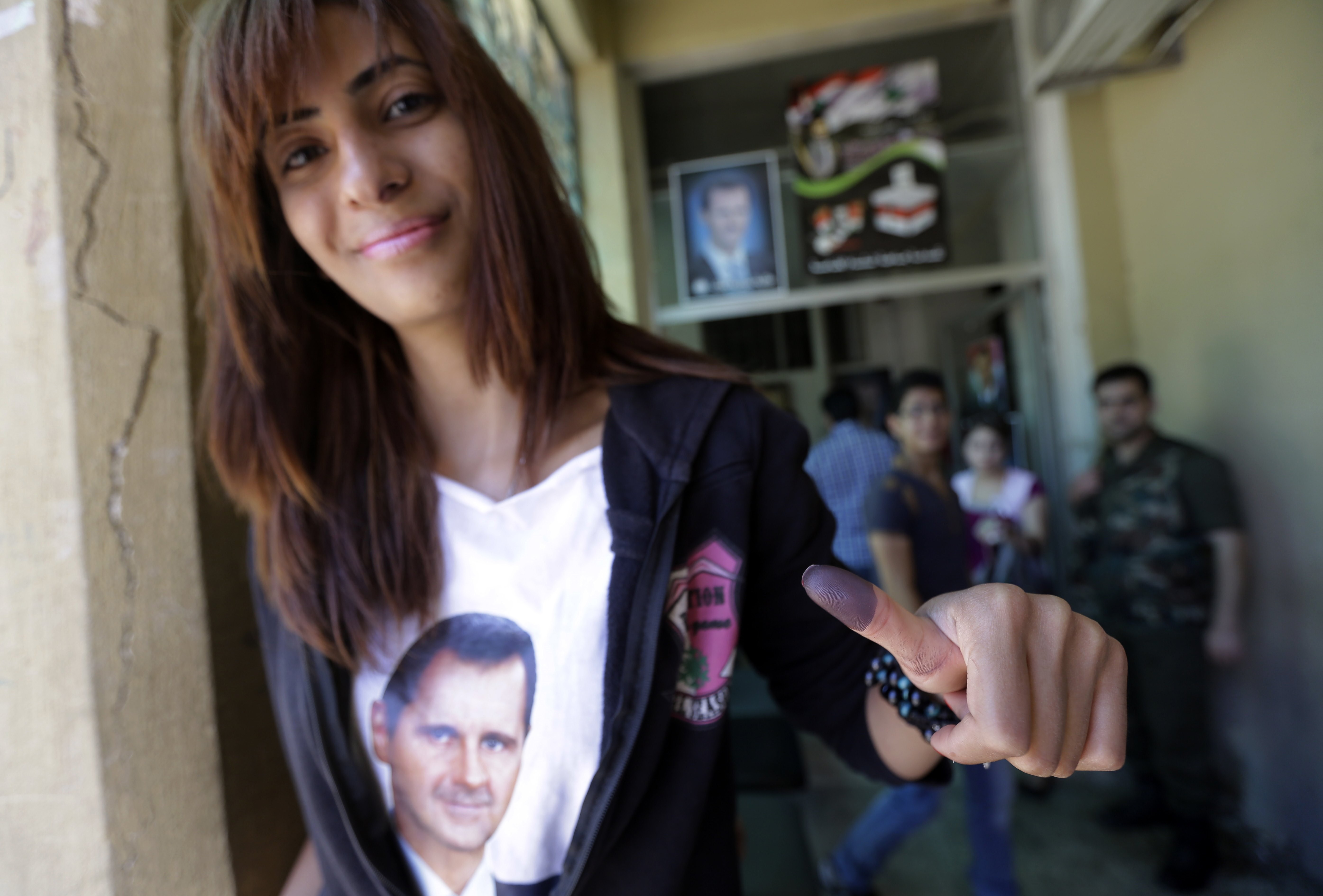
Syrians in government-controlled areas vote today in a presidential “election” that pits incumbent Bashar al-Assad against two pre-approved, token opposition candidates with no chances of winning. Steven Heydemann explains why the regime bothered to hold the sham election at all:

[A]s tempting as it might be, it would be a mistake to dismiss the election as a farce — it has already caused real harm. It has accelerated the resignation of U.N. special envoy for Syria Lakhdar Brahimi, who said on March 14 that “holding elections [in Syria] would doom prospects for future talks by negating the need for an interim government.” Without a swift and compelling response from the United States and other lead FOS governments, the election will continue to muddle the international case against Assad. Election results will be hauled out at every opportunity to justify regime intransigence, continue to stymie the efforts of the U.N. Security Council to act on issues such as the regime’s obstruction of humanitarian assistance, and undermine possibilities for a negotiated settlement based on the internationally-agreed Geneva Protocol of June 2012.

David Kenner interviewed Assad’s two opponents and was surprised to find that they actually had some non-sycophantic opinions toward the regime:

“The age of the sole ruler has come to an end,” [businessman Hassan Abdullah] Nouri told FP. Assad’s rule has resulted in the emergence of a “100 family economy” that controls the preponderance of the country’s wealth, he said, while the middle class has collapsed.

Nouri framed his efforts to combat corruption and improve the country’s economy as a strategy for strengthening Syria’s struggle against both the United States and Israel. “The U.S. administration knows full well that there is no way to breach Syria militarily,” he said. “The United States can only breach Syria socially, because of its scientific supremacy” — which, he noted, Damascus can circumvent through internal reform and deeper cooperation with Russia.

When it comes to political reform and the regime’s ongoing crackdown on its domestic enemies, however, Nouri had nothing but praise for Assad. He heralded the country’s new “modern and balanced” constitution as opening the door for political pluralism in the country, and said that the coming election would be “honest and democratic, in the Syrian way.”

Nicholas Blandford expects Assad’s election victory to forestall an end to the conflict for years to come:

Assad will feel vindicated by his reelection and will likely reject any proposed meaningful negotiations with the opposition. On the battlefield, Assad’s forces will continue to systematically seize territory from the fragmented, poorly equipped armed opposition. The regime has regained control over the critical corridor linking Damascus to the Mediterranean coast via Homs and has either pushed rebel forces away from the suburbs of Damascus or surrounded and bombed them in a brutal but effective strategy of “surrender or starve.” The military is attempting to reverse recent rebel gains in the Golan Heights and Deraa province in the south and continues to chip away at rebel quarters of Aleppo.

Nevertheless, Assad’s military forces – the army, Hezbollah fighters, Iraqi Shiite paramilitaries and the National Defense Force militia – are badly overextended. When they concentrate their forces on a specific target, such as the recent offensive in the Qalamoun region north of Damascus, they can usually triumph, but it is by no means certain that the regime can hold the ground after it redeploys to a new objective. As for regaining the country as a whole, that is not a realistic scenario for now. Neither side is strong enough to decisively defeat the other.

(Photo: A Syrian student shows her ink-stained thumb after casting her vote in the country’s presidential elections at a polling station in the Baath University of Homs, north of Damascus, on June 3, 2014. By Joseph Eid/AFP/Getty Images)

Fact-Checking Larry Kramer On Reagan

An important clarification to the now-ubiquitous notion that Reagan did not mention AIDS until the seventh year of his presidency and did nothing to support AIDS research:

For the record, Reagan first mentioned AIDS, in response to a question at a press conference, on Sept. 17, 1985. On Feb. 5, 1986, he made a surprise visit to the Department of Health and Human Services where he said, “One of our highest public health priorities is going to be continuing to find a cure for AIDS.” He also announced that he’d tasked Surgeon General C. Everett Koop to prepare a major report on the disease. Contrary to the prevailing wisdom, Reagan dragged Koop into AIDS policy, not the other way around.

As for Waxman’s recollections about AIDS funding, he does an unusual thing for a politician: He’s forgotten the success he and other Democrats had in convincing Reagan to spend more money. The administration increased AIDS funding requests from $8 million in 1982 to $26.5 million in 1983, which Congress bumped to $44 million, a number that doubled every year thereafter during Reagan’s presidency.

Dissents Of The Day

[vimeo https://vimeo.com/15307136 w=580]

A reader writes:

As a 23-year-old transgender woman and a big fan of yours, I’ve struggled with your clear misunderstanding and discomfort with the topic. I no doubt agree that from a strategic standpoint, a marginalized community has to be patient with folks who are struggling to understand.

Having said that, I think you are dead wrong that the public is entitled to know about Laverne Cox’s medical history simply because she is talking publicly about being transgender. If Laverne is comfortable talking about her privates, that’s fine. That is everyone’s individual decision, but the notion that 1) journalists think this is a totally okay question to ask, and 2) that people feel entitled to the answer even after a person explains that it’s personal, is both disturbing and reveals an inappropriate double standard. I would venture to say that any non-trans person’s genitals are just as important to them and their experience of their gender as any transgender person’s genitals, and yet no one would dare ask a similar question to a non-trans person.

Perhaps you view this as too prudish. Maybe. But that’s not the point. It’s the fact that a general dignity is granted to non-trans people that is not granted to trans people. Would you seriously chastise Tammy Baldwin or Ellen DeGeneres for refusing to answer questions about intimate details about their sex life? Trans people shouldn’t be expected to bare all in order to achieve equality.

Finally, RuPaul has been “cast aside” because her show mocks trans people and she refuses, as a non-trans identified person, to stop using an objectively derogatory slur. Reminds me of your disgust at Will & Grace.

One small rebuttal: I don’t think I’m “uncomfortable” with this subject. I find it fascinating. I’ve just become nervous in discussing it because of the extreme defensiveness and anger that many – but not all – in the trans community seem to be stuck on. Another:

As a former long-time reader, a founding member of the Dish, and a trans woman, I hope you’ll take the time to read my response to your recent, rather frustrating piece on transgender activism. Hopefully my response will help you to understand the details of why we’re so frustrated.

You wrote: “No writer wants to unleash the hounds of furious, touchy trans activism.”

If trans activists are touchy, it’s only because we’ve been treated so poorly over the years that we’ve effectively developed PTSD (recent estimates put the incidence of PTSD rate in the trans community at 1 in 6). There’s a reason “tranny” is considered a slur by the trans community, and it has nothing to do with RuPaul using it and everything to do with the fact that it’s what many of us hear as we’re beaten to a pulp, raped, and murdered.

Take, for example, the two trans women who were assaulted last week on public transit in Atlanta. What were they repeatedly TV Academy Presents 10 Years After The Prime Time Closet - A History Of Gays And Lesbians On TVcalled? “Tranny.” This is the same reason the gay community does not wish to be called “faggots” and takes offense when the word is used by people who do not consider themselves gay.

Returning to the so-called “language police,” RuPaul has been repeatedly asked, for years now, not to use slurs in his show. He has repeatedly ignored these requests, often responding with violent, misogynist, hateful language towards those who would dare question his choices.

You wrote: “Any minority […] has […] to explain itself to the big, wide world […] there is no need to be defensive about it.”

And the first few times we have tried to explain ourselves, we were perfectly civil. But at some point, when your repeated explanations are ignored, a change of tactic might be necessary. Had we not gotten upset, this conversation would never be happening, and we would continue to be thrown under the bus by the rest of the GLB community, just like we were after the Stonewall riots (many of the rioters were trans women of color, a fact which some members of the gay rights movement later tried to erase from history), with federal employment non-discrimination protections under ENDA, numerous other cases, and most recently, very nearly with the recent non-discrimination ordinance in Houston.

Moving on to the question of whether random strangers have a right to know about the genitals of every trans activist, I think the answer should be clear, but apparently, it wasn’t.

You wrote: “Laverne Cox […] refused to answer a question about whether she had had her genitals reassigned as too ‘invasive.’ Sorry, Laverne. But if you’re out there explaining yourself, you’ve gotta explain all of it.”

On a similar front, as a gay activist, do you feel obligated to explain intimate details of your sex life and anatomy? When you have sex with your husband, do you top or bottom, or is that off the table as too invasive? You have also repeatedly lobbied for an end to circumcision; have you had foreskin reconstructive surgery yourself? When did you first realize you were unhappy with being circumcised? I’m only asking because the public is curious and wants to know.

A simple point: since reassignment surgery is often intrinsic to a full trans identity, it is relevant to understanding that identity in a way that the appearance of one’s junk is not relevant to the question of being gay. Another sends the above video:

My friend Kris came and stayed the night at our place (I first new him as Kristen) and I was getting used to his new identity. In the morning I drove him to the University of Richmond campus – a fairly conservative town and college – and dropped him off with his “Ask A Tranny” sign in the quad where he was holding it up with a smile. I couldn’t help be a bit worried about him, or think, “what position are you putting yourself in?” The thing is, he didn’t care. He was happy and out there just engaging and answering questions – open to ANY question, brave, and engaged, and above all, happy in the world. He’s at peace with who he is and any questions other people might have. I’m sure I asked some questions that might make me seem ignorant to some, but that is what he puts himself out there for. To take a gendered phrase, he has balls on him, but coupled with real good will towards others.

And for those reasons, he’s a hero.