An Iranian reader flags this leaked video of Mohammed Ali Jafari, the head of Iran’s Revolutionary Guards, addressing a group of Iranian officials. In it, he seems to acknowledge a role “interfering” with the 2009 election:
If there is anyone out there, Leveretts aside, who still thinks the 2009 election was legit, this video is the single best piece of evidence yet that it was fixed. The two most important revelations:
1) Jafari says that their “red line” was the reformers (Mousavi et al) returning to power. By calling it a red line he is implying that they would not allow it to happen.
2) Jafari also remarks that in the days before the election, it was clear that Ahmadinejad was going to be forced into a second round, at which point they wouldn’t be able to predict what would happen (i.e. they couldn’t guarantee him a victory). Again the implication here is that they then did something about that.
“The sensitivity of the [2009] presidential elections is clear for all of you,” Jafari says at the beginning of the approximately five-minute Facebook video. “The concern and worry that existed, and the red line that existed for the forces of the revolution, is again the return of those opposed to the revolution and the values of the revolution, that during the 2nd of Khordad found an opportunity and penetrated the government, for them to return to power once again.”
By “2nd of Khordad,” Jafari was referring to the 1997 election won by Reformist President Mohammad Khatami in a landslide victory.
Also:
Jafari said that the Reformists had planned their return through Mousavi, saying, “In these elections and the events afterward, it became clear why they insisted so much that Sepah and Basij and the security forces should not interfere in the elections. That the [Revolutionary Guard] shouldn’t interfere so that they could their thing … This pattern was so worrying that everyone assessed that if this process continued, the elections would go to the second round and in the second round, it was not clear what the result would be.”
If any candidate had failed to receive 50% of the vote, the elections would have entered a second round. Mahmoud Ahmadinejad won the 2009 presidential elections with over 62% of the vote. Candidates Mousavi and Mehdi Karroubi, who, along with Mousavi’s wife Zahra Rahnavard are currently under house arrest, contested the results.
Jafari’s statement complements other evidence — from the IRGC itself — that the Guards used detention, repression, and disruption of communications to stop Mousavi. In summer 2010, a leaked audio and Power Point documented a presentation by a “General Moshfegh” outlining the IRGC’s strategy before and after the ballot. [link]
A few days before the vote, the head of the IRGC’s Political Directorate, Brig. Gen. Yadollah Javani, accused Mousavi and other reformists — who had adopted Green as their symbol of trying to start a “color revolution”. He warned that the Guards “will suffocate (the movement) before it is even born.”
Reza HaghighatNejad highlights another part of the video:
Jafari’s speech provides new information about Revolutionary Guards tactics following Khamenei’s criticism of Mousavi and Korroubi: street rallies were to be crushed even if they were peaceful; reformist movement protesters were to be arrested; and Green Movement activists’ telephone and online communication was to be disrupted. Jafari tells his audience that the Revolutionary Guards successfully carried out all three tasks. Through creating confusion and organizing widespread arrests among Mousavi supporters, they effectively drove him out of the competition. Jafari also dismisses protesters, claiming they are from affluent northern Tehran neighborhoods, people who are unable to cope with even minimal hardship.
It appears that the speech was made some time before July 19, 2009. Only two days before, on July 17, former president Hashemi Rafsanjani spoke at Friday Prayers, calling for “unity” and for trust to be restored. Mir Hossein Mousavi’s was also present. The film suggests that, even before protests gathered real momentum, the Revolutionary Guards were determined to stifle dissent.
You may recall the kerfuffle recently when the UN Rapporteur on Torture tried to indict the Vatican for “crimes against humanity” because of the widespread scheme, orchestrated by the church hierarchy, to facilitate and cover up the mass rape and sexual abuse of children. Many argued that the very term “crime against humanity” was over the top, fueled by anti-Catholicism or secularism, and effectively undermined itself by its extreme language.
In a town in western Ireland, where castle ruins pepper green landscapes, there’s a six-foot stone wall that once surrounded a place called the Home. Between 1925 and 1961, thousands of “fallen women” and their “illegitimate” children passed through the Home, run by the Bon Secours nuns in Tuam. Many of the women, after paying a penance of indentured servitude for their out-of-wedlock pregnancy, left the Home for work and lives in other parts of Ireland and beyond. Some of their children were not so fortunate.
More than five decades after the Home was closed and destroyed — where a housing development and children’s playground now stands — what happened to nearly 800 of those abandoned children has now emerged: Their bodies were piled into a massive septic tank sitting in the back of the structure and forgotten, with neither gravestones nor coffins.
A mass grave for eight hundred children, buried with no dignity, no humanity, no trace of decency. And the mass grave may well have been facilitated by rampant, disgusting and callous neglect:
According to documents Corless provided the Irish Mail on Sunday, malnutrition and neglect killed many of the children, while others died of measles, convulsions, TB, gastroenteritis and pneumonia. Infant mortality at the Home was staggeringly high. “If you look at the records, babies were dying two a week, but I’m still trying to figure out how they could [put the bodies in a septic tank],” Corless said. “Couldn’t they have afforded baby coffins?”
Special kinds of neglect and abuse were reserved for the Home Babies, as locals call them. Many in surrounding communities remember them. They remember how they were segregated to the fringes of classrooms, and how the local nuns accentuated the differences between them and the others. They remember how, as one local told the Irish Central, they were “usually gone by school age — either adopted or dead.” According to Irish Central, a 1944 local health board report described the children living at the Home as “emaciated,” “pot-bellied,” “fragile” and with “flesh hanging loosely on limbs.”
Let us call this what it is: a concentration camp with willful disregard for the survival of its innocent captives, a death camp for a group of people deemed inferior because of the circumstances of their birth. When we talk of mass graves of this kind, we usually refer to Srebrenica or the crimes of Pol Pot. But this was erected in the name of Jesus, and these despicable acts were justified by his alleged teaching.
To my mind, these foul crimes against women and children, along with the brutal stigmatization of gay people as “objectively disordered”, remain a testament to how the insidious, neurotic and usually misogynist fixation on sex has distorted and destroyed Christianity in ways we are only now beginning to recover from. For what we see here is the consequence of elevating sexual sin above all others, of fixating on human sexuality as the chief source of evil in the world, and of a grotesquely distorted sense of moral priorities, where stigmatization of the sexual sinner vastly outweighs even something as basic as care for an innocent child.
It seems to me that we have to move past the church’s current doctrines on sex if we are to fully seek justice for the victims of this pathology and if we are to ensure that never again is a phrase that actually means something. It is not enough to ask for a change in governance (and even that has been hard); what this evil signifies is the need to root out this pernicious obsession with sexual sin. This pathology – perpetuated by Benedict and the sex-phobic theocons – perpetuates the mindset that led to this barbarism. The nuns – and yes, this was abuse practised by women as well as men – did not ever seem to realize that Jesus himself was conceived, to all intents and purposes, out of wedlock – in a manner that may well have led his contemporaries to stigmatize him as illegitimate as well. They did not for a moment internalize Jesus’ emphatic insistence on the holiness of children as those most likely to enter the kingdom of Heaven. No, these precious images of God were consigned, after years of abuse and neglect, to unmarked early graves in a septic tank.
That is not a sign of a church gone astray. It’s a sign of a church given over to evil. A church that leaves young children to die of malnutrition and then dumps hundreds of them into a mass grave is not a church. It’s an evil institution that robs the word “church” of any meaning, and twists the Gospels into their direct opposite.
We failed these children in their short lifetimes. Never, ever forget them if we are to have a chance at restoring a Christianity worthy of Jesus.
I think I may be on a winner here. The photograph is of the Derwent River in Hobart, Tasmania, Australia. The tall building across the body of water is the Hobart Casino. My hunch is that the photograph was taken from the Bellerive or Rosny neighbourhoods near Kangaroo Bay, on the other side of the river bank (but I don’t have OCD and won’t be pinpointing the exact location). I once drove around Tasmania with my family when I was a teenager. It’s a beautiful Island.
Another spins the globe:
This looks to be New York looking south along the Hudson. Maybe Stony Point.
And back again:
Yoros Castle, Istanbul, Turkey. I know that’s wrong, but this is somewhere on the Bosphorous, right?
Nope. Maybe it’s in South America:
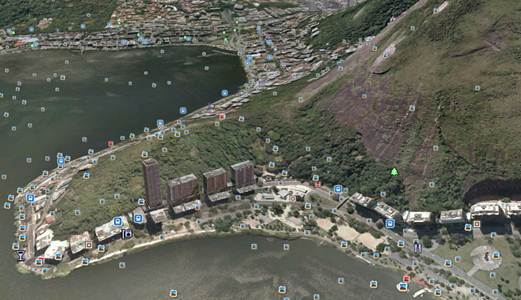
I so wanted this view to be taken from somewhere around the Lagoa Rodrigo de Freitas in Rio de Janeiro in the shadow of the Christ the Redeemer statue. It looked so much like what I remembered when I visited there – from the high rise condos, to the rounded, partially bald mountains rising from the water.
I looked for hours for the possible angle, but the pieces just wouldn’t fall into place. I searched the Internet for ages to try an located the viaduct looking bridge on the side of the mountain. I looked for the oddly out of place Germanic looking building on the right hand side. No luck.
So, alas, since I have no better guess I will stick with it even though I am pretty sure it is in vain.
Another throws up his hands:
Dammit, Sullivan. A weekend wasted, yet I am completely stumped this week.
My first reaction to the picture was that the geographic features remind me of Lake Como, though the buildings are all wrong. I doubt it’s in the US, especially after two weeks in a row having American locations, though I can’t find anywhere else in Europe that matches. It somewhat reminds me of Canadian utilitarian architecture, but again, I can’t pinpoint where it might be. So I am going to go with a complete shot in the dark and say that it’s somewhere on Lago Maggiore in Italy.
Please: Consider starting some sort of support group or rehabilitation program for those of us who are completely obsessed with this game, but who don’t have the amazing capacity to find the location every week. (That and maybe marriage counseling for spouses who wonder why their lesser half spends the entire weekend staring at their screens trying to divine the clue that will unlock the solution.)
And that’s if you even want to find it:
This has got to be the saddest lakeside town I’ve ever seen. Seriously, it looks completely desolate and deserted. The architecture is very austere, nothing frilly or happy about it. I see something looking like a pseudo-castle-like structure on the bottom right, probably a some sort of hotel or restaurant. The most interesting feature is the ruined aqueduct on the hill. I searched for aqueducts throughout Europe, found no pics of that one. Above it, there seems to be a hotel, casino or cement factory. Again, uninspiring architecture, reminiscent of countries in the former Eastern block. I sincerely hope this is not one of the Italian lakes, even though I did guess that.
Another gets to the wrong lake in the right country:
Precarious rock ledge, Lake Rigi, Lucerne, Switzerland.
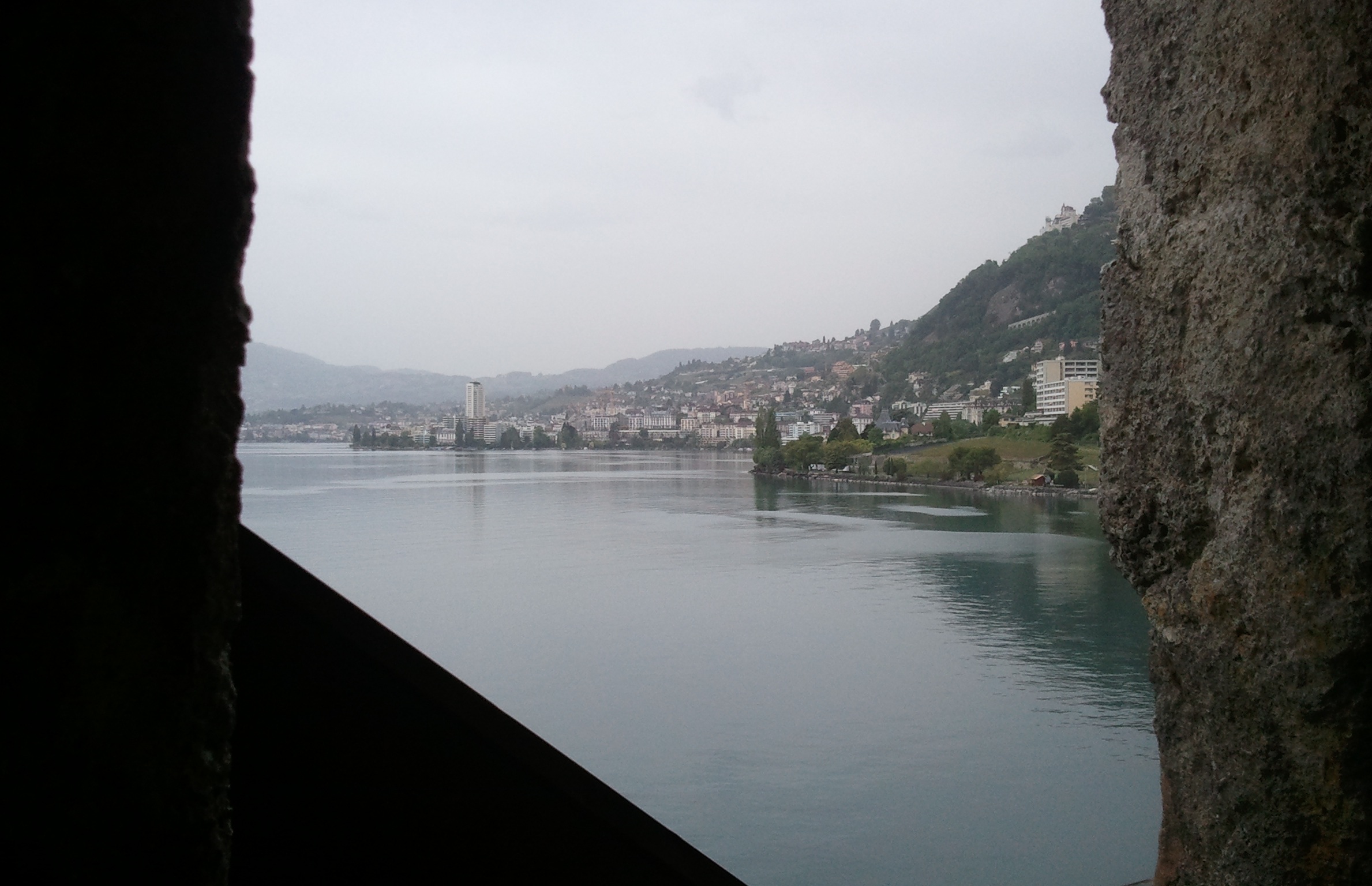
This reader, like most entrants this week, nails the correct lake, castle, and town:
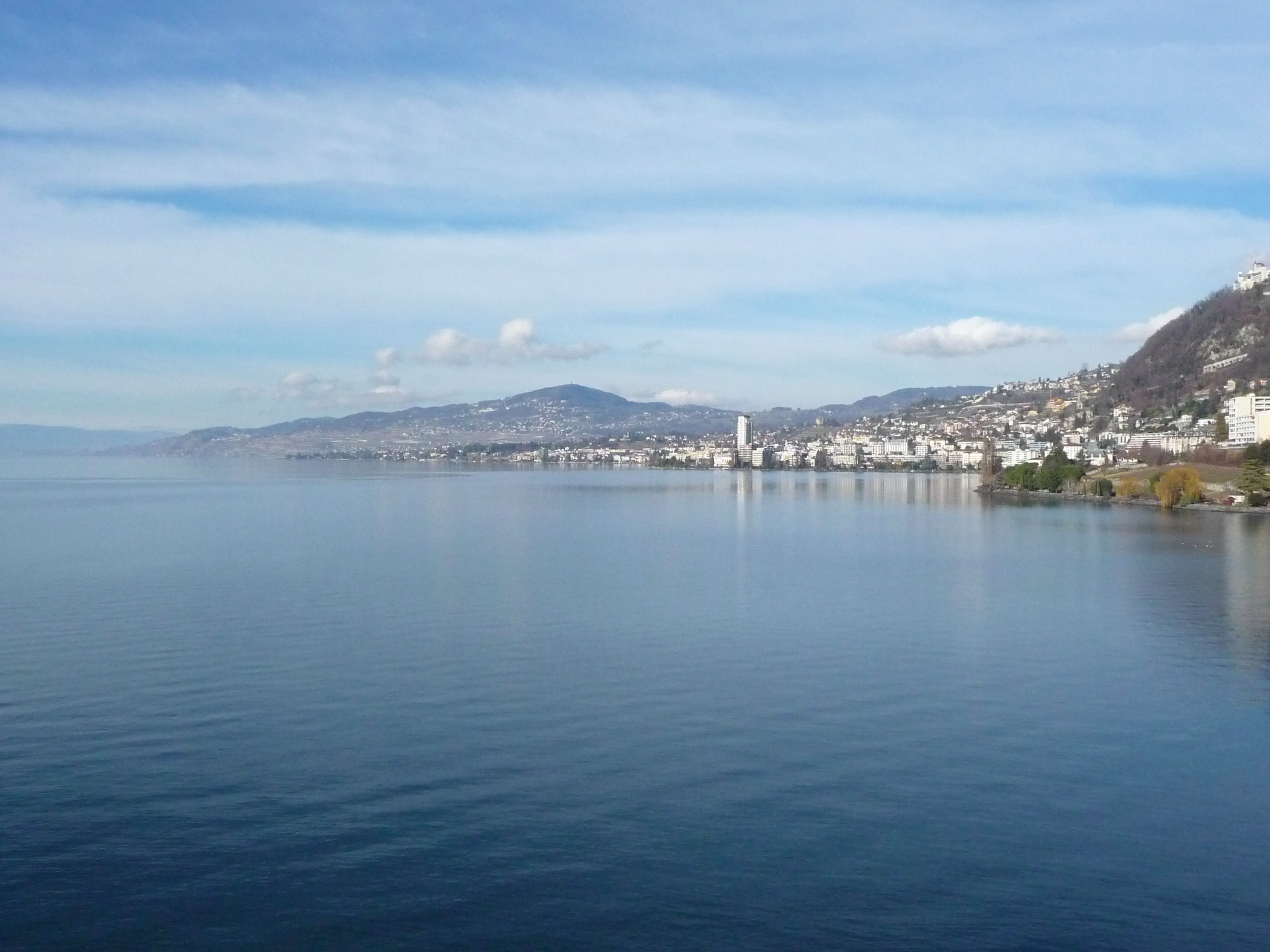
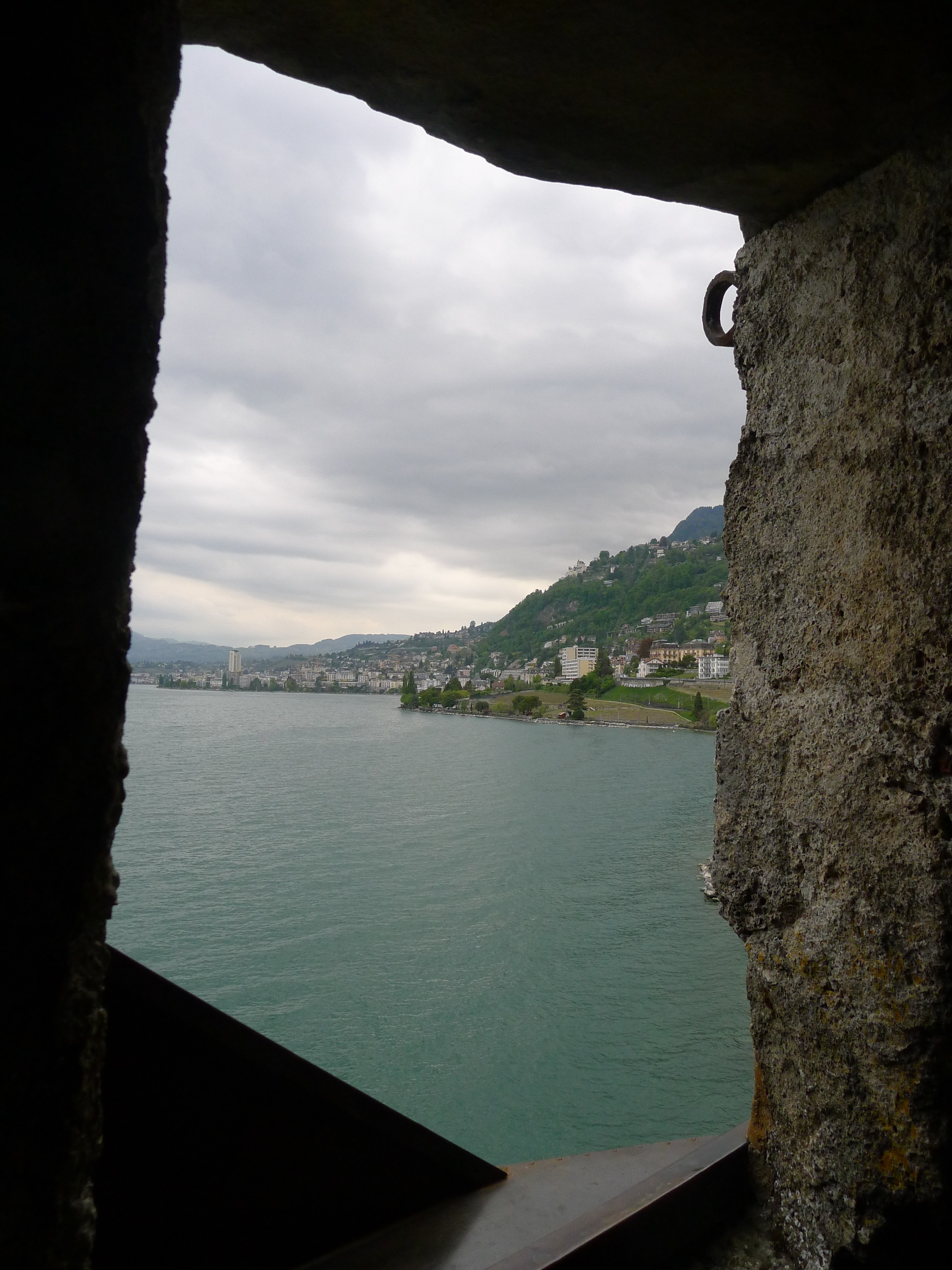
This week’s VFYW contest picture was taken from a window in the stunning Château de Chillon on Lake Geneva in Veytaux, Switzerland. I visited it in February 2010 and took a similar picture from (probably) a different window looking toward the city of Montreux:
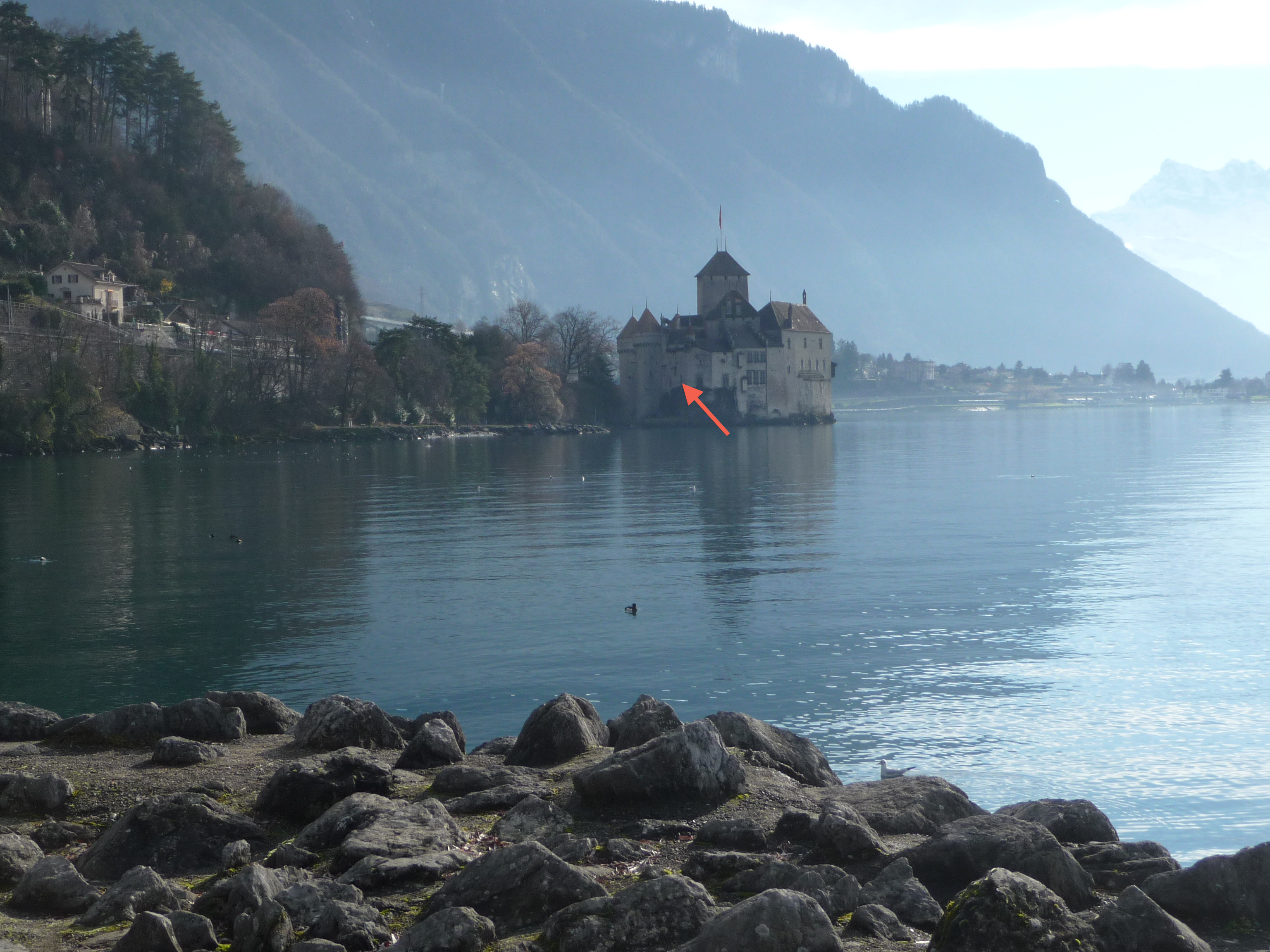
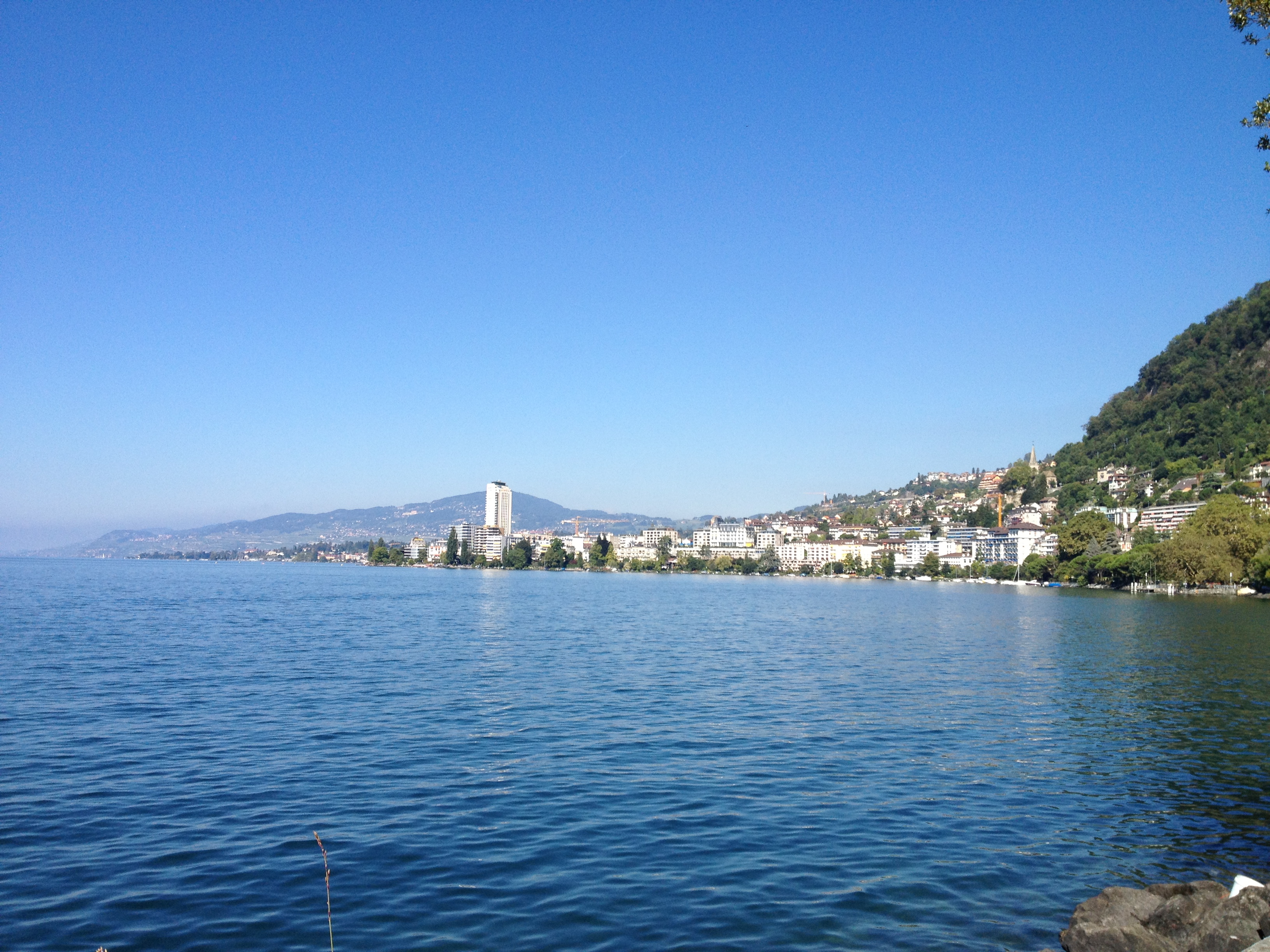
And here’s a photo I took from the shore in the contest picture, looking back at the Château, with my best guess on the window:
Indeed, many readers were delighted to revisit the Alps this week:
The photo is taken from the Chateau de Chillon in Veytaux Switzerland, looking North along the shore of Lac Leman toward Monteux. I haven’t been there since the early spring of 1983, but I recognized it instantly. I remember heading for Geneva by train from Rome. I was a few months shy of 19. It was a gorgeous day, with a full view of the Alps coming through the Rhone Valley. I happened to be out in the passageway gazing at the Lake and the mountains beyond when we passed the Chateau on the way into Montreux. I grabbed my backpack and hopped off the train there, and walked back to Veytaux, where the castle is located. I was very into castles in those days, but had never heard of Chillon. So I just happened upon one of the most beautiful in the world, and on a day that did it full justice. What a great day.
An impressive visual entry:
Another reader:
Wow. Just saw the VFYW picture for this week, and I knew instantly where it was taken. Just offshore on Lac Leman in the Canton of Vaud, Switzerland. My family relocated to Lausanne, Switzerland, for a few years back in the 1980s and my parents brought every visitor, every out-of-town guest (and of course, us kids) to experience the Chateau. How many times did I look out a window like the one in the picture and try to imagine what it was really like back in the day! I was around 12 years old back then, and seeing that photo was kind of thrilling. Thanks.
But this reader trumps everyone:
I didn’t see this weekend’s contest until Sunday evening, having just come back from an afternoon’s walk to Chateau-de-Chillon! Obviously the view is from the top of the chateau looking towards Montreux.
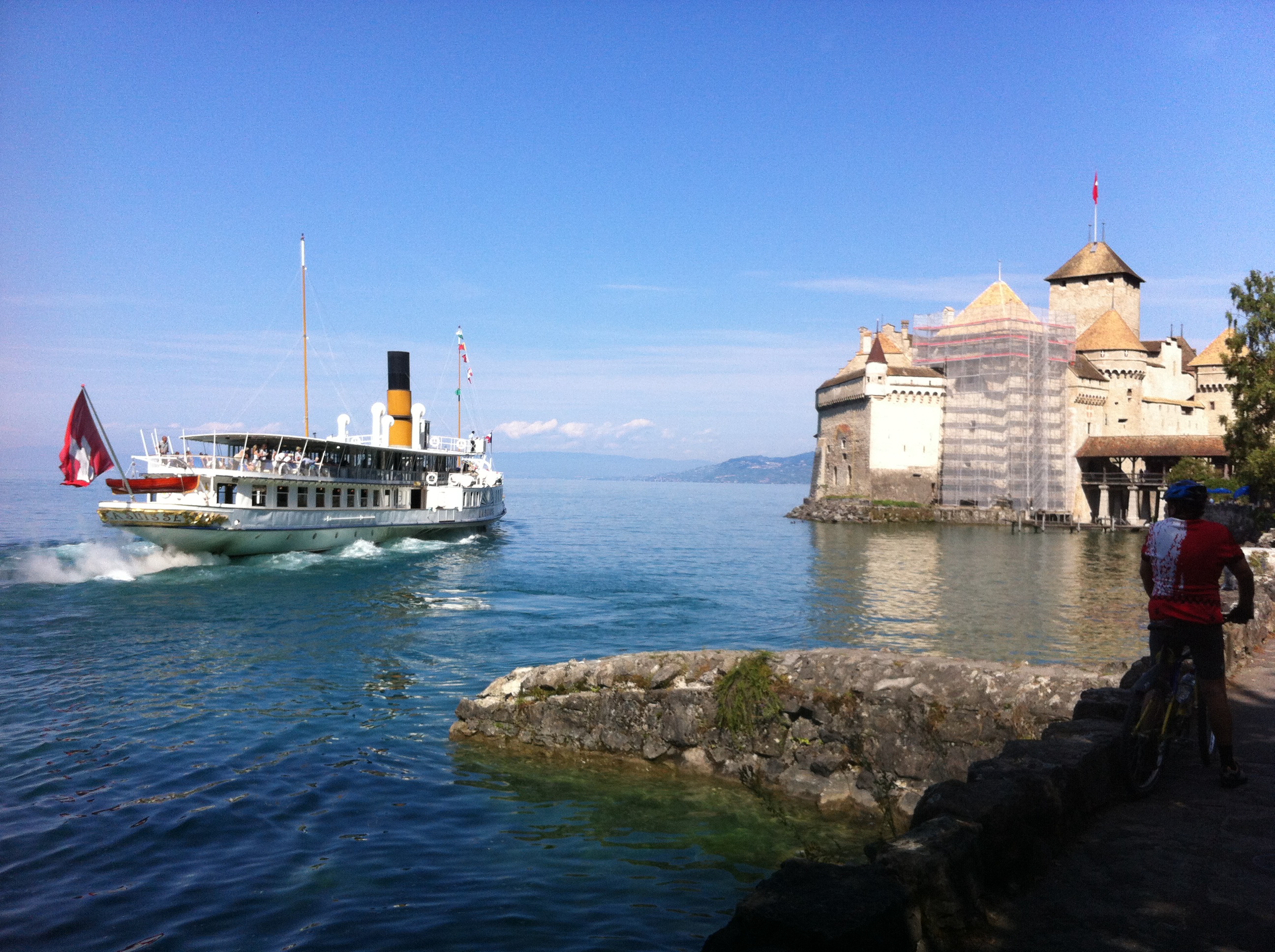
So that’s a hat trick of on-the-spot windows for me. First was a bit further down Lac Leman at Lausanne in VFYW #8. Second was the amazing coincidence of Double Bay in Sydney in VFYW #33. And then today here is a photo of me (on the right) at the Chateau and the boat going past:
It is a great coincidence but to be honest it is now feeling a bit like stalking.
Another:
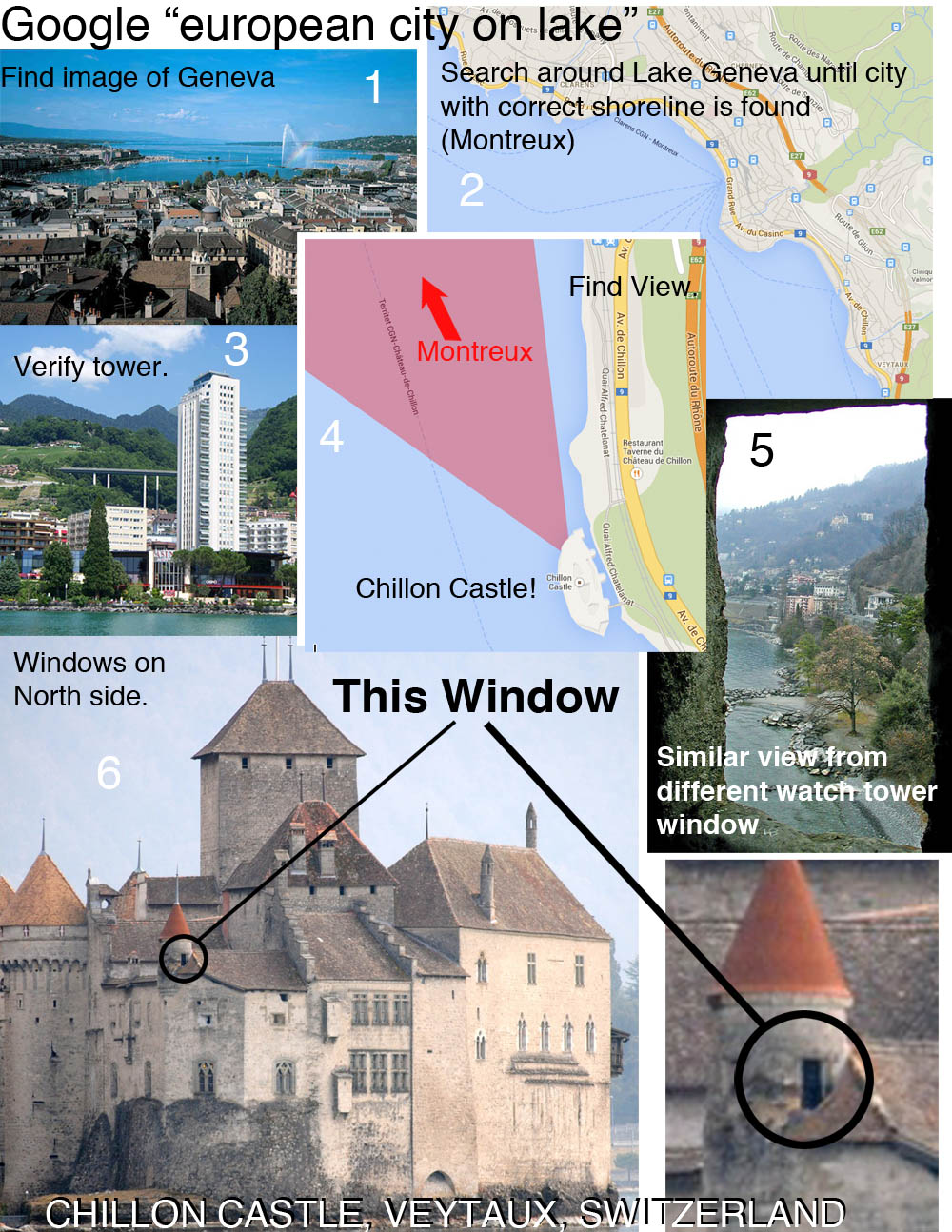
Really fun one this week. I took a tour of ancient and medieval architecture of the Mediterranean and southern Europe before finding the spot. The puzzle was solved with my favorite image search yet: “switzerland lonely highrise,” which yielded this picture as the 4th result:
Another explains the unsightly tower seen above:
The town you can see a kilometer or two away is Montreux, Switzerland. Can I give a shout-out to the Tour D’ivoire, that godawful 25-story apartment block in the middle of downtown Montreux? The town would look a lot prettier without it, but it was the only easily identifiable landmark. Without it I would still be scrolling randomly through thousands of pictures of alpine lake-towns.
But Montreax has a musical history as well:
A couple of nights ago I watched a biography on Queen, and Montreax was where the band lived in tax exile from the insane tax rates of the late 1970s in the UK. With a 75% tax rate on high earners and a further 15% surcharge on investment income, can you blame them?
I grew up in the ’80s and Freddie Mercury was the first person that I knew who died of AIDS. Up to that point in my life, AIDS was a disease that affected other people – people who I did not know. Actors from my parents generation like Rock Hudson or people in faraway places. I was 18, gay, and deeply in the closet when Freddie died. His death scared the hell out of me. To this day, I still can’t listen to “These Days Are The Days Are Our Lives” without crying:
The video is the last time Freddie Mercury appeared on camera and was visibly frail. It was released on the 5th of September in 1991 on Freddie’s 45th birthday. He passed away on the 24th of November, 1991.
I’m not going to go looking for the correct window. Somebody else can waste a beautiful Saturday afternoon doing that. But I do hope you will post a picture of the Freddie Mercury statue that is located in the town of Montreux and overlooks the Lake Geneva:
Another was also inspired by Queen:
I have read VFYW submissions regularly for the past two years, but this is the first time that I felt a personal connection to the location of the contest photo. In the fall of 2011 I rode a bike along Lake Geneva from Lausanne to the Chateau de Chillon, in Veytaux, Switzerland. I stopped to take the photo of the castle, and my guess of which window the contest photo was taken from is circled:
I made the bike ride on September 3, 2011, which happened to be during the annual Montreux Freddie Mercury Festival. Once I realized what was happening, I stopped my bike to dance to the sounds of the tribute bands. It was a beautiful and surreal bike ride along the lake, and the combination of the scenery and festival made it one of the most memorable days of my life. Now when I think of the Chateau de Chillon, the first Queen that pops into my head is not the one that is normally associated with a 12th century castle.
Another rock fan:
What interested me is the giant statue of Freddy Mercury in Montreux, which is just a bad-ass thing to learn exists. I knew of Mercury’s interesting parentage and upbringing, but didn’t realize that he settled in Montreux (home of the famous jazz festival) and recorded the last Queen record near the end of his life in a studio he bought.
Also of rock & roll history interest is the Montreux casino (the big high-rise sits in front of it), which was a popular venue for the jazz festival and in 1971 burned to the ground when some jackass sent up a flare during a Frank Zappa concert. The event was the basis for the Deep Purple song “Smoke on the Water”, a classic rock song best known (and well-parodied by Kids in the Hall) as being one of the first (read: easiest) songs any kid for several decades learned to play when they picked up a guitar.
And the Chateau has a cultural heritage as well:
While I would love to call myself a first-time player, that would be discounting the many times I looked at the VFYW contest and after 5 minutes sighed in despair over the so much more gifted players. But the last couple of days I just happened to be researching movies that concern the summer in 1816 when while staying with her then-boyfriend Percy Shelley and Lord Byron at the Villa Diodati near Lake Geneva, Mary Shelley conceived of the story of Frankenstein.
So I look at the contest this week and go: that’s definitely Old Europe. And it sure looks like a lake. Could it be … ? So I take a drive with Google maps around the perimeter of lake Geneva and happen quite quickly upon some of those buildings and sights in the background. Which leaves me with some triangulation to do in order to determine the window.
How could it have been anywhere else? The picture of course was taken from a window of the Castle Chillon, which inspired Lord Byron’s poem “The Prisoner of Chillon”. I yield to better players to determine exactly which one. I will say that at first it looked like one of the arrow slits near the water surface on the north side. But then there was this triangular black shape just outside the window… maybe a rooftop covered in shadow? So I’ll attach a guess:
What a rush finally recognizing a view. To quote Geena Davis in Thelma and Louise: Now I know what all the fuzz is about!
Another on the castle:
It was made famous to English speakers by George Gordon, Lord Byron, who wrote “The Prisoner of Chillon”. There was a time when people committed huge chunks of poetry to memory. My 96-year-old mother just recited the following verse to me:
Lac Leman lies by Chillon’s walls:
A thousand feet in depth below
Its massy waters meet and flow;
Thanks for the “views” – and the memories.
Another shares their pic from the same exact window:
My wife and I were there in April and she took a photo from the same window. The window is indicated by an arrow in the attached photo. Chillon Castle dates from the 12th Century. It was built to control movement between the north and south of Europe through the upper Rhone valley. The prison in a lower level of the castle was made famous by Lord Byron in his poem “The Prisonier of Chillon”. Byron left his mark on a pilar in the prison.
Another finds the inside view:
The online floor plan of the museum shows no indication that this part of the structure is publicly accessible, but the window would be above #27 “Clerks’ Room”:
Great, so I’ve got the flu in June and some Dish viewer’s running around the Alps touring real life Disney castles. Not fair! At least there was some fun to be had in finding the room where the picture was shot. Figuring out the layout of hotels is one thing; doing the same for a 900-year-old castle is a whole different ball of wax.
Speaking of balls:
This embed is invalid
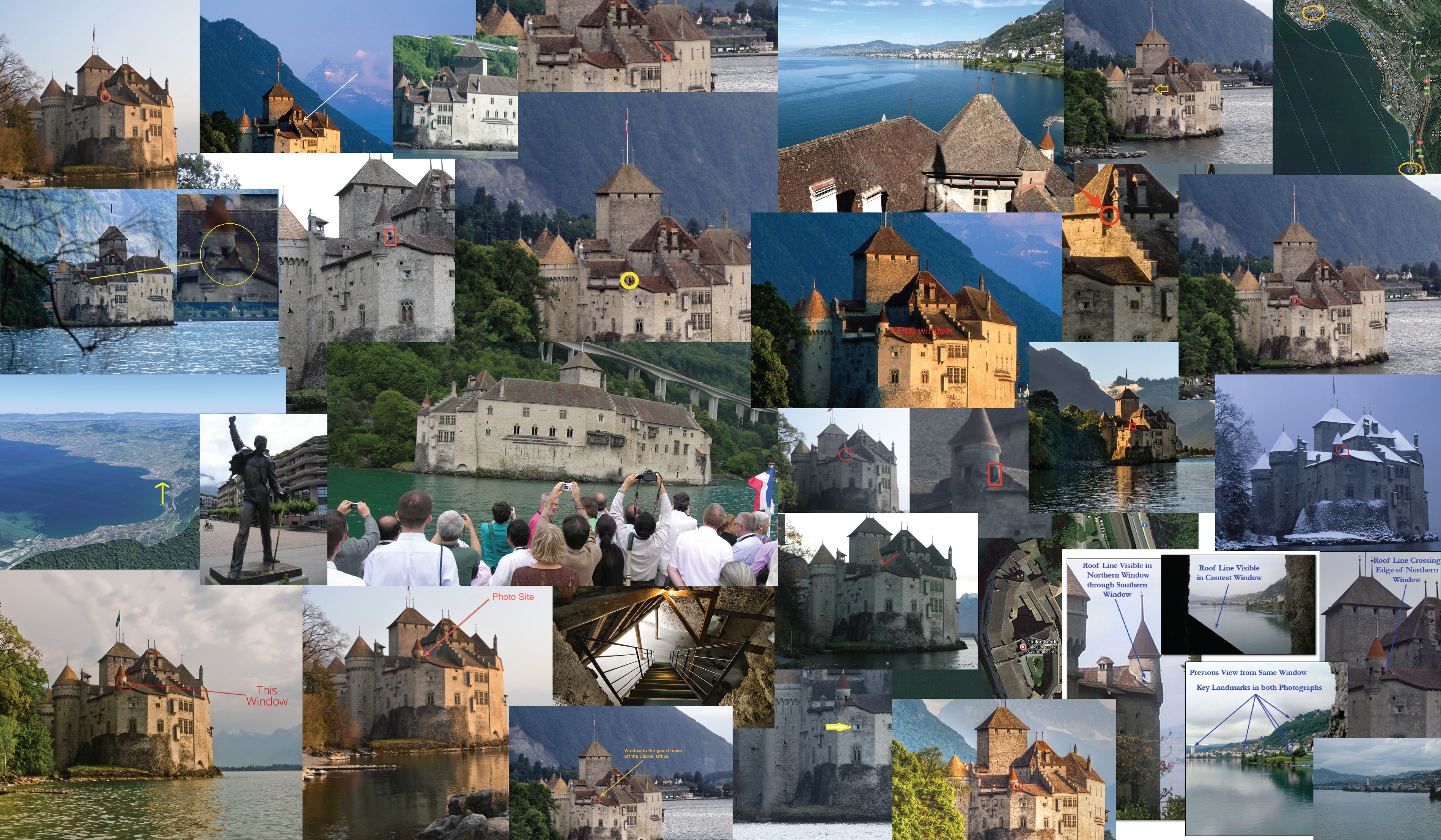
And this week’s collage of guesses:
The winning entry this week comes from a husband-and-wife team that has now correctly guessed nine contests in a row:
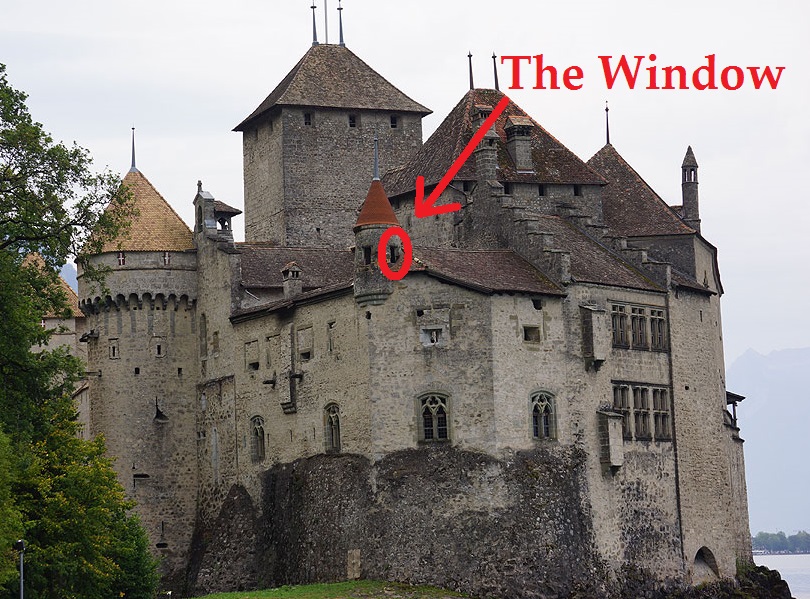
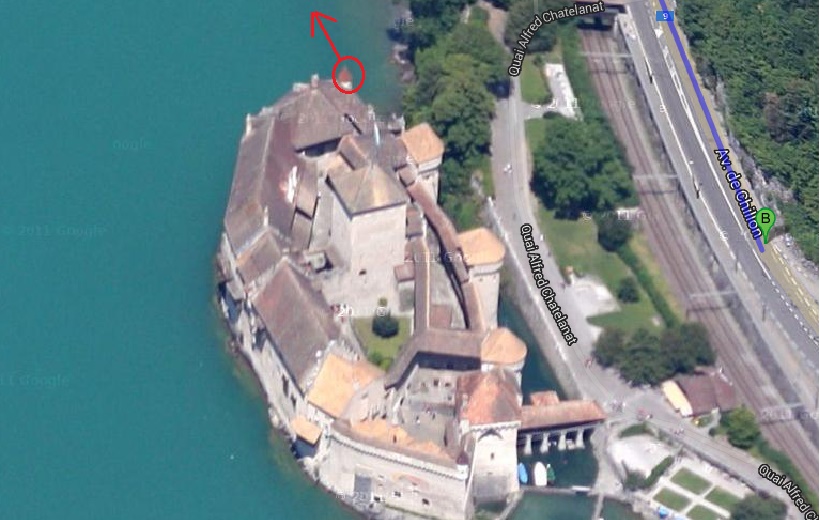
Our guess is that the contest photograph was taken from the Château de Chillon, a castle in Veytaux, Switzerland. The castle is located on a small island in Lake Geneva, and its address is listed on its website as Avenue de Chillon 21, CH – 1820 Veytaux. (Yes, these days even medieval castles have websites.) The photograph was taken facing north-northwest. We are guessing it was shot from the turret window circled in the photograph below:
Normally we would specify which floor, but given the history of the castle (a hundred independent buildings gradually connected over centuries of construction) we’re not sure the ordinary logic holds. (Is a turret a “floor”? Do you count the dungeon?)
Our first impression of the contest photo was that the placid waters and the nature of the shoreline suggested we were looking at a lakefront. The rough surface of the window “frame” suggested an older stone structure such as a castle. Combined with look of the foliage and presence of mountains close to the lakeshore we thought of the Italian Lake District (Lake Garda, Como, etc.) or of Lake Geneva in Switzerland.
Going on Google Earth we searched the Italian Lake District, hoping in particular that we would find that the contest photograph was taken from George Clooney’s island castle in Lake Como. (Perhaps George is a Dishhead). Sadly, the terrain was not a match. Also, the buildings in the contest photograph appeared too modern to fit what we were seeing in that part of Italy.
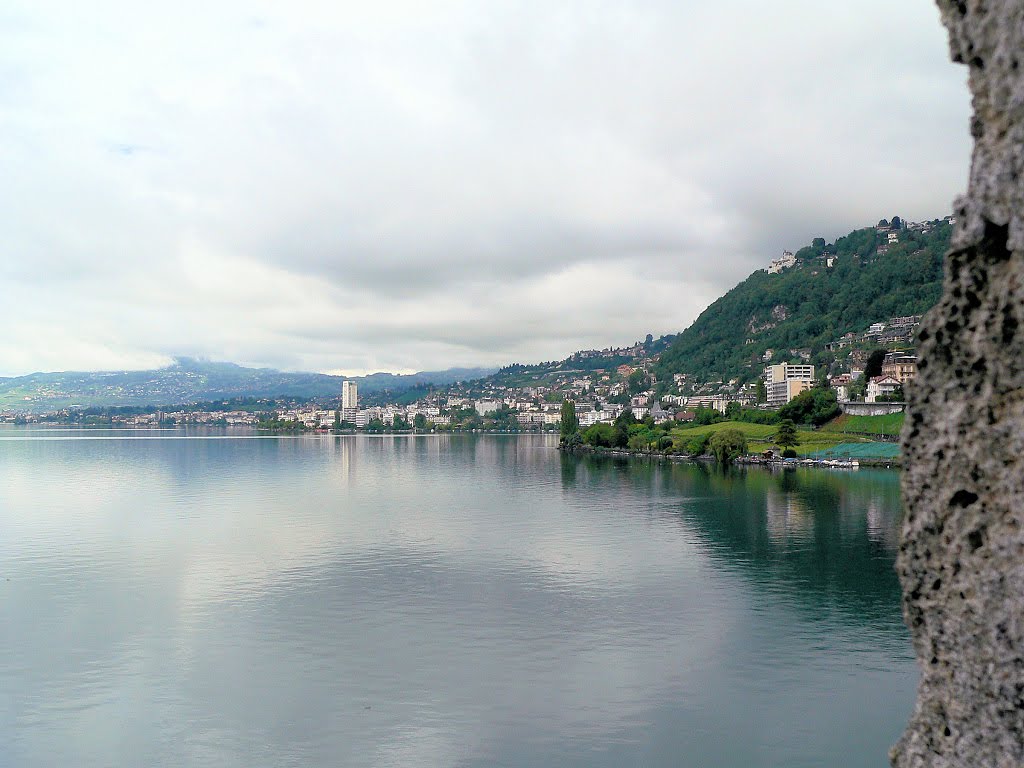
Moving on to Plan B, Lake Geneva, we quickly found the Château de Chillon, and from there the nearby city of Montreux which has a white high-rise structure matching the one that features prominently in the contest photo. Locating the below photograph taken from the Château de Chillon which is nearly identical to the contest photo clinched our choice.
An impressive guess from an impressive pair of players. From the view’s submitter:
I am very excited to see my picture in this week’s contest. I am travelling around southern Europe for four weeks and Switzerland was my first stop. This picture was taken on a cloudy but beautiful day, looking north-west out of the north-most tower in the Chateau De Chillon, onto Montreux city on the shores of Lake Geneva.
This is technically not one of the four watch towers but the view from the north-most watch tower would probably look the same. The Chateau is an island castle on Lake Geneva and was made famous by Lord Byron’s poem “The Prisoner of Chillon”. It is located a couple of kilometers from Montreux, famous for its Jazz festival and other music links. The song “Smoke on the water” by Deep Purple refers to a fire in the Montreux casino.
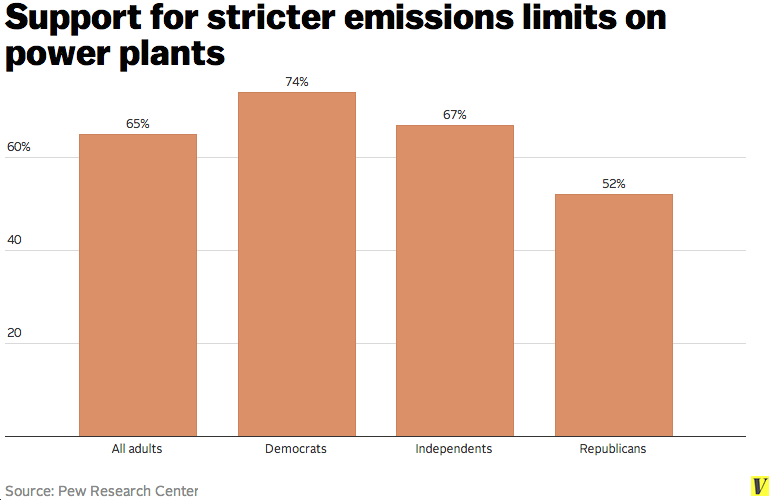
Back in January, Pew asked “US residents whether they support new carbon dioxide emission rules for power plants — the exact sort of rules that were proposed Monday”:
Most American adults don’t agree that these sorts of emissions are causing the climate to change. But strangely, majorities supported these rules. This cut across party lines: 74 percent of Democrats supported the rules, but 67 percent of Independents and 52 percent of Republicans did as well.
Ben Adler lists “nine things you need to know about Obama’s new climate rules.” Here’s #4:
What do states have to do? Each state will be required to submit its own plan for complying with the rules by June 2016, although they can request a one-year extension, until June 2017. States can also create a multi-state plan, thus encouraging more interstate compacts like the Regional Greenhouse Gas Initiative, a cap-and-trade system in Northeastern states; for such multi-state plans, they can request a two-year extension. If states don’t submit a compliant plan, EPA will make one for them.
EPA lays out four main approaches that states can use: make coal plants more efficient (for example by reducing their heat loss), increase natural gas-burning capacity, increase non-carbon energy producing capacity (that’s mainly renewables, but also nuclear), and reduce demand for electricity through improved efficiency. States don’t have to pick just one. “There is no one-size-fits-all option,” said EPA Administrator Gina McCarthy when announcing the rules at EPA headquarters Monday morning. “It’s up to states to mix and match to meet their goals.” They can also submit a plan with a whole other approach, such as a carbon tax.
Jonathan H. Adler doesn’t think the EPA rules will accomplish much:
The stark reality is that the world will not come close embarking on a course toward stabilizing atmospheric concentrations of [greenhouse gases] until it is [cheap] and easy to do so. And this, even more than meeting the 80 by 50 target, requires a technological revolution in energy production 0r carbon mitigation. Such transformations are possible — consider how fiber optics and then satellite and wireless replaced traditional copper wire for telecommunications — but they are rarely driven by regulatory mandates. And although tradeable emission credit schemes are supposed to incentivize innovation, there’s little empirical evidence that such programs have actually achieved this goal.
Elizabeth Kolbert sighs that “it is entirely possible for the new regulations to be the best that can reasonably be hoped for from Washington these days and at the same time for them to be woefully inadequate”:
The President’s goal of cutting power-plant emissions thirty per cent by 2030 leaves only two decades to meet the second part of his pledge—the reduction of total emissions by eighty per cent by 2050. It could be argued that the new regulations will spur such a torrent of innovation that reducing emissions another fifty per cent will become much easier, but it’s tough to find anyone who actually believes this. And it’s only with such dramatic declines in emissions that there’s any reasonable chance of holding the eventual temperature increase to two degrees Celsius.
Sally Kohn thinks Obama’s long-game politics are at work:
Only 3 percent (PDF) of voters under 35 don’t believe climate change is an issue—far less than the 11 percent among voters overall. And polls show young voters favor action on the environment at rates greater than older generations. In fact, even among young voters who oppose Obama, a strong majority (PDF) support the President taking action to address climate change. Going forward, the future voters of America will flock to the party that stands for equality and takes action against pollution. The Democratic Party needs to reassert these beliefs—and put action behind them—to win the future.
And the Republican Party will keep alienating these voters. One study found that voters under 35 think that politicians who deny climate change are “ignorant,” “out-of-touch,” and “crazy.”
And Chait sees the EPA move as part of Obama’s “bid to become the environmental president”:
Obama’s climate agenda may well ultimately fail. If it does, it will be because it was thwarted by actors he cannot control: All five Republican-appointed Supreme Court justices may nullify his proposal, or a future Republican president may dismantle it, or the governments of China and other states may decide not to enter an international treaty. A president cannot save the planet. But it can no longer be fairly denied that Obama has thrown himself entirely behind the cause.
Earlier Dish on the EPA announcement here and here.
Fred Kaplan clears up a few misconceptions about this weekend’s exchange of five captured Taliban leaders for Army Sgt. Bowe Bergdahl:
First, while Obama and his diplomats made the deal on their own (in line with his powers as commander-in-chief), it’s not true that he left Congress out of the picture. He briefed a small group of senators in January 2012, when a deal first seemed in the offing. Sen. John McCain reportedly threw a fit, objecting that the detainees to be released had killed American soldiers, but after talking with John Kerry (at the time, still a senator and a friend), came around to the idea. (This may be why McCain, though displeased with the detainees’ release, is not raising his usual hell in public appearances now.)
Second, it’s not the case—at least if things work out as planned—that the five detainees, some of whom were high-level Taliban officers in their younger days, will go back and rejoin the fight. The deal requires them to remain in Qatar for one year; after that, Americans and Qataris will continue to monitor them—though it’s not yet clear what that means; in the coming days, someone should clarify things.
“There’s one more potential bit of good news,” he adds:
This whole exercise has demonstrated that the Taliban’s diplomatic office in Qatar does have genuine links to the Taliban high command. (A few years ago, when fledgling peace talks sputtered and then failed, many concluded that it was a freelance operation unworthy of attention.) And the fact that the exchange came off with clockwork precision (see the Wall Street Journal’s fascinating account of how it happened) suggests that deals with the Taliban are possible, and that a deal signed can be delivered.
Furthermore, Michael Crowley points out that Obama did not, strictly speaking, “negotiate with terrorists”:
[H]owever nasty the Taliban may be, it’s not really a “terrorist” enemy as we commonly understand the word. The group is not on the State Department’s official list of terrorist organizations and has has long been a battlefield enemy in the ground war for control of Afghanistan. It is not plotting to, say, hijack American airplanes—even if it does have sympathies with people who are. Ditto the Taliban leaders released over the weekend. They are members of a savage and deplorable organization. But unlike, say, Khalid Sheikh Mohammad, they have no history of plotting attacks on the U.S. homeland. Given all that, the real debate isn’t whether Obama negotiated with terrorists—he didn’t. The mystery lies in the particulars of the deal.
Shmuel Rosner compares the swap to the deals Israel makes on a regular basis, sometimes trading hundreds of prisoners for one captured soldier:
So the U.S. got a captured soldier back in exchange for five Afghan inmates. Big deal. Five-for-one is a deal Israel would take in a heartbeat. But there’s truth to the claim that such deals increase the appetite of a terrorist organization in two ways. First, they encourage terrorists to adopt a policy of an abduction of soldiers in the hope of getting more inmates out. Second, they allow terrorists to worry less about being captured by the U.S., since they can hope for a later release.
Israel had been attempting for years to try to resist these exchanges. In 2008, following a heavily criticized deal in which Israel let murderers go in exchange for body bags, then Defense Minister Ehud Barak appointed a special committee, headed by former High Court Chief Justice Meir Shamgar, to make recommendations to the Israeli government on future exchange deals. The Shamgar committee pushed to put limits on prisoner swaps, for the reasons above. But a committee is little match for a mourning family.
But Elliott Abrams identifies a big difference between the US and Israel that, in his view, made this deal unwise:
The trade for Sgt. Bergdahl has given terrorists a real incentive to capture and trade American servicemen and women– and they are very vulnerable. Israeli troops are in Israel, where they are well protected. Occasionally someone tunnels under the border or raids over it, but not often; and Israeli troops in the West Bank take very special care to prevent kidnappings. Americans are in about 150 countries and there are thousands in places where they roam without much protection: 11,000 in Kuwait, 9500 in the UK, 40,000 in Germany. All three countries have significant extremist activity that keeps their police very busy.
Today they are at greater risk because they are more valuable to terrorists. That is a cost of this trade that comparisons to Israel do not correctly measure.
John Bellinger is correct that “it is likely that the U.S. would be required, as a matter of international law, to release [the Taliban detainees] shortly after the end of 2014, when U.S. combat operations cease in Afghanistan.” We are, after all, winding down this conflict, and the authority to detain Taliban forces—as opposed to Al Qaeda forces—won’t last that much longer than the end of combat. So what we may have traded here is one POW deserter (assuming that’s what Bergdahl was, for a moment) in exchange for hastening the release of five Taliban by an indeterminate number of months.
Was it the right move? I don’t know. I certainly don’t think, as Marty Lederman put it on Saturday, that it is “truly wonderful news.” Ask me in a couple of years whether it was a good idea—when we know if any constructive dialog with the Taliban developed out of these contacts, when we know how the US draw-down in Afghanistan went, when we know whether and how the released detainees reengaged with the fight, and when we know exactly what the circumstances of Bergdahl’s disappearance really were. The people who did this deal didn’t have the luxury of remaining agnostic about its merits that long. I will not criticize them.
Keating doubts that the five baddies we released to Qatar will ever pose much threat to Americans:
The reason that the detainee recidivism rates have been dropping is likely not because Guantanamo has become so much more effective at rehabilitating detainees. It likely has more to do with the fact that as the U.S. has drawn down its troop presence in Iraq and Afghanistan, there are fewer opportunities to engage in hostilities against Americans in these countries. If all goes according to plan, by the time these five can get back to Afghanistan, they won’t pose much of a threat to U.S. troops because there won’t be that many U.S. troops there for them to fight.
Opponents of the deal are using Nathan Bradley Bethea’s piece from yesterday, which alleged that Bergdahl had deserted his unit, to make their case, but Bethea isn’t having it:
Zack Beauchamp suspects that Republicans trying to make political hay out of this exchange are probably not willing to make the case that we should have left a POW to die in Taliban custody:
Bethea’s distinction between Bergdahl’s disappearance and his release is significant. It’s one thing to think, as some veterans appear to, that Bergdahl should be now be tried by an American court for desertion (that appears unlikely, according to administration statements). It’s a different thing entirely to believe an American soldier should remain in the Taliban’s clutches indefinitely.
The problem with the emerging Republican position is that it implicitly forces the GOP to defend the latter; that Bergdahl should have been left. No amount of speculation about hypothetical future kidnappings or quibbling over legal niceties are likely, in political terms, to overcome the emotionally powerful support for captured veterans’ freedom. And after the initial wave of press coverage subsides, Republican leaders will probably get that. Bergdahl’s release will not remain a partisan flashpoint for very long.
Bing West advises the administration to manage the controversy by letting the Army court-martial Bergdahl:
By any reckoning, the release of five dedicated Taliban terrorists was a high price to pay for the return of a single American captive. It will be a price worth paying only if the Army is allowed to live up to its own high standards. Left to its own procedures, the Army as an institution will proceed with a thorough judicial investigation. Most probably this will result in a court-martial. The evidence is too compelling to be ignored. If there is a finding of guilt, a judge may mitigate the sentence.
But not to proceed with a judicial course would harm the integrity of the Army. There is a deep anger throughout the ranks about Bergdahl’s behavior. The administration would be well advised not have anything more to do with Bergdahl. Let the Army system work. The Army can be trusted to follow the correct course.
General Martin E. Dempsey statement makes clear that Bergdahl will be investigated:
In response to those of you interested in my personal judgments about the recovery of SGT Bowe Bergdahl, the questions about this particular soldier’s conduct are separate from our effort to recover ANY U.S. service member in enemy captivity. This was likely the last, best opportunity to free him. As for the circumstances of his capture, when he is able to provide them, we’ll learn the facts. Like any American, he is innocent until proven guilty. Our Army’s leaders will not look away from misconduct if it occurred. In the meantime, we will continue to care for him and his family. Finally, I want to thank those who for almost five years worked to find him, prepared to rescue him, and ultimately put themselves at risk to recover him.
Reacting to yesterday’s EPA announcement, Waldman downplays the potential economic damage of going after the coal industry:
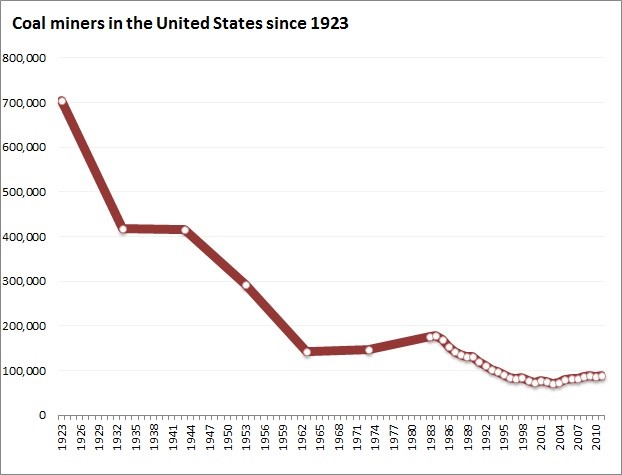
One argument against waging war on coal—that it will cost too many jobs—isn’t really persuasive, because there just aren’t that many coal miners anymore. The National Mining Association has data on the number of miners going back to 1923, when there were over 700,000 Americans doing this work (the data are once a decade until the 1980s, after which they have figures for every year) …
Today, there are fewer than 90,000 Americans mining coal; depending on how you count, there are more people working in the solar power industry. That figure doesn’t include people who work for coal companies but aren’t involved in mining (clerks, accountants, etc.), and of course it doesn’t include people whose livings are dependent on the coal industry, like those who own businesses in mining towns. But the point is that in terms of manpower, coal has become a tiny industry. In the 1920s, one out of every 150 Americans was a coal miner; today it’s one out of every 3,600 Americans.
In all likelihood, the ultimate fate of Obama’s plan will hinge on the 2016 Presidential election. For now, though, he has taken the initiative and put the onus on other countries that have used the lack of U.S. action as an excuse for doing nothing, or very little, to reduce their carbon emissions. China and India, for instance, are both building coal-fired power plants. If the new policy goes into effect, the United States, at long last, will be able to tell them “Do as I do” rather than just “Do as I say.” Since climate change is a global problem that can only be solved at the global level, that is an important step forward.
Daniel Gross tells the energy industry to quit whining:
The EPA doesn’t plan to proscribe coal generation. It’s simply setting a new standard, telling states that they have to reduce emissions related to energy use—but it is leaving the implementation up to them. Closing coal plants and/or installing carbon-scrubbing technology are only two of many ways to reach that goal. Many of the alternatives have a lower cost, some of them have no cost, and virtually all of them will prove economically beneficial over time. In effect, this standard, like so many other hotly contested standards relating to energy use—the 2007 light bulb rule, new standards for vehicle gas mileage or for appliances—is simply a diktat to the industry to stop being so lazy.
Ronald Bailey is skeptical about the EPA’s claims that these regulations will save money:
The EPA calculates that the maximum cost for implementing the new regulations amounts to $7.5 billion in 2020, while the maximum net climate and health benefits range from $27 to $50 billion at a 3 percent discount rate or $26 to $46 billion at a 7 percent dicount rate. On it’s face, that sounds like a pretty good deal. But as I reported last August in my article, “The Social Cost of Carbon: Garbage In, Garbage Out,” anyone can pretty much conjure whatever number one wants when it comes to cranking out the social cost of carbon through integrated assessment models that combine econometric and climate prognostications.
There is a long tradition of cost overestimates for new environmental regulations. At the Huffington Post, Pacific Institute President Peter Gleick provides an extensive documentation, going back to the 1970s, arguing that such claims of huge costs not only have a long history, but that they are “always wrong.”
Among other things, Gleick links to a 2011 EPA study finding that the benefits of the 1990 Clean Air Act amendments (which, of course, were attacked on grounds of supposed cost) “exceeded costs by a factor of more than 30 to one.” That’s not the only such study. In fact, as the World Resources Institute’s Ruth Greenspan Bell has noted, from 1999 to 2009, EPA water and clean-air regulations overall were clear cost-benefit winners. The total costs, according to a 2010 Office of Management and Budget report, were some $26-$29 billion, while the benefits were far greater: $82-$533 billion.
Tomasky today predicts that the Bergdahl prisoner swap may well become the next Benghazi on the fetid horizons of the Palinite right. I hope he’s wrong, but I’ve learned not to under-estimate the extremism of the Dolchstoss brigade. The Benghazi and Bergdahl “scandals”, after all, are both rooted in the assumption that the president is in some way anti-American, that his loyalty is somehow not to the United States, but to some other abstract but foreign authority, and so he would obviously be happy to leave Americans to perish in an undefended consulate and lie about it afterwards to cover his negligence up … or be content to deal with the Taliban on behalf of another “anti-American”.
Beneath the intricacies and easy emotional manipulation, this McCarthy era paranoia is what drives both obsessions. The contradictions are, of course, bleeding obvious. Obama is to be excoriated for abandoning Americans in the line of fire in Benghazi and then excoriated for rescuing a servicemember in enemy captivity in the matter of Bowe Bergdahl. You’ll see that, not for the first time, the president cannot win. You’ll also note that one of the American right’s heroes, Bibi Netanyahu, released more than a thousand Palestinian prisoners, some of whom had actually murdered Israeli civilians, in order to retrieve Gilad Shalit. Somehow Netanyahu is not regarded as a terrorist-sympathizer by the Tea Party.
And it is an outright calumny, of course, to impugn this president’s patriotism, the kind instinctually propagated by Palin and her spittle-flecked confreres. Barack Obama is, au contraire, a uniquely and proudly American story. He has been relentless in pursuing the enemy in Afghanistan and Pakistan in his period in office. He killed bin Laden and Anwar al -Awlaki. His emergence as a biracial president would give any sane American a reason to be proud, not squeamish. And what he did, in the case of Bergdahl, requires no further explanation than that a commander-in-chief’s task is to leave no servicemember behind enemy lines, especially as a war comes to a close. (There’s also a strong argument to be made that, as the war in Afghanistan comes to a close, the Taliban commanders at Gitmo had a right under international law to be exchanged.)
I’m not saying, of course, that robust pushback against this tough call is not legitimate. That’s embedded in the very notion of a tough call. There are powerful questions that need addressing:
Was the deal a good one? How effective will the monitoring of the Taliban commanders be? Did the president comply with the letter of the law? But I’d argue vehemently that Bergdahl’s personal politics and Obama’s core motivations aren’t among them. Whether Bergdahl was a deserter or not, whether he was “anti-American” or not, whether he may have cooperated with his captors under duress or not: these questions should be dealt with by the regular process of military justice and investigation. But none of that can truly happen without Bergdahl himself to question and interrogate. And if we are going to rescue a service-member depending on our assessment of his politics or character, we have undermined a key principle of military justice and discipline. You wear the uniform, you get rescued if captured. Period. No other questions need to be asked or answered until after you’re safe and in US custody.
One final thing about the 30-day notification of Congress requirement. The one exception to the executive’s deference to the legislative in statutory matters such as this are contingent, time-constrained executive actions that require immediate implementation. A quick military response, a drone strike, a raid, or a rescue: these fall into the most solid executive area of legitimate, unilateral executive action. For the Republicans who only recently defended a far greater degree of executive power to cavil at this almost text-book case of executive expedition is a triple lutz in hypocrisy and inconsistency. But this, alas, is not news. They will use any weapon at hand, even if they have to trash some of the most important military principles to indict him.
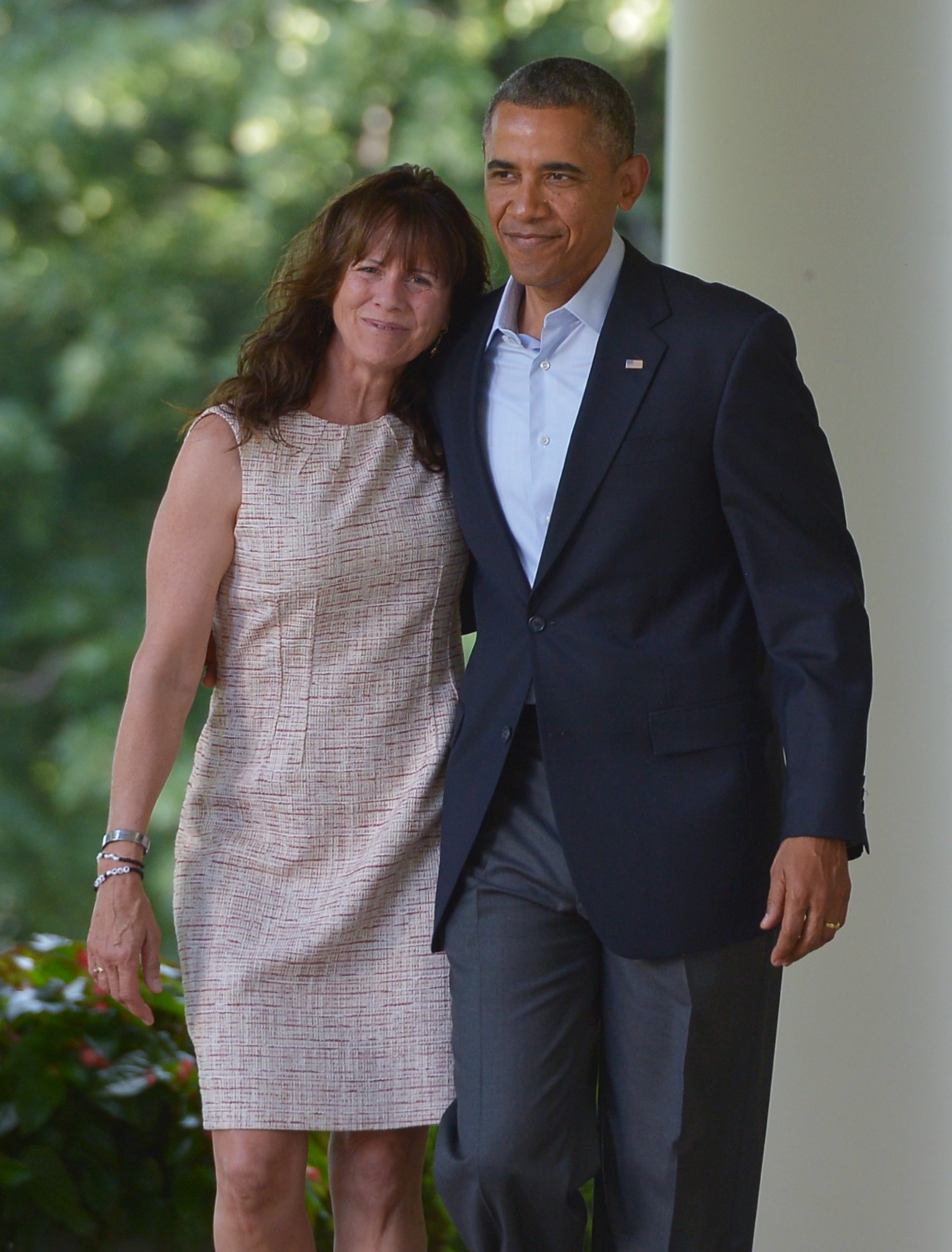
(Photo: Jani Bergdahl, the mother of freed US soldier Bowe Bergdahl, walks through the Colonnade with US President Barack Obama to speak in the Rose Garden of the White House on May 31, 2014 in Washington, DC. Obama spoke after the release of Bergdahl by the Taliban in Afghanistan. By Mandel Ngan/AFP/Getty.)
In an essay exploring the pitfalls of FOMO, Jacob Burak advocates making do with “good enough” rather than trying to maximize our opportunities – in both business and love:
In business, sacrificing maximisation in favour of a predefined ‘good enough’ is known to be the best strategy in the long run. As the saying goes, ‘Bulls make money, bears make money, pigs get slaughtered’: greediness that looks to maximise doesn’t pay.
Business people also know to ‘leave something on the table’, especially in deals leading to long-term partnerships. Experienced capital market investors understand that aiming to ‘sell at the peak’ will ultimately be less profitable than selling once a satisfactory profit is gained. Corporate graveyards are full of companies that did not stop at a ‘good enough’, profitable product that they could easily market, surrendering instead to ambitious engineers with sophisticated specifications and unrealistic plans. …
Even when it comes to emotional intimacy and love, ‘good enough’ works best. It was the British psychologist Donald Winnicott who gave us the concept of the ‘good-enough mother’ – a mother sufficiently attentive and adequately responsive to her baby’s basic needs. As the baby develops, the mother occasionally ‘fails’ to answer his needs, preparing him for a reality in which he will not always get exactly what he wants, whenever he wants it. The child learns to delay gratification, a key to any form of adult success. As we mature, we make do with ‘good enough’ partners almost by definition. Yes, out there is someone probably more suited to our needs – but we might not live long enough to find him or her.
The Economistwonders whether countries with shrinking populations should stop worrying so much about it:
In a recent study Erich Striessnig and Wolfgang Lutz, of the Vienna University of Economics and Business and the International Institute for Applied Systems Analysis in Laxenburg, Austria, argue that in predicting dependency ratios (the number of children and pensioners compared with people of working age), education should also be taken into account. And that makes optimal rates much lower than previously thought.
Not everyone of working age contributes equally to supporting the dependent population. Better-educated people are more productive and healthier, retire later and live longer. Education levels in most places have been rising and are likely to continue to do so. Using projections by age, sex and level of education for 195 countries, the demographers conclude that the highest welfare would follow from long-term fertility rates of 1.5-1.8. That excludes the effects of migration: for countries with many immigrants, the figure would be lower.
Educating more people to a higher level will be expensive, both because of the direct costs and because the better-educated start work later. But they will contribute more to the economy throughout their working lives and retire later, so the investment will pay off. Moreover, fewer people will help limit future climate change.
Kevin Roose reports that “financial start-ups—known collectively as ‘fintech’—are spreading like kudzu, each with a different idea about how to usurp the giants of Wall Street by offering better services, lower fees, or both”:
Part of the reason the tech world is interested in finance is the sheer amount of money involved—financial services is a $1.2 trillion industry, and U.S.-based fintech start-ups raised an estimated $1.3 billion last quarter alone. But banking is also a prime candidate for disruption because, like much of the old-line corporate world, it tends to run on bloated, creaky technology. Even something as simple as applying for a loan can take weeks or months, thanks to the sheer number of human hands such transactions pass through. And, since each intermediary wants a cut, fees are everywhere. Undercutting big banks and speeding up processes might not be as sexy as, say, creating the next Snapchat, but it’s low-hanging fruit for techies who want a way in to a lucrative market. After all, today’s megabanks are really just bundles of particular, loosely related services cobbled together by years of acquisitions and market consolidation. If those bundles can be broken apart, the start-up world’s revolution looks a lot more plausible.






 The Dish