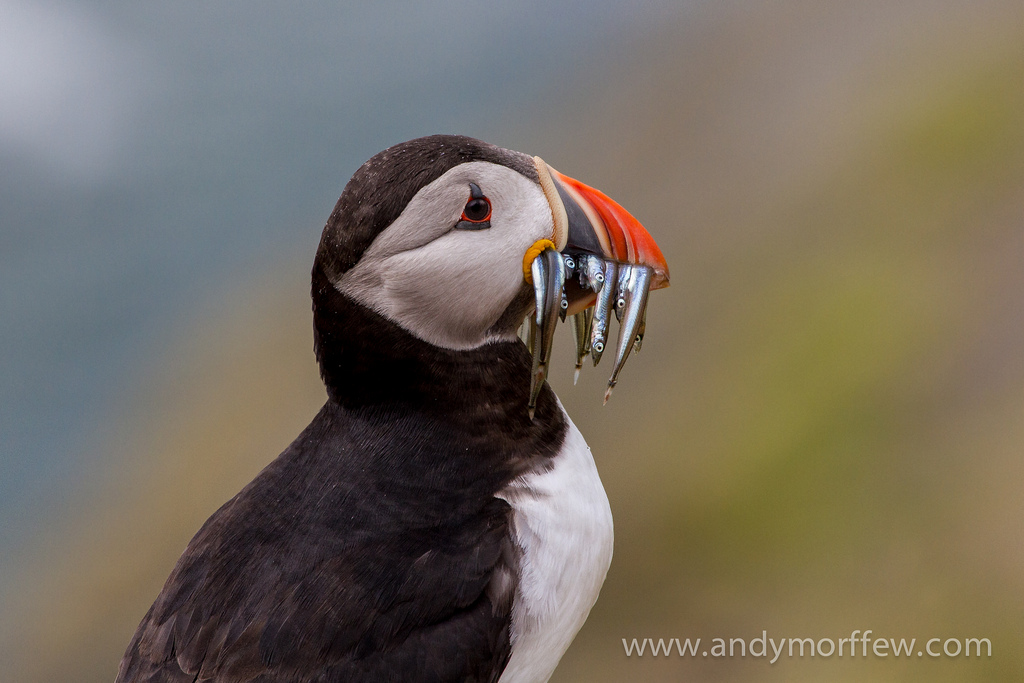
The birds are struggling to adapt to a warming world:
[Stephen] Kress [who set up a “Puffin Cam” to live-stream baby Puffin Petey’s development] soon noticed that something was wrong. Puffins dine primarily on hake and herring, two teardrop-shaped fish that have always been abundant in the Gulf of Maine. But Petey’s parents brought him mostly butterfish, which are shaped more like saucers. Kress watched Petey repeatedly pick up butterfish and try to swallow them. The video is absurd and tragic, because the butterfish is wider than the little gray fluff ball, who keeps tossing his head back, trying to choke down the fish, only to drop it, shaking with the effort. Petey tries again and again, but he never manages it. For weeks, his parents kept bringing him butterfish, and he kept struggling. Eventually, he began moving less and less. On July 20, Petey expired in front of a live audience. Puffin snuff.
“When he died, there was a huge outcry from viewers,” Kress tells me. “But we thought, ‘Well, that’s nature.’ They don’t all live. It’s normal to have some chicks die.” Puffins successfully raise chicks 77 percent of the time, and Petey’s parents had a good track record; Kress assumed they were just unlucky. Then he checked the other 64 burrows he was tracking: Only 31 percent had successfully fledged. He saw dead chicks and piles of rotting butterfish everywhere. “That,” he says, “was the epiphany.”
Why would the veteran puffin parents of Maine start bringing their chicks food they couldn’t swallow? Only because they had no choice. Herring and hake had dramatically declined in the waters surrounding Seal Island, and by August, Kress had a pretty good idea why: The water was much too hot.
The big picture:
Life would go on without puffins. Unfortunately, these clowns of the sea seem to be the canaries in the western Atlantic coal mine. Their decline is an ominous sign in a system that supports everything from the last 400 North Atlantic right whales to the $2 billion lobster industry.
(Photo by Andy Morffew)


 The Dish
