Jesus And Christ, Ctd

A reader writes:

I'm a Christian . . . I think.

I say, "I think" because a recent trip to India left me stumbling on the foundation of faith laid since my youth. I was raised in the church, by a fundamentalist, Baptist preacher father and an "amen" mother. It's true that at several points during the course of my life I have left the practice of my faith, but even in those willful and deliberate seasons I still knew God was God and I could just as soon call him Jesus if I wanted to.

India, for better or worse, has caused me to question all of that.

The temptation, mind you, is not to now let go of Jesus and embrace any of their hundreds of gods – though they are older and arguably more tangible and personal than he is . . . and more clear in their own assertions of divinity. No. What India did is place me squarely at the foot of the cross of Christ to wonder if it was big enough to shadow this whole, big, diverse, Hindu, Muslim, Buddhist, etc., world.

Most people I spoke with in India shared the same gratitude and love for their beloved Ganesha that I did for Jesus. Does this, as the Bible has been traditionally interpreted to suggest, mean that all those beautiful, hardworking, sincere people are going to hell, forever?

For the first time in such a visceral way, the morality of eternal hell – a cornerstone in the Christian faith – struck me as severely lacking. I returned from India angry, incredulous, and disoriented in and about the faith that I had for years prior really made the compass of my life and work (yes, I work in a church). Hell, I didn't even know who to pray to or what to say if I did stumble my way into a quiet mind and heart.

My new-found discontent sent me into the arms of Karen Armstrong and others trying to find a scholarly approach to God, but what can a finite mind fully know of transcendent infinity? I went back to favorites like Lewis and still rebuffed against the exclusivity and "one way"-ness of my faith. In truth, atheism seems like the kinder position . . . except that would require that I deny the countless and real encounters throughout my life that I've had with God, His grace, His mercy, His provision, His joy, and His presence. But still I question, everything. All is not lost.

In my reading, I've stumbled on a book or two that have helped me shape my thoughts and put into words my present experience with Jesus and God. The most notable is If Grace is True by Philip Gulley and James Mulholland. I don't agree with every position they take, but it resonates somewhat within my spirit. And, it gives me hope that the God I love is not morally inferior to me, rejecting some of his children while embracing others . . . but that he will claim every child as His own in the end.

I have to believe that, otherwise, I simply can't stay if what Jesus did isn't enough for everyone.


The DADT Deal, Ctd

Fallows sees an added benefit:

[Ending the ban] should also have another effect, in ending the prolonged absence of ROTC programs from a number of the nation's elite universities. (ROTC = Reserve Officer Training Corps, a way of bringing civilian-educated officers into the military.) The case I know best is Harvard's, where ROTC programs were forced off campus in the late 1960s as part of the general effort to register opposition to Vietnam war policies. That made sense at the time, at least to me. But what was initially intended as a focused objection to a specific war extended into a general separation between an important military intake system and some of the most elite universities. This separation is, in my view, bad for the military, bad for the universities, and bad for the country. Almost no one urging the anti-ROTC change of those days would have argued or imagined that 35 years after U.S. troops left Vietnam the ban should still be in place. As the original Vietnam-related rationale has faded into distant memory, the prohibition on ROTC has been sustained as an objection to the military's exclusion of openly gay service members.

On Kagan, Palin And Lipstick Feminism

Wendy Kaminer re-examines looks, gender and careers:

Would Elena Kagan's sexuality be a subject of so much speculation if she looked like Sarah Palin, or Kim Cattrall?  At The Washington Post, Robin Givhan complains that Kagan, like many other serious, substantive, middle-aged women, doesn't dress like Cattrall, without acknowledging that, given various accidents of nature, she'd look quite foolish if she did.  People choose their clothes partly to signal membership in a "particular social tribe," Givhan observes; but if they have any sense of style (as opposed to a mere sense of fashion), they choose their clothes on the basis of their body types.  And, some women simply strive to make beauty or the lack of it less relevant to their failures or successes.  Men are armored by their unrevealing suits; women are expected to expose themselves, with various degrees of discretion.   

"Armored by unrevealing suits." I've always wondered why I only have one.

Quote For The Day

"It is a Government not driven by party interest but by the national interest, with clear values at its heart.

The values at its heart are freedom, because over the past decade the state has become over-mighty and civil liberties have been undermined consistently…

Fairness, because after 13 years of a Labour government inequality is wider, social mobility has stalled, severe poverty is rising and social justice is falling…

And the third value at the heart of this Queen's Speech is responsibility, because under Labour the age of irresponsibility broke our society and left our economy deep in debt…

Devolving power not centralising; trusting people not dictating to them; saving money not wasting it. It's a radical programme for a radical Government, and that is exactly what our country needs," – prime minister David Cameron, in a parliamentary speech where he spoke of the "appalling mess" left by the previous Labour government.

Latinos Swing Left?

Public Policy Polling gauges the fallout from the Arizona immigration bill:

Hispanics in the Mountain West are leaning much more strongly toward the Democrats since the Arizona law was passed. The big question then becomes whether there are white voters who are going to go Republican this fall who wouldn’t have if that bill hadn’t been passed. We don’t see any evidence of that happening yet…

Recall also 83 percent Hispanic support for health insurance reform … and Sotomayor. There’s a reason the Dems held their last convention in Colorado.

The Audacity Of Hopelessness

O25_23537411

A reader writes:

You wrote, “If we cannot stop this, what else can we not stop?” Exactly my own response these last few days. Honestly, I have not reacted to anything with this much impotent despair since 9/11. Not even Abu Ghraib and our collective, in effect, non-reaction to it made me feel more negative about the likely course of our society in the remaining decades of my lifetime.

I don’t participate in the apotheosis some baby boomers indulge of the so-called Greatest Generation. But the thought keeps coming to mind that if today’s American society were faced with situations as complex and terrible as the first half of the 20th century, we’d probably be living with a Nazi Europe and the aftermath of having preemptively nuked the Soviet Union.

Collectively we have lost any ability to make a hard decision, to accept that every action has consequences (as does every refused call to action) and to actually sacrifice, individually and collectively, to keep a terrible situation from becoming more terrible. If we can’t drill anywhere on the planet in pursuit of unlimited oil without destroying entire regional ecologies…well, then hey I guess we’re just screwed. If we can’t just invade the next country on our shit list and stop global Islamic terrorism…well then WTF are we supposed to do? If it turns out that the “wealth” we thought our households possessed was just a temporary accounting fiction…well that doesn’t mean we should have to quit spending money like it’s 2004.

The coup de grace for me personally? That would have to be this. If Barack Obama can not directly and cleanly end torture and rendition and the indefinite detention of the thousands of randomly rounded up non-terrorist, non-combatants abused by the administration he was elected to replace…then there is truly nothing to be done about anything.

Another writes:

What bothers me most about Obama is exactly the mood that you ended up speaking from in this post – which is the effect I think this has on the whole debate.

When the Bush Administration took some positions, which were consistent with either GOP "usual ground" or with their own peculiar enthusiasms, you could assume that there might be alternatives, or at least proposed alternatives, the other side's stuff.  But the effect of Obama – the Democratic President and change-candidate – now "realistically" taking the same focuses, is that it now seems as if there must actually be no sound alternatives to these focuses that could even be proposed … even at the very moments when it's clearest that we need another course, or when we might jump at any one that was suggested! The present unpleasantnesses, or gigantic horrors, must be in truth inevitable. What seemed radically oblivious Cheney-focus when the Bush Administration was talking is now the real world, which must be looked at straight on in calm adult Obama fashion.

In a way, he can be the great ratifier of the Cheney background drone:  "we might like to think the world was a certain way, we might prefer that it was, but we have to be grown-ups and keep our feet on the ground and look at things dead on and see things as they are"… which isn't objectivity but is the throwing of a blanket marked Objectivity (and Adult Responsibility) over whatever positions the contentless drone happens to be about.

I know you like his centrist conservative mood, Andrew, but I remember Candidate Obama's clarion voice. We complain a lot about politicians being in love with their own voices, but couldn't Obama have been in truth a little more inspired by his own? There seems to be no "we need to go somewhere where we aren't now" in him, if he does not perceive that we're in great part already there, or if the destination he's proposing isn't already prominent on the gameboard and of demonstrated and recognized status. If we do need to do that, or if "the facts are radical" … where is he? Answer:  Reassuring us that he's dealing with the world as it is.

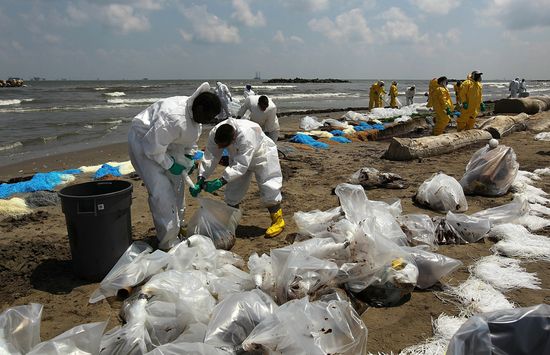
(Photo: A BP cleanup crew removes oil from a beach on May 23, 2010 at Port Fourchon, Louisiana. By John Moore/Getty Images. Many more in the Big Picture's latest series, "Oil reaches Louisiana shores.")