Bruce Bartlett surveys the radar.
Author: Andrew Sullivan
Financial Reform Reax
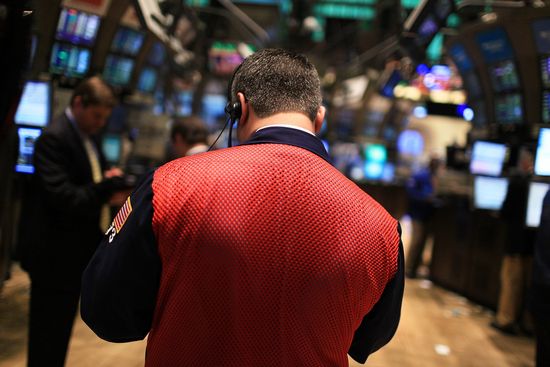
The financial reform bill passed the Senate last night. Daniel Indiviglio on the road ahead:
The House and Senate bills have many similarities; in fact, it's probably not a stretch to say that they are both built on the same foundational ideas. They each create a new systemic risk regulator, non-bank resolution authority, consumer watchdog, and a more aggressive regulatory framework for derivatives and securitization. But there are also some very important differences between the two bills, as the Senate bill is more aggressive in some ways, like on rating agencies and derivatives. But the House's bill contains tougher language in other sections, such as setting leverage limits and creating a truly independent consumer financial protection agency.
In the weeks to come, the two chambers will have to compromise on a final version of the bill. Then it will make its way to President Obama's desk, who will eagerly sign it into law. Given the sense of urgency among Democrats to wrap the bill up, we should see the President sign it this summer.
Historians will probably conclude that the package of reforms was surprisingly modest given the depth and severity of the 2008-09 financial crisis. A harsher historical judgment might find that the political and economic power wielded by the financial industry in the late 20th and early 21st centuries was so extensive that it could weather a near total collapse of the system without having to yield its power or privilege.
The House and Senate bills — which are a lot alike, fortunately — both leave the system at least as complicated as it is at the moment. That was a big part of the problem before the crisis, and if anything it has been made worse. (The council of regulators is a weak solution.) But simplification never seemed to be on the agenda at any stage. That is a shame, and something the architects will come to regret.
A sigh of relief is due on Wall Street. The procedural finale for the Senate’s debate on financial reform came just in time for banks. The bill got tougher as the talk dragged on. But it could have been worse. While banks’ future activities and profitability may get pinched, their core business model appears intact.
Some conservatives and liberals alike are complaining that the bill won’t prevent future bailouts. That’s the wrong mission. Bank bailouts are necessary and inevitable, as we learned in 1933: that’s why we have deposit insurance. What people most disliked about 2008, I’d hypothesize, is not that non-bank financial firms were “bailed out,” but that the bailees profited so handsomely from their bailout. “Bailouts” would not be a dirty word today if shareholders and executives at Goldman Sachs, Morgan Stanley, etc. had shared in the kinds of losses that were suffered at Lehmann Brothers and AIG.
The “resolution authority” invented in the finreg bill purports to authorize the feds to do just that. It doesn’t stop bailouts. It does * try * (key word) to do something better and more worthwhile: it tries to deter them by adding to their future potential painfulness to the parties who cause them.
[T]he upshot of financial reform will have been to make it costlier to be a big bank relative to being a small or medium-sized bank—which is to say, it has effectively taxed bigness. That’s because the legislation imposes a handful of new mandates and regulations—like oversight by a soon-to-be-established consumer financial protection agency, as well as limits on fees for debit-card transactions—from which small and medium-sized banks are exempt. Other reforms—such as a bill Congress passed last year to limit hidden credit-card fees and make statements more transparent, and new restrictions on trading derivatives—would disproportionately dent profits at megabanks. These banks tend to have far bigger credit card operations, and are the only bona fide derivatives brokers around.
The big banks typically complain that these efforts will drive them out of this or that line of business, or at least curtail their activity significantly. And there may be something to those concerns. But in a world in which we worry about megabanks doing too much rather than too little, that’s not necessarily a bad thing. If only there were a bit more of it.
Like with health-care reform or stimulus, what we have here is a major achievement and a clear step forward, but an insufficient solution to a problem that will continue to dog us. And so the question is not just what the 111th Congress did, but whether the process has educated the members who will continue onto the 112th and 113th and 114th Congresses and has persuaded them to keep paying attention to these issues and to continue building on their legislation.
You can argue that some of these reforms will backfire, and some probably will. But you cannot argue that the reforms amount to little or nothing. These are big changes.
(Image: Traders work on the floor of the New York Stock Exchange on May 17, 2010 in New York, New York. By Spencer Platt/Getty Images)
Malaria In A Warming World
A Nature article complicates the conventional wisdom. The Economist's take away:
People who are thinking about what to do about malaria should bear in mind that the biological basis of its distribution may change in a warmer world. Those thinking about the overall danger that climate change represents should not spend their time worrying about its impact on malaria.
Bradford Plumer's two cents:
As the IPCC details in its chapter on climate and human health, malaria isn't the only disease-based problem we're likely to face in a warming world—there's malnutrition, heat-wave deaths, shifting vectors for infectious and diarrheoal diseases, and so forth. Interestingly, the effects on malaria seemed to be the one thing this IPCC chapter was "mixed" about, even though malaria turned out to get all the headlines whenever the subject of global warming and disease came up. Let's see if this new study changes that.
In Defense Of Rand Paul (Kinda), Ctd
A reader writes:
Here's the problem with Rand Paul's statements over the Civil Rights Act. If he were truly a pure libertarian, they'd be defensible theoretical views, as you point out. But, as Time magazine notes:
Paul has lately said he would not leave abortion to the states, he doesn't believe in legalizing drugs like marijuana and cocaine, he'd support federal drug laws, he'd vote to support Kentucky's coal interests and he'd be tough on national security.
Paul is willing to bend the issue of pure personal freedom for drug laws, abortion, and even coal subsidies … but he thinks telling a restaurant it cannot discriminate is a bridge too far? I still don't think he's racist, but what he chooses to be ideologically pure about certainly raises my eyebrow.
Frum last week highlighted a pretty damning piece from the WSJ:
Tea party favorite Rand Paul has rocketed to the lead ahead of Tuesday’s Republican Senate primary here on a resolute pledge to balance the federal budget and slash the size of government. But on Thursday evening, the ophthalmologist from Bowling Green said there was one thing he would not cut: Medicare physician payments. In fact, Paul — who says 50% of his patients are on Medicare — wants to end cuts to physician payments under a program now in place called the sustained growth rate, or SGR. “Physicians should be allowed to make a comfortable living,” he told a gathering of neighbors in the back yard of Chris and Linda Wakild, just behind the 10th hole of a golf course. …
He also said he plans to continue practicing ophthalmology if elected.
Because Every Country Is Best At Something
A map of international number ones.
Joystick Pilots
Fred Kaplan peers inside the machines flying missions above Afghanistan:
What has happened, in fact, is not so much a revolution in warfare as a revolution in the U.S. Air Force. Far from fulfilling the dream of wars waged far above the crude skirmish of terrestrial battle, the age of the drones has brought back the days when the chief mission of the Air Force was to support troops on the ground.
Gay As An Adjective, Never A Noun
Rob Tisinai summarizes the view of The Family Research Council et al:
There’s no discrimination against homosexuals because there are no homosexuals. Just homosexual conduct. Homosexuality isn’t a state of being — it’s merely a set of actions…This thinking is important when it comes to the “immutability” argument in Constitutional law. Is homosexuality a choice? Our opponents answer by pointing out that the decision to engage in homosexual acts is a choice. People can stop being gay just by stopping themselves from having gay sex. That only makes sense, though, if homosexuality is nothing more than same-sex sex. Obviously, though, it’s a great deal more — I was gay before I ever had sex, I’m gay when I’m not having sex, I’m gay right now as I type this (and there’s no man in sight).
Marriage Genes
Kent Sepkowitz reviews Tara Parker-Pope's new book. He whacks her for basing a chapter on a "fidelity gene" found in the prairie vole:
The real scientific world decodes reality at the rate of a few millimeters per century. But the alternative world that gene studies and books like this one inhabit moves at the speed of light from a vole gene to a kissing gene to a cheating gene. Parker-Pope is trying to move Oprah World into the bright light of science. But she'd be better off leaving well enough alone. You just can't marry the self-help book, which forever has been free of information, to the field of genes. It's the intricate place where the real dreamers live.
The Daily Wrap
Today on the Dish, Andrew gave a qualified defense of Rand Paul and his controversial comments on the Civil Rights Act. Weigel joined him, TNC wasn't as forgiving (and praised Maddow's approach), Ezra grilled the GOP nominee, a reader piled on, and Paul started to panic. Friedersdorf still thought he'd make a good addition to the Senate. Andrew Gelman downplayed Tuesday's elections.
In other coverage, the new British government showed signs of democratic reform, Nate Silver checked in on the California's governor race, Derek Thompson and Ross Douthat toyed with budget cuts, Norm Geras and Shikha Dalmia bashed Hitchens on the burqa ban, Douglas Adams and Maureen Tkacik talked authoritah on the internets, and Goldblog grilled Josh Green over his gay groupies. Andrew and Greenwald continued to bang their heads against the wall of secrecy of sexual orientation.
In other commentary, readers tore into another reader over the drug war, others teared up over the bus driver's birthday, another responded to the Cannabis Closet, and yet another gawked at Beinart's support for denying rights to Arab Israelis. Bible study here and here. We also read the spiritual reflections of a hospice nurse. David Simon joined readers in slamming NYC and Friedersdorf started in on DC.
Brain orgy here – something Nicolas Cage would have no appetite for.
— C.B.
Purpose Of Life Skin Scratch Tests

Jessica Crispin is trying to suck the marrow out of life:
I gravitate to books with titles like Meaning in Life, the latest being Susan Wolf's. These books are mostly nice antidotes to those insufferableables who once dabbled in Wicca and now really love Rumi and tell college graduates to "Follow Your Bliss!" (look, they hand silk-screened it onto a handy little t-shirt so you won't forget!). Wolf thinks following your bliss is useless. People are passionate about a lot of stupid things. It's not a great mantra. Meaning, I think, comes from doing a full accounting of your limitations and assets, your passions and your weaknesses, your belief system and your fears, and then rubbing up against the things that cause you to panic, like an allergy skin scratch test, and find out what your reactions are.
Once you figure out how you can contribute to the greater good, once you're able even to define that, you take that information and pour yourself into one direction. Regardless of discomfort or regrets or what-ifs. (And then doing that over and over again, until death.) That does not fit on a T-shirt.
 The Dish