"This guy is playing with his his finger skateboard, and then dreams he is a part of it."
Author: Andrew Sullivan
The Cannabis Closet: ADD, Ctd
A reader writes:
I have severe ADD as well. Last winter, at the urging of my 20 year old daughter, I smoked weed for the second time in 30 years. And I had the same reaction as I did last time: I curled up and waited for it to pass. Long ago when I was a regular pot smoker I was utterly incapable of even the simplest tasks. So I stopped smoking and life lurched forward. One man's poison is another man's elixir.
When I started taking Adderall about 10 years ago, I literally wept over my new-found ability to manage my life and work. I am old enough that ADD was not on the radar screen for most of my life. Deemed intelligent by most, I was commonly told that I could do better if I just bore down and concentrated. This is as punishing as telling a one-legged man to just run faster.
What I am really pushing back on is the tacit implication that Adderall is a phony treatment. Worse, I am weary of the judgmentalism that seems to cloud ADD.
ADD is something that is extraordinarily difficult to describe and similarly difficult to understand as a non-sufferer. This has brought me an awful lot of unsolicited commentary. I get things like, "You just have to modify your diet," or "Richard Branson doesn't treat his ADD," or even "it's all in your head." (Duh!) Parking tickets and burnt muffins is a way of life for us ADD folk. It is expensive and a pain in the ass. With Adderall, I get half the tickets and burn fewer muffins. Leaving people with the impression that a couple of bong hits will solve my headaches really just compounds them.
I am happy that a reader found relief with pot. If it works, it works. But anecdotal blurbs such as this have a way of depreciating the realities of ADD and are too often seized by the ignorant to support their own beliefs.
Reality Check
Obama’s approval ratings among Independents:
What Did Tuesday’s Elections Tell Us?
Not much, according to Andrew Gelman:
[Y]ou can’t learn much from primary elections. They can be important in their effects—both directly on the composition of Congress and indirectly in how they can affect behavior of congressmembers who might be scared of being challenged in future primaries—but I don’t see them as very informative indicators of the general election vote. Primaries are inherently unpredictable and are generally decided by completely different factors, and from completely different electorates, than those that decide general elections.
Springtime For British Liberty
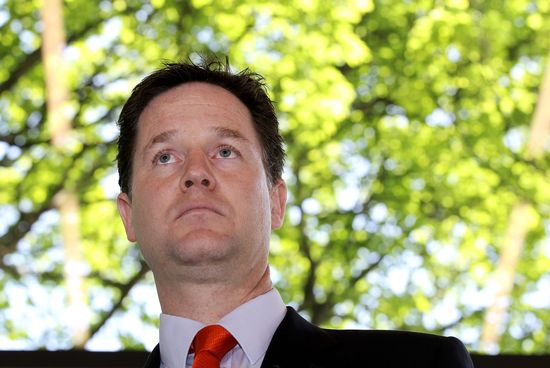
The British coalition government published its joint plans today. What strikes me is the rebound of British liberty in this fusion of Whiggery and Toryism. Check out the devolution of power and the firming up of civil liberties proposed. They're even going to take down some of the CCTV cameras:
Vowing that the coalition would end “the culture of spying on its citizens,” Mr. Clegg said it would “tear through the statute book,” scrapping a nationwide system of identity cards on which the Labour government spent huge sums, and abandoning a new generation of “biometric” passports that would hold a vastly expanded archive of personal data. In addition, he said, there would be new restrictions on the government’s right to intercept and hold personal Internet and e-mail traffic and to store DNA data from people not convicted of any crime.
Constitutionally, the coalition government is offering a new Great Reform Act:
The plan would also create a fully elected House of Lords, scrapping heredity and political favor as a passport to power, and commit to a referendum on changing the voting system for the House of Commons. Under the proposed “alternative vote” system, candidates would have to gain 50 percent or more of the vote in their constituencies to secure election, effectively shaking up the politics of “safe” parliamentary seats that has given many M.P.’s what amounts to lifetime employment.
In addition, the plan would adopt an American-style power of recall, opening the way for restive voters to unseat errant lawmakers by gathering 10,000 signatures on a petition, and introduce new laws to regulate Britain’s $3.5-billion-a-year political lobbying industry.
Bagehot parses:
I think that the underlying principle of the document and the coalition—that the areas where the two parties can agree offers them ample scope for reform, and that they should concentrate on those—is sound. No government can do everything at the same time. And, in any case, in these pinched times there isn't the cash to do everything either party would like to anyway.
The big worry for the coalition, it seems to me (and others), is not what's in the document but what isn't and couldn't be—in other words, events, such as, most obviously, foreign-policy crises or indeed a terrorist incident at home. How will the coalition cope with the resulting strains? Asked about that today, Mr Cameron talked about the need for proper, formal decision-making and dialogue, etc. Hmmmn.
(Photo: Nick Clegg, the Deputy Prime Minister, delivers a speech setting out the Government's plans for political reform at the City and Islington College on May 19, 2010 in London, England. By Oli Scarff-WPA Pool/Getty Images)
In Defense Of Rand Paul (Kinda), Ctd
Wiegel stands up against the "racist" critique. Robert A. George counters smartly:
Why aren't they — as libertarians — outraged that Jim Crow laws themselves infringed on private property and free exchange of goods? Jim Crow said whites and blacks couldn't eat together or live in the same hotels. If you were a white restaurant owner and wanted to serve blacks, you could be shut down. Once again, Jim Crow prevented whites and blacks from engaging in a basic economic relationship. That is the power of the state at its worst.
Chart Of The Day
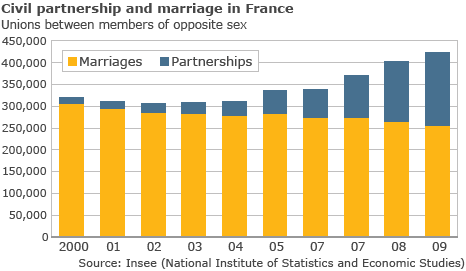
That whole separate but equal thing works both ways:
A heterosexual Austrian couple have embarked on a court battle to have their relationship legally recognised as a "registered partnership" – a new form of civil union for same-sex couples….Meanwhile, the kind of pared-down marriage they want is proving a huge hit with straight couples in France, where 95% of couples taking up the pacte civil de solidarite (Pacs) in 2009 were heterosexual. As the number of straight French couples opting for Pacs has grown, the number of marriages has shrunk, to the point that there are now two couples entering into a Pacs for every three getting married.
Apparently many straights feel partnerships are "a low-risk stepping stone to marriage." A quote from a heterosexual Pacsed woman:
"To me, it doesn't replace marriage. I'd still like to get married one day."
(Hat tip: Kincaid)
A Bumpier Ride For The GOP
Another relatively good omen for the Dems, as Meg Whitman's lead in the primary polls collapses in a vortex of negative campaigning:
Meanwhile, Democratic candidate Jerry Brown is waiting in the wings and raising money. And in every recent poll, he's moved ahead of both Republican candidates in general election trial heats. PPIC shows him leading Whitman 42-37 (and Poizner 45-32), after trailing her 39-44 in its March survey. It's unclear whether the recent GOP preoccupation with immigration is having an impact on the Latino vote, though everyone remembers the fallout that afflicted California Republicans the last time this issue dominated their message (in 1994, when Pete Wilson campaigned on Proposition 187, winning the battle but losing the war). Whitman is definitely walking a tightrope on that issue, calling most recently for National Guard troops to patrol the border (not exactly legal, but it sounds good), and running a radio ad in which her campaign chairman–yes, Pete Wilson himself–vouches for her toughness on immigration.
How To Cut The Budget
The Committee for a Responsible Federal Budget has a shiny new budget simulator. Derek Thompson takes it for a spin:
Ultimately the real lesson you learn as you play is that stabilizing debt, even when the method is box-checking, is painful.
I recommend it, if only because you may be surprised by your choices. I did the test quickly, forcing myself to be tougher than I would want to be. It doesn't ask you to perform the impossible; it lays out the real options in front of us and tries merely to get the debt stabilized at 60 percent of GDP by 2018. There are some options that are not there – I'd like to find a way to push the retirement age to 70 – but most are.
My policy preferences cut the debt to 51 percent of GDP in 2018 (compared with 85 percent on its current trajectory), and they did so, it turned out, by raising taxes by a $1.5 trillion and cutting spending by $1 trillion. That's largely because I favor the expiration of the unfunded Bush tax cuts. I could trim my tax hikes a lot though and still make the goal of 60 percent. Give it a whirl.
The View From Your Window

Kent, Washington, 5 pm
 The Dish