
Austin, Texas, 10 am
Austin, Texas, 10 am
Bouie thinks it’s possible, if not likely:
[W]hen it comes to analyzing black voters, conservatives need to stop treating them as irrational or stuck on some kind of “Democratic plantation.” Like any coherent group of citizens, black Americans have a strong sense of their individual and collective interests. And in their correct view, they do better under Democratic presidents, which contributes to their overwhelming support for Democratic politicians. Put another way, if conservatives want to make inroads with black Americans and other minorities, they have to show them they’ll succeed under Republican governance and have to deliver when the opportunity comes.
Unfortunately for the GOP, research suggests that African Americans have good reason to vote Democratic:
According to a recent paper from Zoltan L. Hajnal and Jeremy D. Horowitz – both political scientists at the University of California–San Diego – there’s clear evidence that when the nation is governed by Democrats, black well-being “improves dramatically” across multiple dimensions. Specifically, looking at data from 1948 to 2010, Hajnal and Horowitz found that “African Americans tend to experience substantial gains under Democratic presidents whereas they tend to incur significant losses or remain stagnant under Republicans.” On average, under Democratic presidents, blacks gained $895 in annual income, saw a 2.41 point drop in their poverty rate, and a 0.36 point drop in their unemployment rate. By contrast, under Republicans, blacks gained $142 a year, along with a 0.15-point increase in poverty and a 0.39-point increase in unemployment.

Clive Thompson wants an end to stock photography:
Let me be blunt: Stock photography needs to die. In his 1946 essay “Politics and the English Language,” George Orwell argued that clichéd language produces clichéd thinking. Using a stale image, as he’d put it, “makes it easier for us to have foolish thoughts.” Stock photography imprisons us in the same cognitive jail. Its intentionally bland images are designed to be usable in many vaguely defined situations. This produces wretched photography for the same reason Hallmark cards produce wretched poetry. We live in a visual world, communicating and thinking in pictures. When we use stock photos, we think in clichés.
His solution:
You take pictures every day, many of which I’ll bet are superb. Several photo-sharing sites let you slap on a Creative Commons license, allowing others to use your pics. (A bunch of my own pictures are on Flickr.) If everyone reading this article posted their best snapshots online, we could seed hundreds of thousands of free pictures of real things and real people in the real world. The true cure for stock photography is inside your camera phone.
(Photo: “Smiling young girl eating salad for breakfast.” By Kristian Sekulic/Vetta. More such images can be seen on this classic tumblr. Update from a reader: “How can you mention ‘Women Laughing Alone With Salad’ without also mentioning ‘Women Struggling to Drink Water‘?…”)
OpenWorm, an informal collaborative group of biologists and computer scientists from several countries, aims to create a complete digital model of a simple organism:
On May 19th this group managed to raise $121,076 on Kickstarter, a crowd-funding website. The money will be put towards the creation of the world’s most detailed virtual life form—an accurate, open-source, digital clone of a critter called Caenorhabditis elegans, a 1mm-long nematode that lives in the soils of the world’s temperate regions. … The idea, says Stephen Larson, a neuro- and computer scientist, who is the project’s co-ordinator, is to model the biochemical behaviour of every one of the worm’s cells, and how they interact with each other. If that can be done, then movement—and all the beast’s other behaviour patterns—should emerge by themselves from that mass of interactions.
George Dvorsky reviews the brief history of virtual organisms and why scientists are eager to create more of them:
To be fair, scientists have already created a computational model of an actual organism, namely the exceptionally small free-living bacteria known as Mycoplasma genitalia. It’s an amazing accomplishment, but the pathogen — with its 525 genes — is one of the world’s simplest organisms. Contrast that with E. coli, which has 4,288 genes, and humans, who have anywhere from 35,000 to 57,000 genes. Scientists have also created synthetic DNA that can self-replicate and an artificial chromosome from scratch. Breakthroughs like these suggest it won’t be much longer before we start creating synthetic animals for the real world. Such endeavors could result in designer organisms to help in the manufacturing of vaccines, medicines, sustainable fuels, and with toxic clean-ups.
There’s a very good chance that many of these organisms, including drugs, will be designed and tested in computers first. Eventually, our machines will be powerful enough and our understanding of biology deep enough to allow us to start simulating some of the most complex biological functions — from entire microbes right through to the human mind itself (what will be known as whole brain emulations).
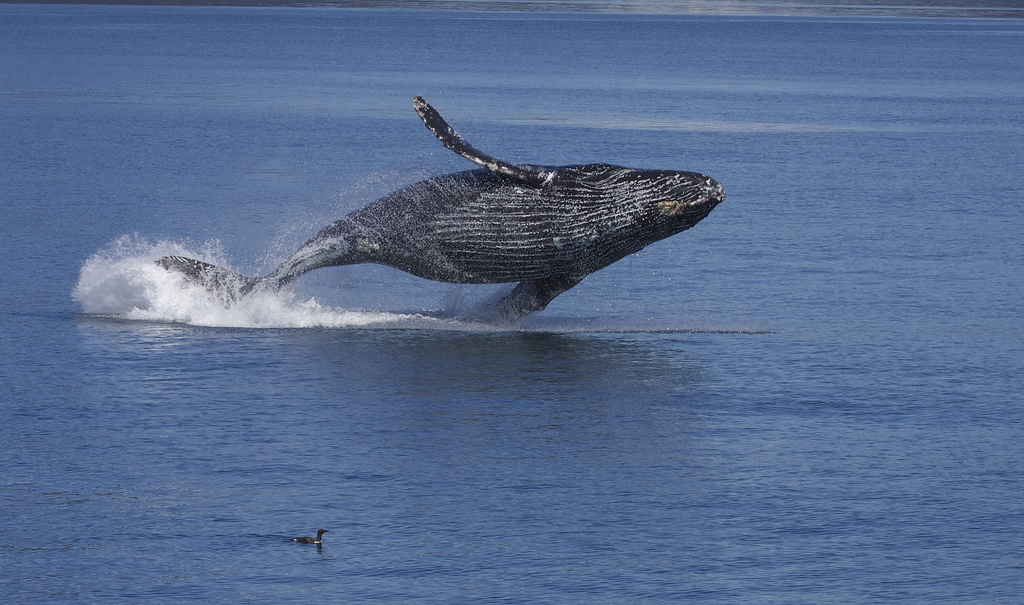
Simon Lewsen traces “our whale fixation [to] the fraught, shifting relationship between humans and the non-human world”:
Anthropologist Arne Kalland explains that, with the rise of the green movement, cetaceans became icons of environmental utopianism. They epitomized the complexity of the natural world: a realm that could teach us a thing or two, if we didn’t destroy it first. Whales were imagined as highly sensitive creatures swimming peacefully through rarified water. Many whale behaviours jibe with human notions of compassion: they sing to each other, nurture their infants into maturity, and care for their wounded and elderly. Given their longevity (they predate humanity by at least 25 million years) and brain size (larger than that of any other creature), it is possible to envision them as sage-like and profound—a species that has outgrown our territorial and violent impulses. Their ability to communicate across hundred-mile expanses seemed to indicate an otherworldly, near-telepathic sensitivity.
As Kalland makes clear, this eco-utopian “super whale” is actually a mash-up of different species-specific traits:
the grey whale’s friendliness, the sperm whale’s braininess, and the humpback’s phenomenal ability to project sound across large ocean basins. In ecological terms, this hybrid creature is every bit as mythical as the unicorn.
Lewsen adds that a global whaling moratorium in 1982 shifted the real threat from human hunters to more complex problems, such as industrial pollution:
Some whales, like the humpback and blues, really do need our protections; other species, like the minke, could probably sustain a limited harvest. Of course, the thought of an intelligent mammal being brutalized with harpoons is obscene, but from a conservation perspective, there’s little to be gained from scapegoating small-time hunters for global problems. The super whale became the sacred cow of the green movement, and after the 1980s moratorium, many pods regenerated briskly; meanwhile, carbon emissions continued to rise.
(Photo of breaching humpback whale by Gregory “Greg” Smith)
Segregation deserves a lot of the blame for them:
[D]uring those decades when African Americans were kept out of New Orleans pools and beaches, black kids found other places to dive, like the other dredged-out canals around the city and dangerous parts of the Mississippi River. These unauthorized swimming areas would end up stewing a steady news feed of drownings. By the 1940s, the NAACP estimated that 15 black children had been drowning each summer in the city.
This chapter of New Orleans history helps explain some of the truths underlying the stereotype that black people don’t swim — but also illustrates why that reputation is ill-deserved, just like the notion that people of color don’t like the outdoors. The truth in it comes courtesy of the oft-cited statistics that close to 70 percent of black children can’t swim (compared to 42 percent of white kids) and black children are three times more likely to drown than white kids. But clearly, those stats don’t tell the whole story.

Mike St Maur Sheil photographs World War I battlefields:
This is the site of the most intense and protracted engagement of the Great War. For nearly 11 months, German and French troops waged an unrelenting battle. Despite the horrific losses on both sides, the iconic Battle of Verdun failed to be decisive for any of the combatants, though it effectively marked the end of Erich von Falkenhayn’s military leadership. Today, the farmers’ fields still bears its tortured marks.
Recent Dish on Verdun here. See more of Sheil’s work here and here.
(Photo © 2014 Mike St Maur Sheil / Mary Evans Collection)
Guy Raffa argues, contrary to popular opinion, that a liberal arts education can impart logical, analytical thinking skills just as well as a course of study in STEM can:
In “Dante’s Hell and Its Afterlife,” an undergraduate course I teach at my university, students have to work hard to achieve good results (not to mention an A-level grade) on a research essay. The “excellent” paper will contain a substantive thesis that is appropriately focused, coherent, and interpretive, not merely descriptive; a detailed analysis of well-chosen examples to support the argument; a logical ordering of parts, each contributing to the whole, with transitions and topic sentences that advance and crystallize the main points; an effective use of information from credible sources, correctly cited and documented; and all expressed in clear, concise, grammatically correct prose.
My course – a large-format class in which students read Dante’s Inferno in English translation and examine its resonance in other creative works – is one of many “signature courses” offered across disciplines at my university. To fulfill core requirements, students must take at least one of these courses, whose objectives include developing the writing and critical-thinking skills evaluated in the research essay. Performing at the highest level on this kind of assignment is a challenge for everyone. But the degree of difficulty increases for STEM majors who have been fed red-meat lines mistakenly suggesting that they will learn to think with rigor, structure, and logic in computer science but not in English.
Somaly Mam and Nicholas Kristof in happier times.
seems nick wont even acknowledge her existence these days pic.twitter.com/XjF1YqQFpT
— Tom Bender (@tbendu2) May 31, 2014
In Newsweek‘s latest cover-story, Simon Marks exposes the exaggerations, inconsistencies, and outright fabrications of Cambodian anti-sex trafficking activist Somaly Mam:
At the heart of the questions surrounding Mam is a debate within the nonprofit sector on the acceptable tactics for fundraising and educating the public. For a long time, there has been a strong push to move away from using children to raise funds. … Experts in sex trafficking say that while it is a serious problem, the scale and dynamics of the situation are often misunderstood, in part because of lurid, sensationalistic stories such as those told by Mam and her “girls.” In 2009, 14 organizations and academics, including George Soros’s Open Society Foundations, wrote a letter to Salty Features, an independent film production company based in New York, to thank it for its interest in making a film about Mam’s work in Cambodia. But they advised against having the documentary focus on Mam due to [her organization’s] lack of understanding of the sex industry. In an interview for Euronews in 2012, Mam said girls as young as 3 are being held in Cambodian brothels. Experts in the field say that is almost unheard-of.
The accumulated allegations have effectively ousted Mam from her own foundation. Erik Loomis rips into Nicholas Kristof for having taken Mam’s bait:
Wait, Nic Kristof? No! You mean, Mr. Helicopter Rich White Man Rescuer was ready to buy lurid, falsified stories hook, line, and sinker? Who could have guessed! Here’s a 2011 Kristof article lauding Mam and her story, in what has to be the most prototypical Kristof column. Here’s another, on Pross, entitled, “If This Isn’t Slavery, What Is?” Oh, I don’t know. Maybe something that actually happened. …
The history of prostitution reform in Progressive Era America tells a similar story.
There were Kristof’s then too, freaking out about the white slavery traffic. They wanted to hear the most lurid stories possible and then publicize them to make points about the evils of prostitution. They didn’t bother fact-checking either. And time and time again, these stories about young women didn’t pan out. The impact of this movement was to make sex work illegal, making it far more dangerous, as it largely remains today.
Elizabeth Nolan Brown is disturbed at the revelations:
Perhaps the story is indicative of nothing more than how motivated, mentally ill manipulators can really thrive if they find the right angle. But some say it highlights the downside of nonprofits using tragedy porn to raise funds. “If your goal is fundraising, you actually have an incentive to pull out the most gory story,” one activist told Marks, “and so we get completely false realities of the world.”
These false realities are then used not just to tug at the heart and purse strings of potential donors but to launch initiatives and make lawmakers weepy-eyed at Congressional hearings. They inspire policy, and that’s scary. Boogeymen make frighteningly good lobbyists.
But Marcotte offers a somewhat more sympathetic take:
It’s easy to see why non-profits trying to fundraise, as well as the media industry used to raise attention to various social justice issues, are drawn to the “heroes beating the odds” stories that Mam told not only of herself but of the various girls she used for media and fundraising appeals. It’s simply easier for audiences to connect with the story of an individual than to examine dry, statistical data charting economic, public health, or educational outcomes. The fantasy of being able to rescue some beautiful, charming girl from the hell of sex slavery and put her on the road to a “normal” life has the kind of power that a chart detailing maternal health outcomes after various public health interventions will never have. The faces of young heroes who have overcome adversity make for good magazine covers. All the economic incentives are in place.
Unfortunately, the need to hear a relentless drumbeat of tales that start in horror and squalor and end in uplift and hope also creates incentive to fudge the facts, as Mam’s story shows. It might also mislead people about what problems are most pressing.
[So] says Rachel Herz, a professor of psychiatry at Brown University and author of The Scent of Desire. Her research and experiments indicate people do not respond to odours while they are in the dreaming phase of sleep (REM) or deep sleep. “You cannot smell while you are asleep,” she says. “You don’t smell the coffee and wake up; rather you wake up and then smell the coffee.” But, she says, if we very briefly wake up and perceive the scent of coffee, it will wake us further if we are interested in it. Any odours that are experienced in dreams, like [Smell Festival director Francesca] Faruolo’s, are “created by the brain not from outside”.
That is one theory. Prof Thomas Hummel of the University of Dresden’s Smell and Taste Clinic has another. His research corroborates Herz’s conclusion that smells do not rouse us from sleep, but olfactory stimuli do influence our dreams, he suggests. In one experiment, in which volunteers were stimulated with hydrogen sulphide (the rotten-egg stink-bomb smell) and phenyl ethyl alcohol (which resembles the smell of roses), participants reported having more positive dreams with the sweet-smelling stimulus and more negative dreams with the foul-smelling one.
 The Dish