What The Settlements Mean

A scene from the weekly protest at An Nabi Saleh, a Palestinian village in the West Bank. It's a tiny village, with only 500 or so residents, but is now flanked by an illegal Israeli settlement. Wikipedia:

Near the village the is a natural spring named Ein Al Kus ("the Bow Spring"). In 2009 settlers from the nearby settlement of Halamish took control over the spring and its surroundings while preventing Palestinian access to it. Subsequently, people of Nabi Salih and the nearby village of Dir Nizam began regular Friday protests for the spring which they claim as their own, and against the Israeli occupation in general.

Some also say that some olive trees were taken. An account of a previous clash in which several were injured is here. But what you can see more generally is what Israel has to do in the face of these settlers' provocations: they have to arrest and mistreat peaceful protesters and they have to shoot live ammunition to keep villagers at bay. This is the trap Israel is in, the trap that is getting tighter and more lethal by the day.
Bullish On Flyover Country

Lexington praises America's hinterland:

My column this week is about America's wide open spaces. I argue that America's colossal land mass is a big advantage, since it means the country can absorb vast numbers of immigrants (and new babies) without feeling crowded. I also look at how the internet is boosting remote places. It makes it easier to find out about them (people shop around online for places to live, and once you start comparing house prices and crime rates, places like Boise start to look very attractive). The internet also makes it easier to find interesting work in the boondocks. A broadband connection gives you nearly the same access to information as someone in New York or the Bay Area has.

Huffing Pageviews

Andrew Rice looks into the growing trend of online media companies crafting their content around the top search queries of the day:

There is, of course, nothing wrong with giving readers what they secretly want every once in a while. The problem arises when you start producing articles solely for the id of the search engines, because some clicks are more valuable than others.

The Dish has recently shifted its focus away from pageviews.

Avoiding Pigeonholes, Ctd

Steinglass defends his belief that bloggers “have an incentive to condemn and satirize in all political directions so as to maintain their claim to ideological independence”. He illustrates his point:

I think one of the best examples of the risk one avoids through the easy out of constant cynical is the problem Sullivan has in his treatment of Barack Obama.

I’m actually with Sullivan on this: Barack Obama is an enormously talented politician and a deeply ethical guy, with a complex and sophisticated view of how politics works and of how to be responsible in trying to strengthen the polity and improve people’s lives through the messy medium of politics. I give him an enormous benefit of the doubt in almost any situation, both in terms of his intentions and in terms of whether his take on an issue is better than mine. This is true of Sullivan as well. But the risk Sullivan has run in his very admiring writing on Obama is that many readers will come to see him as a cheerleader.

I don’t think this is fair, and I think that even if it’s true, that’s a problem those readers have, not a problem Sullivan has. But still, this is a risk that exists in the journalistic world. The same thing happened to Hendrik Hertzberg during the administration of another extremely talented and admirable president, Bill Clinton. It would be easy for Sullivan to avoid this risk by simply adopting a world-weary skeptical attitude towards Obama, and it’s to his credit that he’s not doing so.

But I hope it’s also clear that I will not hesitate to criticize when I think it’s due – on Afghanistan, Bagram, the packaging of Kagan, DADT, etc. But I remain of the view that we are indeed lucky to have Obama as president right now.

Waves And God

A reader writes:

The notion that a wave is made of water is, I believe, a false one. A wave is a pulse of energy that propagates through water. If you place a piece of wood in the water and watch it float as waves go by, you will notice that the wood is pushed forward as the wave approaches, then is pulled back as the wave moves on, and in the end, the wood remains in much the same place as it started (this does assume that there is no current in the water. Currents and waves are different things). Similarly, sound is a wave that propagates through air, the same way, just different media. Claiming that a wave is made of water is like claiming that sound is made of air. The difference is that we have a sense that is designed to bring sound into our consciousness so we can process it. We have no sense for waves in the ocean, other than looking at them.

Understanding this difference is, I think, critical to understanding spirituality. It’s not just an academic exercise.

We have no sense that can process and clearly understand spirituality – God, Budda, whatever you call it. Therefore, spirituality is a mystery. The best we can do is look in awe at the mystery. But that makes it hard for us to discuss spirituality with each other, so we create metaphors to help us talk about what we feel inside.

The wave is a metaphor. Creating a metaphor does two contradictory things at the same time. First, it gives us a common framework in which we can discuss spirituality with each other, which allows us to get closer to the mystery. Second, it cements in our minds a method of thinking that is man-made, not spiritual, which prevents us from getting closer to the mystery.

The quote for the day is one of the clearest examples I have seen of a metaphor that speaks of things we can understand, but hinders us from closer understanding of our own spirituality.

The Tyranny Of NYC, Ctd

A reader writes:

Are the people of New York narcissistic? Yes, but the phenomenon of narcissism is not any more widespread here than anywhere else, including the small rural town and suburban sprawl where I grew up. It may be that the narcissism of New Yorkers is particularly recognizable because it so often looks like worldly self-congratulation; but people find all sorts of ways to congratulate themselves, including being dismissive of New York. My father, for instance, takes pride in having been here only once – in Penn Station, which he didn’t even leave. “I don’t know why you’d want to live in a place like that,” he says to me; as if he even knew. And then there is that familiar refrain: “New York is a nice place to visit, but I wouldn’t want to raise a family there.” How many of these have ever come to New York with a truly open mind? How many of these have gone beyond Times Square and Fifth Avenue?

If you come to this vast, bewildering city honestly and alone, there is nothing about it that congratulates you. There is nothing in it to even acknowledge you. If the city itself has any direct influence on a person’s self-conception, that influence must at first be humbling, not inflating. It is an experience I wish more people could have. If you grew up in the places I did, you can drive from Erie to Detroit and see nothing to challenge your world view or your sense of self; the same cannot be said of the distance between Wall Street and Harlem.

This alone makes me disagree with Conor. I would say that New York does not loom large *enough* in the national consciousness – it is a chimera of New York that looms, not the real experience of the city itself.

Conor is on the ground in Harlem. One of his readers reflects on New York neighborhoods.

Drugs Win Drug War

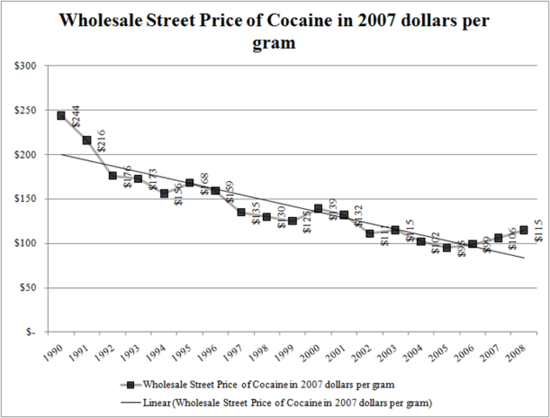
CocaineStreetPrice

Steven Taylor produces the above graph on cocaine prices:

[W]e are spending billions of dollars a year to try and stop cocaine production and the trafficking of said substance into the United States.  We are not getting what we are paying for.  The numbers above clearly demonstrate that even with increased crop eradication and constant “record seizures” of the drug by land and at sea are not accomplishing the stated goals of the policies and therefore calls into serious question whether they are worth the expenditures in question.  Indeed, it is quite clear that the ability of coca famers to produce enough coca leaf to overtake whatever successes that are accomplished in crop eradication and cocaine seizures is quite clear.  Such overproduction is simply the cost of doing business.  This is a lesson, by the way, that we need to keep in mind in Afghanistan, where the policy direction it towards crop eradication of opium poppies.  I predict now that even if thousands upon thousands of hectares or opium poppies are eradicated, that the poppy farmers will be able to out produce the eradicators.

Jacob Sullum notes a damning AP article from Friday chronicling the drug war's numerous failures.

“An Epidemic Of Not Watching” Ctd

Goldblog will be publishing a back and forth with Beinart soon, but for now he laments the placement of the piece in the New York Review of Books, "the one-stop shopping source for bien-pensant anti-Israelism." In the day of the web, what does it matter where an argument is placed? The point is the argument, not any associations. The era of media authoritah is over. Ackerman understandably balks at the characterization and dives into the substance:

Peter is right that it’s the moral task of Zionist liberals like, well, himself and myself and the J Street generation to save Zionist liberalism. But if you’re Malcolm Hoenlein or Abe Foxman, why should you care what pischers like us think? You’ve got aspirant Republican officeholders tripping over each other to profess their deep faith in Israel. That should underscore the urgency of the J Street generation.

Ezra Klein notes the disparity between the understandably apocalyptic psyches of many among the older generation and, well, reality:

Today, Israel is far, far, far more militarily powerful than any of its assailants.

None of the region's armies would dare face the Jewish state on the battlefield, and in the event that they tried, they would be slaughtered. Further stacking the deck is America's steadfast support of Israel. Any serious threat would trigger an immediate defense by the most powerful army the world has ever known. In effect, Israel's not only the strongest power in the region, but it has the Justice League on speed dial.

That is not to say that the Jewish state is not under threat. Conventional attacks pose no danger, but one terrorist group with one nuclear weapon and one good plan could do horrible damage to the small, dense country. That threat, however, is fundamentally a danger born of the Arab world's hatred of Israel. It follows, then, that hastening the peace that will begin to ease that hatred makes Israel safer. Exacerbating the tensions that feed it, conversely, only makes the threat more severe.

Thank God for the blogosphere. This debate would have been squelched without it.