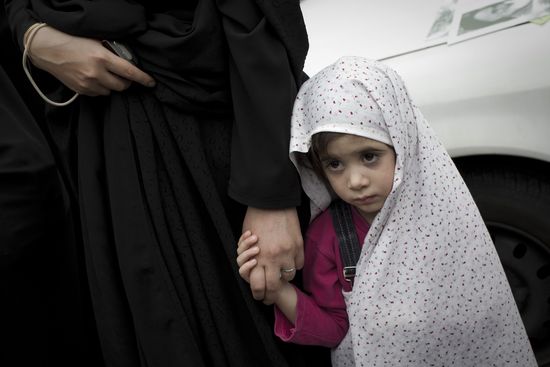
An Iranian girl holding her mother's hand attends the funeral of Iranian armed forces who were killed during the Iran-Iraq war (1980-88) after the Friday prayers in Tehran on May 14, 2010. Iran held a funeral for 89 soldiers who were discovered by a searching team on the Iran-Iraq border. Photo by Behrouz Mehri/AFP/Getty Images.
In response to this post on gay MPs in Britain, Joyner asks:
Granting that the House of Commons is somewhat larger than the combined U.S. House and Senate, how can the numbers be that different? Sure, there are parts of the country that where religious fundamentalism makes it hard for gays to run for office; but one imagines that’s true in the UK, too. But there are numerous urban centers in the United States where gays have lived openly since before Archie Bunker went on the air. And whole swaths of the country where rugged libertarianism is the norm. How come…few open gays are in senior positions in American politics?
One of his readers answers:
Part of what's at issue, I think, is that Britain has been much more tolerant on these issues than many parts of the United States have been…Also, I don't know that it's so much that there are more homosexual politicians in the UK as it is that there are more open homosexual politicians there.
The Leveretts go after Nazila Fathi, for her NYT article on five recent executions in Iran. From their follow up:
[O]ne of our criticisms is that Ms. Fathi did not inform her readers that the organization to which three or four of the executed prisoners (depending on which Western media reports one reads) are alleged to have belonged, PJAK, was designated as a terrorist organization not only by the Islamic Republic but even by the Obama Administration. On this issue, Mr. Lucas now writes, “Point taken…yes, Fathi could have mentioned that PJAK is proscribed as “terrorist” by the US Government.”
…In the end, we do not know whether the five executed prisoners were wrongfully convicted—and, as we noted in our initial critique of Ms. Fathi’s article, we are personally opposed to the death penalty. But we do know that Ms. Fathi’s reporting on this case was professionally irresponsible. It is Ms. Fathi’s prerogative to report on human rights cases in Iran. But when she, or any other journalist, does so in a professionally irresponsible way in order to advance a particular political agenda, we will call them on it.
The authors of Race for Iran have posted an attempted rebuttal of this column. As it is largely a misrepresentation of my analysis and a continuing assault on Nazila Fathi, I will not post a detailed response. There is no value in continued conversation with or even recognition of those who are void of information and deaf on ethics and morality.
I will note, however, how the authors met this challenge that I set on Wednesday: “1. Make their own critique of the material surrounding this case of the 5 executed Iranians and present that critique; 2. Alternatively, acknowledge that they have no concern with human rights, justice, and fairness within the Iranian system; 3. If they do so, disclaim any ability to assess the legitimacy of the Iranian Government since they are not concerned with issues — human rights, justice, fairness — which may affect the legitimacy of that Government in the eyes of the Iranian people.”
The authors make no attempt to meet the first test, but they do tacitly accwept the second and third challenges: “[Race for Iran] is not focused on human rights; it is focused on Iran and its geopolitics.”
Hari contends that "the British people have not got what they voted for." Norm Geras, a Labour supporter himself, counters:
[Y]es, they have. Or, put in slightly more qualified form: they have got a perfectly legitimate outcome within the range of what their collective vote permitted. The claim that this isn't what the British people voted for is predicated on the assumption that a democratic electoral system aims, or should aim, to yield results that perfectly reflect the preferences of the totality of voters. But, apart from the fact that no method of aggregating preferences can guarantee this, it is not what an electoral system does. An electoral system is, rather, a set of rules for giving some approximate expression of voter preferences and then translating the result (in candidates elected) into a governing arrangement. If the vote is fair and the count is accurate and the rules for forming a government from the elected representatives are duly followed, then to complain that this isn't what the people voted for is beside the point.
[F]or Elena Kagan, as for many people operating in government, the way to make sure nobody pigeonholes you as part of one ideological camp or political clique, or dismisses you as somebody's lackey, is to be relentlessly technical and positive. If you're down in the wonky weeds on every issue, and always congratulating everyone for sincerely addressing an important problem that everybody needs to work on, you're fine. For bloggers, on the other hand, the way to make sure nobody pigeonholes you or dismisses you as somebody's lackey is to be relentlessly cynical and negative. As long as you're constantly bemoaning the hypocrisy and stupidity of all political actors (yourself included), you're golden; you're nobody's lickspittle.
This is itself too cynical for me. It is also possible for a blogger and (to a lesser extent) a politician to have a complicated view of the world and be honest about it. Not to be popular, not to be golden, not to prove you're "nobody's lickspittle" – but because it's what you honestly think and believe.
That is seriously what I try to do here, and longtime readers can judge for themselves how successful I have been. I am simply trying to understand the world as I see it – and my own experience is obviously the filter. I'm hard to pigeonhole not out of any strategy but because I am who I am, and my life has pushed me into all sorts of apparent contradictions and conflicts … which are less of a contradiction or conflict when you can see the totality of someone's life and thoughts. By opening up about this, I hope the Dish fosters more complicated thinking and fewer pigeonholes.
Because almost all of us are complex and contradictory in this modern world, and all of us deserve an equal chance to be heard.
Thank you for highlighting the work of Chris Christie here in NJ. I'm a Democrat. I didn't vote for him, but I didn't vote for him primarily because of the campaign he ran and his refusal to condemn the actions of Bush and the national party. But after the election, he did something very few politicians do. He chose to do more to balance the state budget than he'd originally promised. He backtracked on campaign promises that should not have been kept (like his vague reassurances to the teachers unions, or his promise to increase property tax rebates), while keeping many of the promises that were most needed and most difficult to fulfill. It's really surprised me, and I'm thankful that more NJ residents voted for him than for Corzine (who all but the most partisan Democrat will admit was an awful governor).
Christie's acted as though the last 20 years of Republican evolution never happened. He's also the first governor our state has had in quite a long time who's actually interested in running the state effectively. It's really quite refreshing.
Mark Thompson noted not long ago that a lot of Christie’s spending cuts were really just spending shifts to local municipalities. Now, to be fair, this goes into something I’ve been pushing – autonomy – and if local governments have to bear the fiscal burden and get their autonomy out of the deal maybe that could work out well – at least for mid to large sized cities.
Zooming in, two Jersey readers are upset over Christie's cuts in two areas – libraries and public broadcasting. One writes:
The Governor has called on government programs to embrace group contracts, shared services, and fiscal responsibility. The libraries in New Jersey have long been adherents to these principles. Group contracts for databases and internet access have resulted in taxpayer savings of nearly 100 million dollars; the borrowing of books between NJ libraries saves additional taxpayer monies in utilizing shared resources; and many libraries stay within their budgets and put away money for future constructions and projects. Yet, rather than being elevated as a role model for what the Governor wishes department heads to emulate, funding for state library programs is being slashed by 74%.
This would eliminate funding for internet access for over 80% of libraries around the state at a time when the unemployment rate is roughly 10% and employers have moved their employment applications exclusively online. At a time when reliance on the internet is at an all time high by those on the other side of the digital divide, this funding would be cut.
The response from the Governor's office to the elimination of funding has been a stock answer: that it is all part of the statewide shared sacrifice. This shared sacrifice is being performed on the backs of the unemployed, small businesses, students of all grade level, and those without internet access. He cannot, in any amount of seriousness, hope to revitalize the state economy and lower the unemployment levels by taking away funding from the one government entity that unequivocally supports small business and the unemployed. It's an untenable position.
The budget axe does fall heavy, but it should not fall on the heaviest on the programs that embrace the principles the fiscal responsibility the most.
And yes, I'm biased on this subject. I rallied with other librarians last week at the state capital for the restoration of funding. It's not even a big sum by any measure of the government spending imagination; it's $10.4 million dollars. But it irks me when a Governor touts one thing and then punishes the people who are already engaged in doing it.
Another:
I can't argue with NJ Gov. Christie being a potential bad-ass, budget-wise. But he's not playing an honest man's game. This story needs to be told:
Our state's public broadcasting network, NJN, is in danger of being handed over – for nothing – to its interim director, Howard Blumenthal, who was brought in with the guise of rescuing the network from its budget crisis. Christie is on board with this seemingly criminal transaction; he and Blumenthal, who is angling to take over the network, are claiming the network's assets are worth $5 million, tops. According to one of the network's founders, the network (esp. its expensive transistors) is worth at least $250 million. Word has it that Blumenthal intends to sell the airspace to cellular companies (e.g., Verizon) – and this money is going where? We know where it's not going to go: to New Jerseyans, currently the stakeholders in NJN. And everyone knows our state is mad broke, right?
(Full disclosure: I only know of this angle to the story because my sibling and his colleagues at NJN were told unceremoniously, by Blumenthal, to ready their resumes.)
The beauty of the Dish is that it reaches into local stories – across the country and the world. While "the fiscal balls of Chris Christie" may seem admirable from afar, please hold that thought until you hear from the locals.
Eric Baker digs up a study from a couple years back:
Recent research suggests that, for most women, high sex drive is associated with increased sexual attraction to both women and men. For men, however, high sex drive is associated with increased attraction to one sex or the other, but not to both, depending on men's sexual orientation…These findings were replicated in a very large BBC data set and were found to hold true in different nations, world regions, and age groups.
Male sexuality is very very different from female sexuality – because testosterone matters. Which makes the binary gay-straight male question far simpler and less subtle than the gay-straight female question.
 The Dish